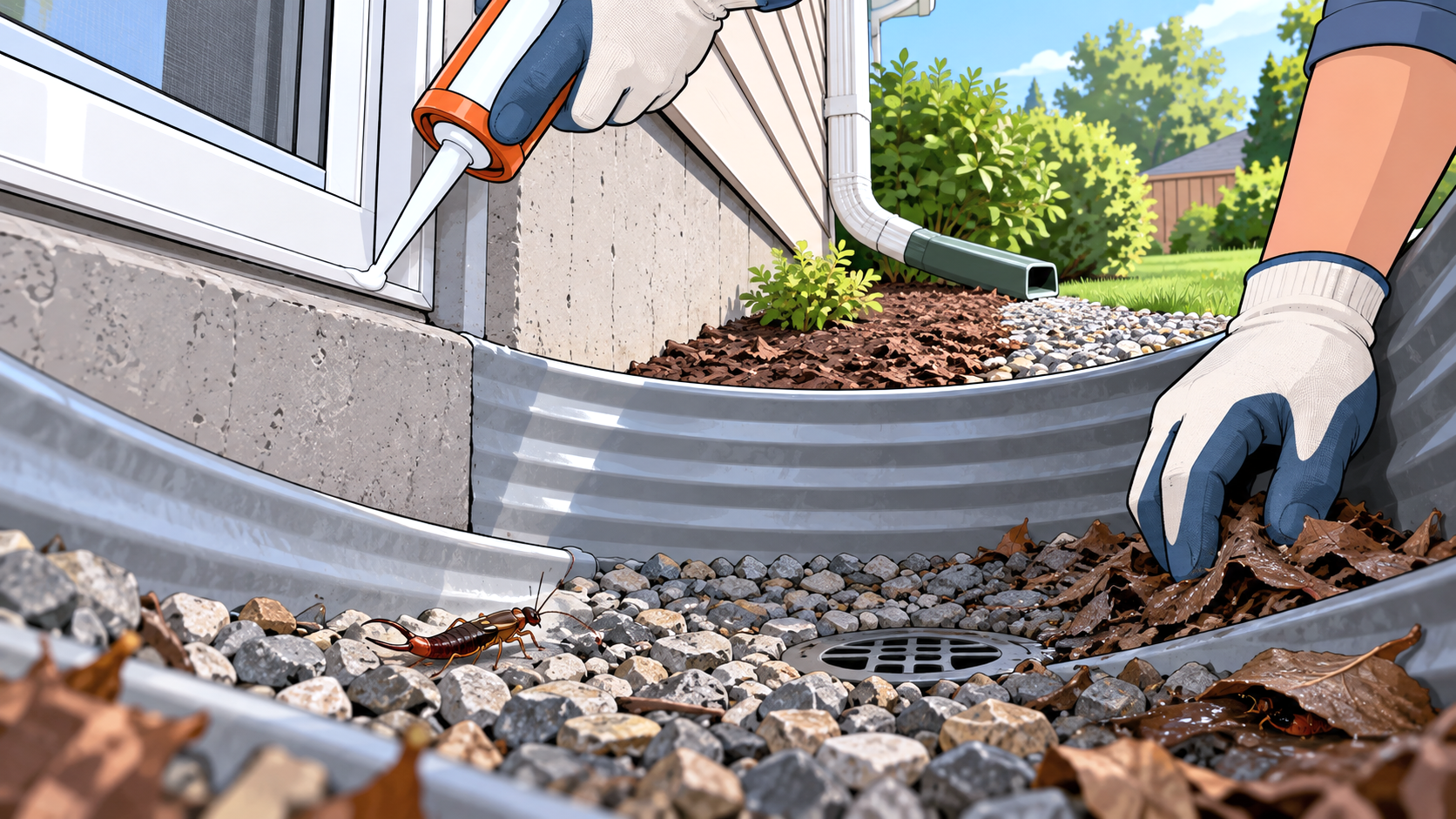
Killing the earwigs already crawling across the floor does not do much about the next ones outside. When earwigs repeatedly appear indoors, the more useful question is how they are getting from the yard into the building.
To keep earwigs out of the house, seal gaps around doors, windows, vents, utility openings and the foundation, then reduce damp hiding places close to those entry points. Keep leaves, dense vegetation, wood and other shelter away from the exterior where practical. Indoors, vacuum or sweep up earwigs that have already entered rather than relying on indoor pesticide applications.
That approach works with earwig behavior instead of treating the house as though it contains a self-sustaining indoor infestation. European earwigs do not reproduce indoors. When they keep appearing inside, prevention should therefore concentrate on the connection between the outdoor population and the openings that let them cross indoors.
Find the Side of the House Where Earwigs Are Getting In
A complete inspection of every inch of a house sounds thorough, but it is not necessarily the best place to start. Begin where the earwigs are appearing.
Earwigs move primarily by crawling, and small gaps around doors, windows and vents can provide entry. If most sightings occur near a basement window, exterior door or one side of the foundation, inspect the exterior immediately opposite that area. Check the lower part of the building especially carefully because ground-level cracks and openings create obvious connections with outdoor earwig habitat.
Look around door thresholds and frames, window frames, basement window wells, vents and places where pipes, faucets, cables or other utilities penetrate exterior walls. Also examine the junction between the siding and foundation. A worn door sweep can leave a continuous route beneath a door even when the door itself closes correctly.
Where you find an accessible crack or gap that should not remain open, seal or repair it with a material appropriate for that part of the building. Install or replace door sweeps where necessary, and make sure screens fit tightly. These are simple changes, but they attack the part of the problem that removing individual insects indoors cannot fix.
Do Not Ignore What Is Sitting Against the Foundation
An entry gap becomes more important when earwigs have good shelter immediately beside it.
During the day, earwigs seek dark, confined and damp places. Leaves, weeds, thick mulch, boards, wood piles and other debris can provide those conditions. Removing unnecessary shelter near likely entry points such as doors and window wells reduces the number of convenient hiding places immediately beside the building.
This does not mean creating a lifeless strip around the entire property. Landscaping still has a purpose, and mulch can be useful for plants. We would concentrate first on the places where suitable earwig shelter overlaps with a likely route indoors. A heap of damp leaves beneath a basement window deserves more attention than a garden bed on the far side of the yard.
Move stored lumber and loose debris away from the exterior where practical. Clear accumulated leaves from the building perimeter and gutters. Dense groundcover or climbing vegetation around a recurring entry area may also need thinning or repositioning.
This is where knowing what attracts earwigs around a property becomes more useful than simply asking what kills them. Prevention works better when you remove the conditions supporting repeated activity at the building edge.
Keep Excess Water Away From the House
Moisture deserves its own inspection because sealing a crack while leaving an unnecessarily wet refuge beside it only solves half of the problem.
Check downspouts and drainage around areas with frequent earwig sightings. Irrigation should not continually soak the foundation perimeter, and leaking outdoor faucets deserve repair. Where drainage is poor, correcting the source of persistent excess moisture makes the area less favorable for insects that seek damp daytime shelter.
The useful distinction here is excess moisture, not all moisture. Plants still need appropriate irrigation, and drying landscaping beyond what the plants can tolerate is not sensible pest management. The goal is to stop creating persistently damp hiding places against the structure when that water serves no purpose.
This becomes particularly relevant during periods when earwig sightings suddenly increase. Weather can change where they are encountered, which is why our separate guide explains why earwigs can become more noticeable after heavy rain. A weather-related spike does not change the basic prevention strategy. Entry routes and favorable shelter around the house still deserve attention.
Check Doors, Windows and Utility Openings as Actual Routes
Some exclusion advice becomes so broad that it stops being useful. “Seal your house” is not a realistic instruction. A better approach is to work through the openings that actually connect indoor and outdoor space.
Exterior doors are a good starting point because even a narrow opening along the bottom or side can remain available every night. Inspect the weatherstripping and door sweep while the door is closed. Windows need the same treatment, especially lower-level windows and window wells where insects can collect close to the frame.
Next, inspect utility penetrations. Pipes, cables, exterior faucets and similar installations can leave small spaces around the material passing through the wall. Vents should remain functional, so the solution is not to plug required ventilation openings. Instead, repair damaged screening or other protective components appropriate to the vent.
The recommended exclusion measures for earwigs specifically emphasize cracks and gaps around doors, windows, siding-foundation junctions, faucets and vents. Working through those locations gives you a much more useful checklist than randomly caulking every seam you can find.
Outdoor Lighting Can Be One Part of the Problem
Lighting is worth checking when earwigs repeatedly gather around an illuminated entrance at night.
Earwigs are nocturnal, but nocturnal does not automatically mean every earwig is strongly attracted to every light. Light response can vary. Still, exterior lighting can contribute to activity around entrances, and yellow outdoor lighting is less attractive to earwigs than white lighting.
If a bright white light stays on beside the exact door where earwigs keep entering, changing that light can complement exclusion. It should not replace sealing the gap beneath the door or cleaning up nearby shelter.
That distinction keeps lighting in perspective. A porch bulb is a possible contributor around a particular entrance, not a universal explanation for why earwigs are inside your house.
Reduce Earwig Numbers Outside When Entry Pressure Stays High
Sometimes the house is only one part of the picture. A property with many earwigs immediately around the foundation can continue producing indoor wanderers while you work through exclusion.
Trapping can reduce that pressure without turning the inside of the house into the treatment zone. Rolled corrugated cardboard, newspaper and similar refuge traps exploit the dark daytime shelters earwigs naturally seek. Oil traps are another established option. When traps are placed where earwigs are active outdoors and checked regularly, they can gradually reduce local numbers.
The important placement is outside, near the activity you are trying to intercept. Our DIY earwig trap guide covers the trap designs in detail, while daily trapping can reduce populations to tolerable levels when outdoor numbers are high.
Trapping is particularly useful when you are unsure which part of the property has the greatest activity. Several refuge traps around the perimeter can show where catches concentrate. That information can then direct your inspection toward nearby shelter, moisture and possible entry points.
What to Do With Earwigs That Are Already Inside
Once an earwig has crossed indoors, the simplest solution is usually enough. Sweep it up or vacuum it.
Indoor pesticide applications are a poor substitute for exclusion because they do not stop additional earwigs from entering. In fact, indoor pesticide treatments are not recommended for preventing earwig invasions. The insects you see indoors are the end of the route, not the place where prevention needs to begin.
Repeated sightings in a particular room can still provide useful information. An earwig in a basement does not prove that it entered through the basement, and finding one in a bathroom does not prove it came through a drain. However, patterns are worth investigating. Several sightings concentrated near one exterior wall give you a better starting point for an exterior inspection than isolated insects appearing throughout the building.
For location-specific situations, our guides cover earwigs in basements and the common assumption that earwigs are coming up drains in more detail.
When an Exterior Pesticide Treatment Makes Sense
Physical exclusion and habitat changes should do most of the preventive work. However, exterior pesticide treatments can supplement those measures when earwig numbers around the structure remain high.
This is where we would avoid treating “spray the foundation” as a universal instruction. Pesticide registrations, permitted treatment sites and application directions depend on the specific product and jurisdiction. Any product used around a structure must be labeled for that use, and its current label determines where and how it can legally be applied.
More importantly, an exterior treatment should not replace a repairable door gap, persistent moisture problem or pile of earwig shelter beside the wall. Those conditions can continue supporting the same route after a pesticide application has lost its effect.
If the problem is large enough that exclusion and outdoor habitat management are not controlling it, professional service becomes more reasonable. Our guide to when an earwig exterminator is worthwhile covers that decision separately rather than treating professional treatment as the automatic next step.
Make the Exterior Boundary Do the Work
The best earwig prevention happens before an insect reaches the living space.
After sealing the most likely entry points, inspect the same exterior areas periodically rather than waiting for another indoor wave. Door sweeps wear out. Caulk can separate. Leaves collect in window wells and gutters, irrigation patterns change, and objects gradually get stored against exterior walls. Prevention is therefore less about performing one huge cleanup and more about keeping the narrow boundary around the house unfavorable for repeated entry.
That is also why we would prioritize the exterior over spraying individual rooms. When earwigs outside have fewer convenient refuges beside the building and fewer openings leading through it, there are simply fewer opportunities for them to turn into an indoor nuisance.
Other Questions About Keeping Earwigs Outside
Can earwigs enter when you open a door?
Yes. An earwig can simply crawl through an open doorway. Exclusion cannot prevent every accidental entry, especially when insects are active immediately outside an entrance. Repeated sightings are more useful for identifying a prevention problem than one earwig that happened to get inside.
Can earwigs come inside with things you carry into the house?
Yes. Earwigs can hide in objects that provide dark, protected spaces outdoors. Inspect items that have been stored in suitable earwig habitat before bringing them inside, particularly when you already know the surrounding area has substantial activity.
Will keeping the house colder stop earwigs from coming inside?
Indoor thermostat settings are not a substitute for exclusion. The practical preventive steps remain blocking entry routes and reducing favorable shelter around the exterior rather than trying to make occupied rooms unsuitable for an occasional invading insect.
Why do I still find an occasional earwig after sealing the house?
Exclusion reduces entry but does not make a building completely insect-proof. Some openings must remain functional, doors open during normal use, and an earwig can occasionally be carried indoors with an object. A major reduction in sightings is therefore more meaningful than expecting never to see a single earwig again.
Should I be worried if I find several dead earwigs indoors?
Dead earwigs still indicate that the insects reached the interior. Instead of treating the dead insects themselves as the problem, use their location to help decide which part of the exterior deserves inspection for gaps and nearby earwig habitat.
4 thoughts on “How to Keep Earwigs Out of the House”