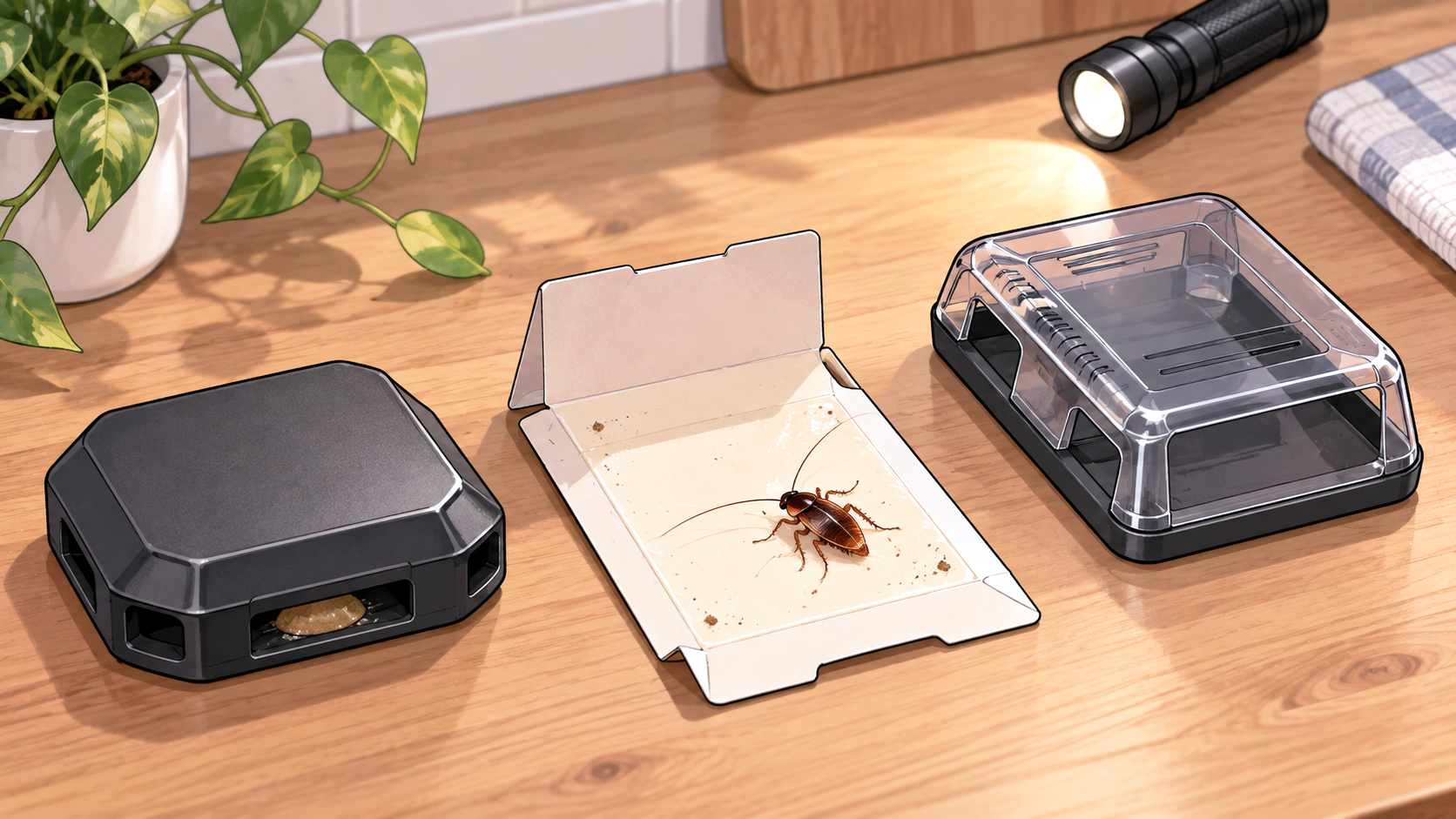
For most homes, the best cockroach trap is a low-profile sticky monitor that can sit flush against walls and fit beside appliances, cabinets, and other likely travel routes. Enclosed glue traps are useful where the adhesive needs protection from dust or accidental contact. Attractant-enhanced traps can improve detection, but placement usually matters more than elaborate trap features. Traps are excellent for finding and tracking cockroaches; they should not be expected to eliminate a substantial infestation by themselves.
The word “trap” creates some confusion because cockroach products sold in small plastic stations do not all perform the same job. A glue monitor physically captures insects that cross its adhesive surface. A bait station contains insecticide that cockroaches consume and is therefore a treatment rather than a conventional trap. That difference matters when comparing products because cockroach baits and gels are designed around toxicant delivery, while a sticky monitor gives you information about where cockroaches are moving.
Our Best Overall Choice Is a Low-Profile Sticky Monitor
A simple folding glue monitor wins on usefulness rather than sophistication. It works continuously without electricity, pesticide spray, or moving parts, and the captured cockroaches remain available for counting and inspection. Sticky traps are standard monitoring tools in German cockroach research, where repeated catches provide a practical measure of population activity. They have been used to evaluate treatment progress in housing studies because changes in trap counts can reveal whether cockroach activity is actually declining.
Shape matters more than it first appears. A low-profile trap can fit beside a refrigerator, beneath a sink, along a cabinet edge, or against another surface cockroaches already follow. Flat glue boards offer more exposed adhesive but can collect dust and leave the sticky surface accessible. Folding monitors protect more of the adhesive and create a narrow enclosed passage. For ordinary indoor monitoring, we prefer the enclosed or tent-style design because it combines useful capture area with easier handling.
Buy enough traps to monitor several locations simultaneously. One trap in the middle of a kitchen tells you very little about activity behind the refrigerator, beneath the sink, and near the stove. Research in high-rise apartments found that traps beside the stove and refrigerator caught significantly more German cockroaches than traps in some other monitored locations. A multipack of inexpensive monitors is therefore usually more useful than one elaborate device.
Trap Placement Can Matter More Than the Brand
An excellent glue trap placed in open floor space can lose to an ordinary one positioned directly along a cockroach travel route. Cockroaches frequently move along structural edges, so monitors work best with an entrance touching a wall, cabinet base, appliance edge, or similar route rather than sitting several inches away. Sticky traps used in field research are deliberately placed along vertical edges and near suspected harborages, including refrigerators, sinks, and cabinets showing activity.
Use several traps to create a map rather than concentrating them where you happened to see one cockroach. A sighting does not necessarily identify the principal harborage. Kitchens deserve particular attention because food, moisture, warmth, appliances, and numerous narrow hiding spaces can explain why cockroaches concentrate in kitchens. Bathrooms and utility areas can justify monitors too when sightings or other evidence point there.
Write the location and placement date on each monitor. Check them on a consistent schedule and record the catches before replacing traps that have lost adhesion, filled with insects, become wet, or accumulated substantial dust and debris. Consistent locations make successive counts more meaningful because moving every trap between checks introduces another variable into the comparison.
Attractant-Enhanced Traps Can Improve Detection
Many cockroach monitors rely entirely on an insect wandering onto the adhesive. These are sometimes called blunder traps. The National Park Service describes sticky monitors as continuous monitoring devices that preserve information about the insects moving through a particular location. Cockroach-specific versions may add food odors or other attractants intended to increase encounters with the trap.
Attractants can help, although “pheromone trap” on a package does not automatically make it superior. Research comparing food-based lures confirmed that ordinary sticky traps depend heavily on placement and exposure time, while selected attractants can increase German cockroach trap catches. The improvement varies with the lure and conditions, so we would choose a well-designed attractant monitor when the price difference is modest rather than paying heavily for marketing claims.
Attractant-enhanced monitors are particularly appealing when the goal is detecting low-level activity. If you found one cockroach and are trying to determine what the sighting means, several sensitive monitors around likely harborages can reveal activity that casual observation misses. A completely empty trap still needs cautious interpretation because cockroaches elsewhere in the room may never cross its capture surface.
Large Flat Glue Boards Offer More Capture Area but Less Protection
Open glue boards provide a broad adhesive surface and can capture numerous cockroaches when positioned on an active route. Their simplicity also makes catches easy to count. We prefer them in protected locations where dust, children, pets, and accidental contact are unlikely to interfere with the adhesive.
Their weakness is exposure. Dust, grease, moisture, hair, and debris can reduce useful sticky area, while an uncovered board is easier to step on or touch. A larger surface also cannot compensate for poor positioning. For most occupied rooms, several smaller enclosed monitors distributed intelligently give us better information than one oversized board in an arbitrary location.
Open glue boards become more useful when you already know exactly where activity is concentrated and can place them securely. When the location remains uncertain, distribution matters more than sheer adhesive area.
Reusable Jar Traps Are Cheap but Awkward for Routine Monitoring
A smooth-sided glass jar can function as a live-capture cockroach trap when bait draws cockroaches inside and the upper interior is made difficult to climb. Researchers have used baited jars to capture German cockroaches, so the basic concept is legitimate rather than an internet invention. Jar traps can also be emptied and reused instead of discarded after each catch.
We still prefer purpose-made sticky monitors for household surveillance. Jars occupy more space, can spill or break, require preparation, and are difficult to slide into the narrow locations where cockroaches commonly travel. Sticky monitors also preserve captured specimens in place, which makes counting small nymphs and comparing catches easier.
A jar makes sense when you need a simple trap from materials already available and have room to position it safely. It is less attractive when you want several identical monitors operating simultaneously throughout a kitchen or apartment.
Electronic and Ultrasonic Devices Do Not Replace Physical Traps
Plug-in devices marketed for cockroaches sometimes appear alongside traps even though many do not capture anything. Ultrasonic units are especially poor substitutes for monitoring because an empty device gives you no physical record of whether cockroaches crossed the area. You cannot count insects, identify developmental stages, compare locations, or measure treatment progress from a device that provides no catch.
Monitoring needs evidence. A glue trap containing adults, nymphs, or both provides a physical sample of activity at a known place during a known period. Capturing multiple sizes can complement other signs of an established cockroach infestation, although trap catches alone cannot reveal every hidden insect.
We would spend a modest budget on multiple sticky monitors before paying considerably more for an electronic device that does not provide comparable population data.
Traps Can Catch Many Cockroaches Without Controlling the Whole Population
Glue traps unquestionably remove every cockroach they capture. The limitation is scale. A trap only removes insects that physically encounter its adhesive, while eggs and cockroaches remaining inside harborages continue unaffected. Pest-monitoring guidance therefore treats sticky traps primarily as a way to detect activity and measure changes rather than as a stand-alone solution for a substantial infestation. The National Park Service explicitly classifies sticky traps as monitoring tools rather than complete infestation control.
Research illustrates their more valuable role. Integrated pest-management programs have used multiple sticky traps per apartment to establish baseline counts, identify heavily infested units, direct treatment, and measure subsequent reductions. In one year-long housing program, monthly monitoring accompanied targeted treatment as cockroach counts fell by more than 98% in participating groups. (pubmed.ncbi.nlm.nih.gov) The traps supplied the population data; they were not solely responsible for those reductions.
A lightly infested location may lose a meaningful number of cockroaches to well-positioned glue boards. Once catches repeatedly reveal substantial activity, however, cockroach control needs to address the population beyond the traps. Using more glue boards indefinitely is not equivalent to reaching hidden harborages with an appropriate treatment strategy.
Trap Counts Are Most Valuable When You Compare Them Over Time
The number written beside a trap catch gains meaning through comparison. Suppose six monitors catch 31 cockroaches during the first monitoring period. After treatment, the same six locations produce 12, then four, then one. That trend provides far more useful evidence than simply noticing fewer cockroaches while the kitchen lights are on.
Keep the monitoring conditions reasonably consistent. Use the same number of traps, return them to the same locations, and compare equivalent monitoring periods whenever possible. Sticky-trap counts are routinely used as a treatment-response measure in cockroach research, including studies comparing integrated pest management with conventional insecticide programs. Changing locations or leaving one set out substantially longer makes the numbers harder to compare.
Trap distribution can reveal something equally useful: concentration. If most captures repeatedly occur beside one appliance while monitors elsewhere remain nearly empty, treatment can focus more closely on that area. Conversely, catches scattered across several rooms suggest activity is not confined to the first place where cockroaches were noticed. Apartment residents may also need to consider movement between individual units and the wider building when monitoring reveals persistent activity despite treatment inside one unit.
What We Would Buy
For routine home monitoring, we would buy a multipack of folding, low-profile cockroach glue monitors rather than one expensive trap. Choose a design that stays open reliably, has enough adhesive area to retain adults and nymphs, and fits against walls and beneath or beside appliances. An attractant is useful when the added cost is reasonable, but good placement remains essential.
Open glue boards are our second choice for protected sites where a larger exposed adhesive area is useful. Jar traps are functional budget alternatives but less convenient. Devices that do not physically capture cockroaches rank poorly for monitoring because they cannot provide a count.
None of those choices replaces treatment when monitoring confirms an infestation. Commercial insecticides and their active ingredients have a separate role among cockroach sprays and killers, while traps remain most valuable for showing where activity is concentrated and whether the numbers are changing.
Questions That Come Up Once the Traps Are Down
How long should I leave a cockroach trap out before checking it?
Check new placements frequently enough to learn where activity is concentrated, then use consistent monitoring intervals for comparisons. A trap can remain longer if the adhesive is still functional, but replace it once catches, dust, moisture, or debris substantially cover the sticky surface.
What does it mean if I catch nymphs but no adults?
Nymphs confirm that immature cockroaches are active at that location. Their presence can be especially useful because baby cockroaches differ from adults in size and development. Do not assume the absence of adults from one trap means adults are absent from the surrounding infestation.
Can I move a trap after it catches nothing?
Yes, particularly during the initial search for activity. Move unproductive monitors closer to likely travel routes, edges, appliances, moisture sources, or locations showing cockroach evidence. Once you begin comparing population trends, keeping productive traps in consistent positions produces cleaner data.
Should traps be placed out only at night?
No. Leave monitors in place continuously during the chosen monitoring period. Cockroaches are predominantly active during the dark phase, but cockroach activity patterns can change with conditions and infestation pressure. A continuously available trap can intercept activity without requiring you to predict the exact hour it will occur.