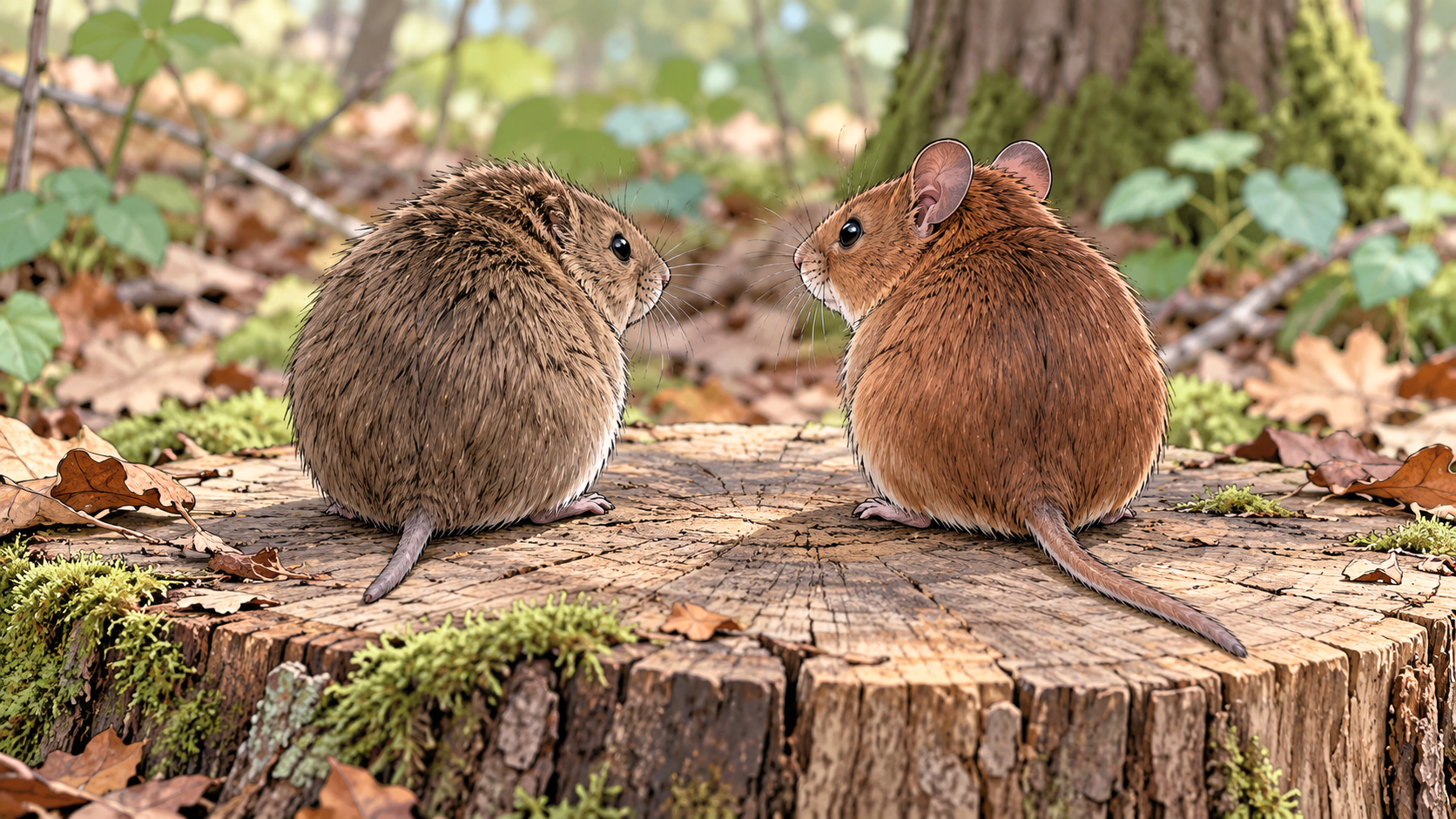
A short tail almost hidden beneath a shaggy grey-brown coat is a strong clue that you’re looking at a field vole (Microtus agrestis). A longer tail, warmer reddish-brown fur, and more visible ears point toward a bank vole (Myodes glareolus). Both are small, blunt-faced rodents found in Britain, and their body sizes overlap enough that size alone is rarely useful for identification.
The names refer to particular European species, not interchangeable descriptions of where any vole happens to live. Field voles can occupy woodland, while bank voles regularly venture into grassland. Identifying them requires a combination of proportions, coat characteristics, and surroundings rather than assuming that an animal found in a field must be a field vole.
Compare the Tail Before Judging the Coat
Tail length is generally the strongest visible difference between these two species. A field vole’s tail is usually about one-third of its head-and-body length, giving it an exceptionally compact appearance. A bank vole’s tail is closer to half its head-and-body length and normally projects farther behind the animal.
The difference remains useful even though individual measurements overlap. Field voles typically have a head-and-body length of 9–12 cm, with tails measuring roughly 1–5 cm. Bank voles have a similar body length of 9–11 cm, but their tails commonly measure around 3–7 cm.
Looking at the tail relative to the body is more dependable than attempting to estimate its length in centimeters from a photograph. A tail extending noticeably behind the hindquarters favors a bank vole, while a short projection almost disappearing beneath the fur favors a field vole. The animal’s posture can distort this impression, especially when the back is arched or the tail is curled against the ground.
| Feature | Field vole | Bank vole |
|---|---|---|
| Scientific name | Microtus agrestis | Myodes glareolus |
| Alternative name | Short-tailed vole | Sometimes called red-backed vole |
| Upper coat | Greyish or yellowish brown | Richer chestnut or reddish brown |
| Underside | Creamy grey | Cream or greyish white |
| Fur texture | Relatively long and shaggy | Generally smoother and sleeker |
| Tail proportion | About one-third of head-and-body length | About one-half of head-and-body length |
| Ears | Small, heavily concealed by fur | More prominent, partly exposed |
| Favored surroundings | Rough grassland and grassy young woodland | Woodland, hedgerows, scrub, and gardens |
The tail proportions and ear visibility of different voles vary considerably among species, so these measurements should be applied specifically to Microtus agrestis and Myodes glareolus.
Grey-Brown or Chestnut? The Coat Gives a Second Clue
A field vole generally has dull greyish-brown or yellowish-brown upper fur, with a pale grey or creamy underside. Its coat often looks slightly untidy because the hairs are relatively long and shaggy. The subdued coloration can make the animal difficult to distinguish from dead grass, soil, and low vegetation.
Bank voles tend to look warmer in color. Adults frequently display chestnut or russet tones along the back, contrasting with paler flanks and a cream-colored underside. Their fur is usually less shaggy, creating a smoother outline. The reddish coat and pale underside characteristic of bank voles are useful in clear daylight, particularly when the tail is concealed.
Color can nevertheless mislead. Juvenile bank voles may be duller than adults, field voles can show brown tones, and rare dark color forms occur in both populations. Shadows, wet fur, and camera settings can further reduce the apparent differences.
An unusually dark bank vole may lack the characteristic chestnut appearance entirely. The documented variation in bank vole coat color includes rare melanistic individuals, making it unwise to reject an identification solely because the animal is blackish rather than red-brown.
The range of natural vole colors is broader than the familiar brown coat. In this particular comparison, color becomes most convincing when it agrees with the tail and ears.
Bank Voles Have More Noticeable Ears
Both animals possess rounded snouts, relatively small eyes, and compact heads. Neither has the prominently pointed muzzle of a typical wood mouse. Their ears, however, often differ in visibility.
The field vole’s ears are short and almost completely buried beneath its thick fur. Viewed from the side, its head can appear smoothly rounded without an obvious ear projecting above the outline. The small eyes contribute to this impression.
A bank vole’s ears are more exposed, and their rounded edges can usually be distinguished when the animal turns its head. The ears are still much smaller and less conspicuous than those of many mice, but greater ear prominence is a recognizable bank vole characteristic.
The difference is subtle in juveniles and photographs taken from above. Grass, whiskers, and shadows can conceal ear edges, while windblown fur may make field vole ears appear larger than usual.
If only the head is visible, identification may remain uncertain. The blunt muzzle and compact appearance shared by many voles can establish that an animal resembles a vole without reliably separating these two species.
Where You’re Looking Changes the Odds
A small rodent running through dense grass on open moorland is more likely to be a field vole than one feeding beneath a woodland hedge, but neither habitat offers absolute certainty.
Field voles favor open areas containing substantial grass cover, including rough pastures, grassy field margins, heathland, moorland, and young woodland with a developed grassy understory. They maintain pathways through vegetation and spend considerable time concealed within them. The grassland association of field voles is particularly strong in landscapes with extensive ungrazed or lightly managed vegetation.
Bank voles are closely associated with woodland, woodland edges, hedgerows, scrub, and gardens. They also occur in grasslands and farmland, especially where shrubs, trees, or thick ground cover provide shelter. A bank vole may be seen crossing fallen branches, moving through leaf litter, or feeding beneath a hedgerow.
Their use of woodland edges, hedgerows, and urban gardens creates considerable overlap with field voles in mixed habitats. A woodland clearing with tall grass may support both species within a relatively small area.
Location within a garden can therefore provide supporting evidence. An animal repeatedly appearing among long grass may favor the field vole identification, whereas one emerging beneath a dense shrub border and moving across fallen leaves may favor the bank vole.
Neither species should be assigned purely from its habitat. The habitats occupied by voles include several environments where closely related species coexist.
Feeding Behavior May Reinforce the Identification
Field voles are strongly associated with grasses and other low-growing vegetation. Their feeding commonly involves grass leaves and stems, and their movements often follow covered pathways beneath the vegetation.
Bank voles have a more varied diet, including seeds, fruits, nuts, buds, leaves, and some animal material. They may climb through low vegetation or along branches to reach food. The greater dietary variety and climbing behavior of bank voles can make them particularly noticeable near berries, fallen seeds, and woodland-edge vegetation.
An animal holding a blackberry or investigating an acorn is consequently more suggestive of a bank vole than a field vole. However, a field vole may consume foods other than grass, and a bank vole can feed on green vegetation. One feeding observation cannot establish the species.
The foods consumed by voles depend on species and habitat, so plant remains should be considered supporting evidence rather than a substitute for seeing the animal.
Burrows and runways are similarly inconclusive. Both species use sheltered passages and underground refuges, and field signs rarely reveal the tail length, ear visibility, or coat color needed for confident separation.
Are Both Species Found Throughout Britain and Ireland?
The comparison is most relevant in Great Britain, where field voles and bank voles are both widespread.
Field voles are native to Britain but are absent from Ireland. Bank voles occur across mainland Britain and have also become established in parts of Ireland, where they are an introduced species.
Their distributions mean that the same identification problem does not arise everywhere. On the island of Ireland, an animal cannot be identified as a native field vole because Microtus agrestis is not part of the established Irish fauna.
The British Isles also contain populations of the common vole (Microtus arvalis) in restricted locations, including Orkney and Guernsey. Those island populations are distinct from the British field vole, despite the similar appearance and overlapping everyday terminology.
Outside Europe, the name field vole is sometimes used loosely for small rodents living in fields. That informal usage should not be treated as a species identification. North American meadow voles, prairie voles, and other grassland species are not Microtus agrestis, while the European bank vole is a different species from North American red-backed voles.
The differences between voles and mice are also worth separating from this pair-specific comparison. The colloquial term field mouse may refer to several unrelated small rodents, including animals that are not voles at all.
What If the Tail Is Hidden in the Photograph?
Many encounters last only a second or two. The animal may be partly concealed by grass, facing the camera, or moving too quickly for its tail to appear clearly.
A useful identification photograph shows the animal from the side, with its head, back, hindquarters, and tail visible together. Several frames can be more informative than a single close-up because changes in posture may reveal features that were initially hidden.
When the tail cannot be assessed, combine coat color, ear prominence, and habitat. A shaggy grey-brown animal with barely visible ears in rough grassland leans toward field vole. A sleeker chestnut animal with exposed rounded ears among woodland debris leans toward bank vole.
If these characteristics conflict, a species-level identification may not be justified. Young animals, unusual coat colors, and incomplete views can make the two difficult to distinguish even for experienced observers. Recording the animal as an unidentified vole is preferable to assigning a species based on a single unreliable feature.