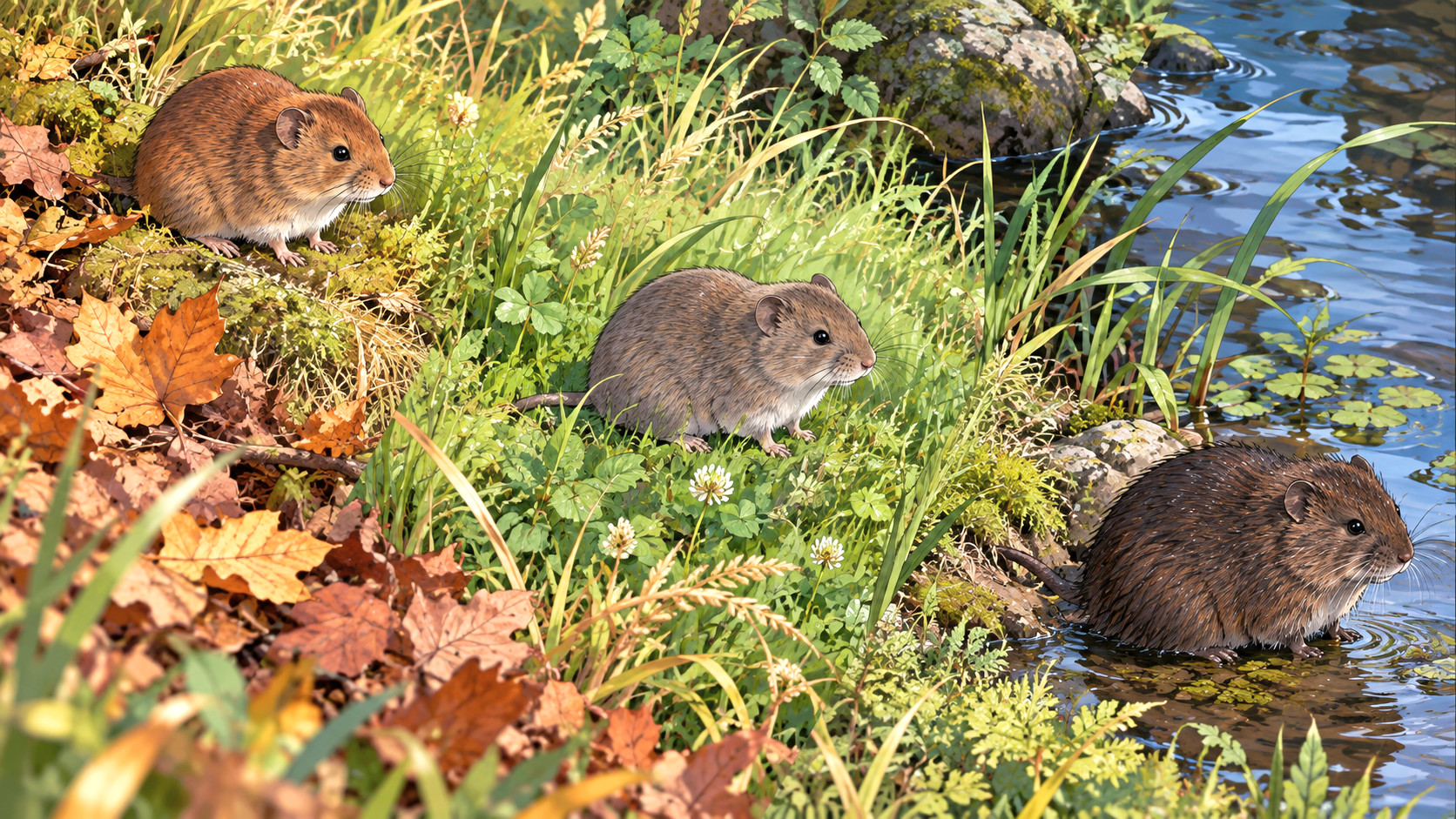
Voles come in shades of brown, gray, reddish-brown, chestnut, and nearly black, with some individuals displaying yellowish or unusually pale fur. Most have darker coats along their backs and lighter fur underneath. The exact coloration depends on the species, age, geographic population, and, in certain species, the season. Rare color variations include completely black, yellow, white, and spotted individuals.
A vole’s coat is seldom one uniform shade. Individual hairs often contain several colors, and darker tips can change the overall appearance of the animal. Two voles with similarly brown fur may look noticeably different under natural lighting because of the distribution of dark and pale hairs across their coats.
Brown, Gray, and Reddish Voles
Brown is among the most familiar vole colors, but it covers several distinct appearances. The meadow vole (Microtus pennsylvanicus) commonly has brown fur mixed with gray, yellowish, or reddish tones. Dark-tipped guard hairs contribute to its overall appearance, while the underside is generally gray, sometimes with silvery or buff-colored shading. The meadow vole’s documented coat structure includes individual hairs with gray bases, yellow or orange middle sections, and darker tips. These combinations explain why an animal can appear plain brown from a distance but show several colors in a close photograph.
Prairie voles (Microtus ochrogaster) have a particularly recognizable mixture of dark and light hairs. Their backs contain brown to nearly black hairs with black or yellowish tips, creating a mottled, salt-and-pepper appearance. The underside can be tan, golden, yellow, or reddish. The Illinois Department of Natural Resources’ prairie vole description also identifies a darker upper tail surface and a paler underside. A prairie vole can therefore show different colors across its back, belly, and tail without having an unusual coat.
Reddish-brown coloration is especially noticeable in woodland voles (Microtus pinetorum). Their backs are commonly chestnut or slightly reddish, while the underparts are grayish. The Canadian woodland vole management plan describes this combination alongside the species’ thick, silky fur. Its reddish tones can be considerably stronger than those of a gray-brown meadow vole, although neither color belongs exclusively to one species.
Why Some Voles Look Darker or Lighter Than Others
Geographic differences influence coat coloration even within the same species. Montane voles (Microtus montanus) in the southwestern part of their range typically have darker fur than those farther north. Northern populations can show lighter brown, reddish, or grayer coloration. The documented geographic variation in montane voles also indicates that females exhibit more coat-color variation than males.
These differences make broad color labels less informative than they initially appear. A grayish vole from one region and a brownish vole from another may belong to the same species, while two animals with nearly identical coloring may represent different species. Coat shade cannot reliably establish an animal’s identity without additional evidence.
The color of the underside also deserves attention. Some voles have distinctly pale bellies, while others show only a subtle contrast between the back and lower body. The prairie, meadow, and long-tailed vole descriptions document gray, yellow-gray, buff, and whitish underparts among these species. An animal’s overall coat may appear dark from above while its belly is considerably lighter.
Do Voles Change Color in Winter?
Some vole species develop seasonal differences in their coats, but they do not all follow the same pattern. Meadow voles in Newfoundland and Labrador have rusty-brown fur that becomes longer and grayer during winter. The provincial meadow vole profile documents this seasonal change.
Woodland voles exhibit another pattern. Their summer fur is often shiny reddish or chestnut-brown with darker undertones, while the winter coat becomes darker and less vivid. Virginia Tech’s woodland vole research summary documents this seasonal difference, which runs contrary to the assumption that small mammals universally become lighter in winter.
Prairie voles provide a useful contrast because their typical coloration remains consistent throughout the year. The species’ documented coat characteristics do not describe the same seasonal color shift found in meadow or woodland voles.
Seasonal changes also involve fur density and texture. A study of field voles (Microtus agrestis) documented a relatively sparse summer coat and a denser winter coat with more underfur. Consequently, a winter vole can look different even when its underlying pigmentation changes little. There is no universal winter color for voles, and a gray winter coat should not automatically be interpreted as white.
Can Voles Be Black, White, Yellow, or Spotted?
Unusual color forms occur naturally in some vole species. Prairie voles have documented variants with black, yellow, albino, or spotted fur. These individuals differ from the usual brown-and-tan coloration, but they remain members of the same species.
Woodland voles also have documented albino and bright orange-yellow color forms. The Canadian woodland vole status assessment records these variations, including the orange-yellow condition known as xanthochromism.
Albinism involves a lack of normal melanin pigmentation and may produce white fur with pinkish eyes. A pale coat alone does not establish albinism because unusually light fur can occur through other pigmentation variations. Similarly, an entirely black-looking vole may have a naturally dark coat or an uncommon pigmentation pattern.
These color forms should not be mistaken for additional species. The range of different vole species and the variety of colors within individual species are separate matters. One species may display several coat variations, while unrelated species can share similar shades.
Does a Vole’s Fur Color Change as It Grows?
Age can affect coloration. Meadow vole pups develop fur that is initially darker than the adult coat. As they mature, the distribution and appearance of colored hairs change, eventually producing the more varied coat associated with adults. The process involves replacing developing fur rather than simply making each existing hair lighter.
Townsend’s voles (Microtus townsendii) provide another documented example. Adolescents generally have darker coats than adults, so a younger animal can look noticeably different from a mature member of the same population. Age-related coat variation therefore needs to be considered before interpreting darker fur as evidence of a separate species.
The appearance of baby voles also changes during early development, but these color differences cannot establish an exact age. The timing and extent of coat changes vary among species.
Can You Identify a Vole by Its Color Alone?
Fur color is useful supporting evidence, but it cannot reliably identify a vole to species. Brown, gray, chestnut, and reddish shades occur across multiple species, while seasonal and age-related changes can alter the appearance of an individual animal. Unusual pigmentation adds another source of variation.
For example, finding a reddish-brown animal does not establish that it is a woodland vole. The same general shade can occur in other voles, and even a woodland vole’s coat changes across seasons. Its overall body shape and visible features provide more meaningful context than coat color by itself.
Photographs can also distort the colors being compared. Warm evening sunlight can make brown fur appear redder, while shade can make a gray-brown coat look nearly black. Wet fur may appear darker than dry fur, and camera processing can alter the contrast between the back and belly.
For a useful color record, photograph the animal in natural daylight without applying heavy filters. Preserve the original image and record the location and date. A clear view of both the back and underside, when available without disturbing the animal, gives a more dependable account of its actual coloration than a single photograph taken under artificial light.
2 thoughts on “What Colors Do Voles Come In?”