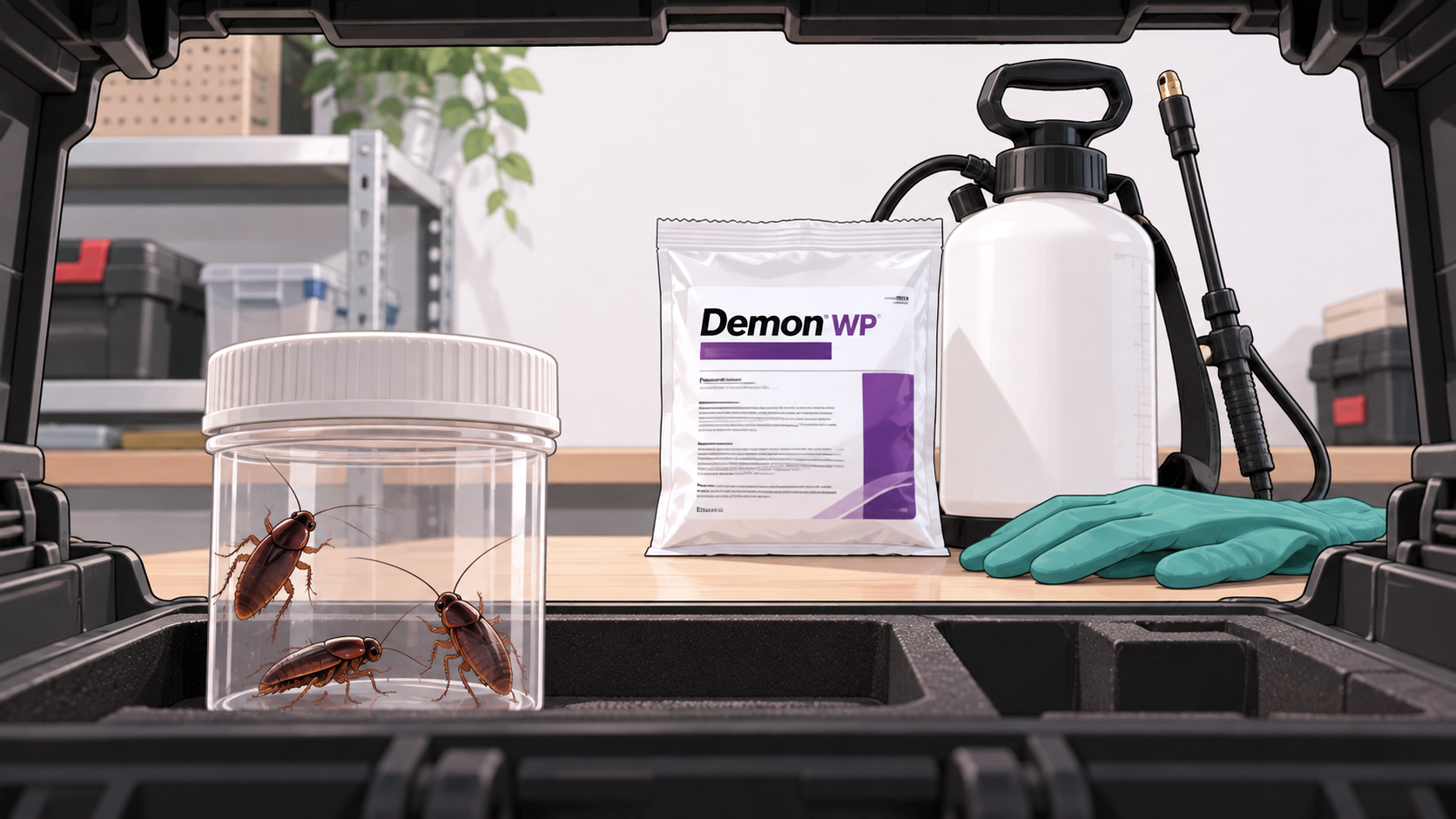
Demon WP kills cockroaches through direct contact and residual insecticide exposure. It contains 40% cypermethrin, a synthetic pyrethroid that disrupts insect nerve function. Syngenta markets it for fast cockroach knockdown and longer-lasting control on treated surfaces. Its U.S. label authorizes specific indoor crack-and-crevice and spot treatments, as well as certain outdoor applications. However, the product’s effectiveness depends on cockroaches contacting a sufficient amount of insecticide, and pyrethroid-resistant populations can survive treatment.
Demon WP is supplied as a wettable powder in water-soluble packets. Unlike an aerosol, it requires preparation in appropriate spray equipment. It is particularly suited to targeted structural treatments where cockroaches travel across accessible surfaces, but its repellent properties and resistance limitations make it a less dependable standalone choice for established German cockroach infestations.
Demon WP’s Cypermethrin Formulation
Demon WP contains one insecticidal active ingredient, cypermethrin. Its EPA-registered formulation identifies the product as Demon WP Insecticide in Water-Soluble Packets, registration number 100-1000, with the signal word WARNING.
| Product specification | Demon WP |
|---|---|
| Manufacturer | Syngenta |
| Active ingredient | Cypermethrin 40% |
| Insecticide classification | IRAC Group 3A |
| Formulation | Wettable powder in water-soluble packets |
| Cockroach exposure | Contact and residual |
| Indoor applications | Labeled spot and crack-and-crevice treatments |
| EPA registration | 100-1000 |
Cypermethrin interferes with voltage-gated sodium channels in insect nerve cells. This causes abnormal nerve activity, impaired movement, paralysis, and death following sufficient exposure. The ingredient also has repellent properties, which can influence whether cockroaches cross treated surfaces.
The National Pesticide Information Center’s cypermethrin fact sheet describes its toxicological and environmental characteristics. Demon WP’s wettable-powder formulation allows the insecticide to remain deposited on surfaces after the water evaporates. Its effectiveness then depends on the condition of that deposit and subsequent insect contact.
The product is designed to leave a residual insecticide rather than disappear after application. Syngenta acknowledges that treated surfaces can develop a visible, milky-white deposit. This cosmetic drawback matters when treating exposed interior finishes, particularly because cleaning away the residue can also remove the insecticide.
Demon WP Mixing Rates for Cockroach Treatment
Demon WP’s label distinguishes between maintenance applications and higher-concentration cockroach clean-out treatments. The water-soluble packets contain a measured amount of powder, allowing the applicator to prepare either concentration without opening the packets themselves.
| Cockroach treatment | Packets per gallon of water | Finished cypermethrin concentration |
|---|---|---|
| Maintenance | 1 packet | 0.1% |
| Clean-out | 2 packets | 0.2% |
Each packet contains 0.33 ounces (9.5 grams) of Demon WP. These are the manufacturer’s labeled dilution rates for the identified U.S. formulation, not general instructions for other cypermethrin products. The higher concentration is designated for clean-out treatment rather than automatic use whenever a cockroach is spotted.
The Demon WP application information distinguishes the two rates and identifies cockroaches among the intended structural pests. The registered label requires mixing intact packets in the spray tank, allowing them to dissolve before completing preparation. The finished liquid is a suspension, so appropriate agitation is necessary to distribute the wettable powder.
One practical consequence is that opening a packet to estimate a smaller dose defeats its measured packaging design and increases handling exposure. The applicator should prepare only the amount needed for permitted treatment and follow the complete mixing instructions. The label prohibits storing diluted material in application equipment overnight.
Where Demon WP Can Be Applied Indoors
Demon WP is labeled for cockroach treatments around baseboards, corners, storage areas, water pipes, doors, windows, cabinets, sinks, and suitable locations beneath or behind refrigerators and stoves. These locations are relevant because cockroaches tend to travel along edges and occupy narrow protected spaces.
However, the current label restricts indoor surface treatments to spot and crack-and-crevice applications. Each indoor spot treatment must not exceed two square feet. Application must also prevent dripping and runoff. A homeowner cannot interpret the product’s general structural-pest labeling as permission to spray entire kitchen floors, cabinet interiors, or room surfaces indiscriminately.
An approved crack behind a sink may provide a useful treatment location when cockroaches regularly travel through it. The same cannot be assumed for an opening leading directly into electrical equipment. Demon WP is water-based after mixing, and its label prohibits spraying into conduits, motor housings, junction boxes, switch boxes, and other electrical equipment because of the shock hazard.
Food-handling restrictions are particularly important. The product is not authorized for food areas within commercial food-handling establishments. In homes, exposed food must be removed or covered, and food-processing surfaces and utensils must be protected or thoroughly washed before use.
The University of California’s cockroach management guidance supports concentrating control efforts around confirmed insect activity. For Demon WP, that means identifying permitted treatment locations rather than assuming that covering more surface area necessarily improves results.
How Quickly Does Demon WP Kill Roaches?
Syngenta advertises cockroach knockdown in less than an hour under suitable exposure conditions. That figure describes the manufacturer’s performance claim rather than a guaranteed mortality time for every German, American, or Oriental cockroach.
Cypermethrin can cause rapid neurological effects, including abnormal movement and temporary incapacitation. An insect lying motionless after exposure is not automatically confirmed dead, particularly where the dose is insufficient or the population has reduced susceptibility.
The manufacturer’s Demon WP product information also promotes residual activity. This allows cockroaches crossing treated surfaces after application to encounter insecticide without being directly sprayed. Nevertheless, the product’s current label does not establish one universal number of weeks or months during which every treated surface remains lethal.
Porous materials, accumulated dirt, cleaning, and exposure conditions can change the practical value of the residue. A deposit remaining visible does not demonstrate that every cockroach contacting it will receive a lethal dose.
Why Demon WP Can Struggle With German Cockroach Infestations
German cockroaches (Blattella germanica) have developed resistance to several pyrethroid insecticides, including compounds in the same chemical group as cypermethrin. Demon WP belongs to Insecticide Resistance Action Committee Group 3A, so its performance can be reduced where resistant individuals dominate a population.
Repellency also affects exposure. Cockroaches disturbed by a pyrethroid deposit may avoid a treated route and remain active elsewhere. This is particularly troublesome when breeding populations occupy several inaccessible spaces. Killing insects that cross one treated baseboard provides little information about cockroaches sheltering behind an adjoining cabinet.
Combining Demon WP indiscriminately with bait can create another difficulty. The feeding behavior required for cockroach bait and gel treatments means repellent residues should not contaminate bait placements or discourage insects from approaching them. Treatments need to be coordinated so that the contact insecticide does not undermine a separate feeding-based control method.
Demon WP’s registered label addresses resistance management directly. It recommends monitoring for unexpected insect survival and considering insecticides with different modes of action rather than relying repeatedly on Group 3A products. For a persistent German cockroach infestation, repeated applications of increasingly concentrated cypermethrin are not a substitute for determining why the population remains active.
Demon WP Safety Restrictions Are More Demanding Than Those of a Ready-to-Use Spray
The product’s WARNING signal word reflects significant handling precautions. Demon WP can cause substantial but temporary eye injury and is harmful if swallowed, inhaled, or absorbed through the skin. Its label requires protective eyewear, suitable clothing, and specified chemical-resistant gloves during relevant handling and application activities.
Water-soluble packaging reduces direct handling of the concentrated powder, but it must remain intact. The packets should not be cut or punctured. Their outer packaging also protects them from moisture before mixing.
Indoor applications must take place in well-ventilated areas, and people and pets must remain away from treated surfaces until the spray has dried. Birds and other pets must be removed before application, while aquariums and ornamental fish ponds require the protection specified on the label. Demon WP must never be applied directly to animals.
These restrictions make product selection especially consequential in households with children or animals. The potential exposure associated with cockroach treatments around pets depends on application location, animal access, and the pesticide formulation. A professional-use concentrate demands more preparation and exposure management than an enclosed bait station.
Cypermethrin is also highly toxic to fish, aquatic invertebrates, and bees. The current label restricts outdoor applications to protect waterways and drainage systems. Spraying before rainfall, allowing runoff into storm drains, or treating impervious outdoor surfaces outside permitted exceptions can create environmental exposure and violate application restrictions.
Demon WP must be used only where its registration and label permit. The U.S. registration does not authorize use in every country, and state-level restrictions can also apply.
When Demon WP Is Worth Using Against Cockroaches
Demon WP is a reasonable choice for an applicator who needs a registered residual pyrethroid treatment for identified cockroach activity in permitted structural locations. Its water-soluble packets simplify measuring the two labeled concentrations, and its wettable-powder formulation provides contact and residual insecticidal activity.
Its disadvantages become more significant when the infestation involves German cockroaches breeding throughout a kitchen. Resistance, avoidance of treated surfaces, and inaccessible harborages can all reduce performance. Homeowners dealing with those conditions should avoid assuming that a stronger mixing rate will solve the problem.
We favor careful monitoring and targeted treatment over purchasing Demon WP solely because it is marketed as a professional insecticide. The EPA’s integrated pest management principles prioritize pest identification, population monitoring, prevention, and proportionate intervention. Those measures provide a way to determine whether pesticide treatment is warranted and whether it has achieved a meaningful reduction.
For an isolated outdoor cockroach, extensive residual treatment may be unnecessary. For a widespread indoor infestation, especially in connected housing, a licensed pest-management professional can determine whether Demon WP fits the treatment plan or whether another mode of action is more appropriate.