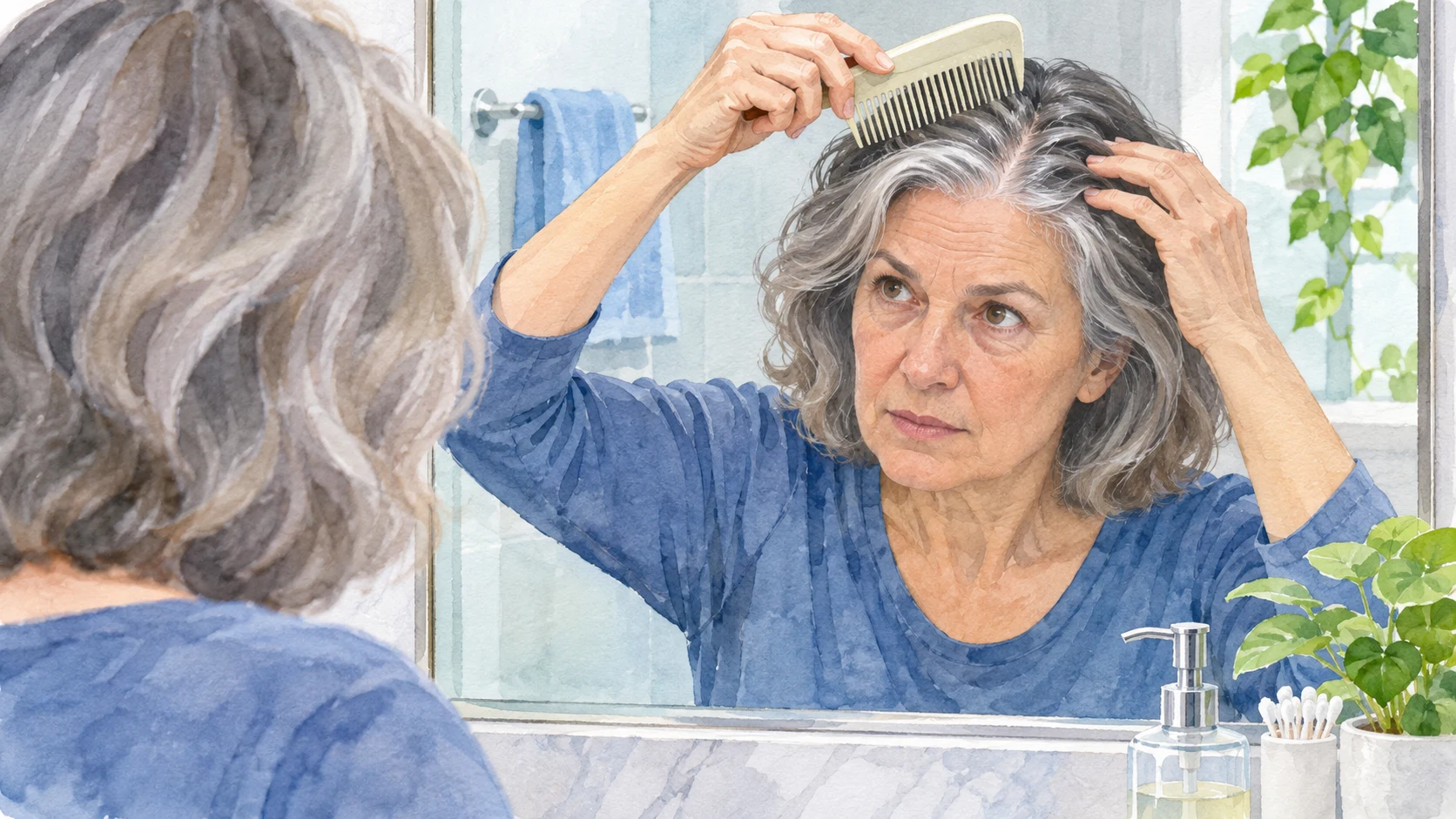
Adults can get head lice at any age. Although infestations are most common among preschool and elementary school children, the insects are equally capable of living and reproducing on an adult’s scalp. Parents, grandparents, caregivers, and other adults who have close contact with someone carrying lice can become infested without realizing it.
An adult infestation often begins with an ordinary interaction at home. A parent might cuddle a child, rest their head against a partner’s, or spend time with a young relative who has an unrecognized infestation. The insects can transfer during close contact between people’s hair, and the adult may not notice anything unusual for several weeks.
Being an adult does not provide immunity to head lice. Age influences how frequently people encounter the insects, but it does not prevent lice from surviving on an adult host. For adults who suspect an infestation, the most useful approach is to consider recent close contacts, check the hair carefully for living lice, and avoid assuming that an itchy scalp automatically means lice are present.
Why Adults Are Susceptible to Head Lice
Human head lice, Pediculus humanus capitis, are small blood-feeding insects that live among scalp hairs. They require human blood to survive and use specialized claws to hold onto individual strands.
An adult’s scalp provides the same essential resources as a child’s scalp: access to blood, hair for attachment, and suitable conditions for reproduction. The insects do not stop feeding or laying eggs simply because their host has reached adulthood.
There is no biological age limit beyond which a person becomes immune to head lice. The susceptibility of people of all ages to head lice is recognized in public-health guidance, even though infestations are more frequently reported among children.
Adults may be less commonly affected because their daily activities often involve fewer opportunities for close hair contact with multiple people. Many adults work, socialize, and travel without regularly touching heads with others.
That difference in exposure should not be mistaken for resistance to the insects.
A person who has never had head lice can acquire them as an adult. Someone who experienced infestations repeatedly during childhood can also become infested again later in life.
Previous exposure does not create dependable protection against future infestations. The insects can establish themselves whenever a viable louse reaches a suitable human host and survives.
Why Parents and Caregivers Are Particularly Exposed
Adults who care for children often have more opportunities for head-lice exposure than adults who rarely spend time in close contact with young children.
A parent may hold a child on their lap while reading, lie beside them at bedtime, or comfort them when they are upset. During these activities, the adult’s hair may touch the child’s hair repeatedly.
Grandparents, babysitters, childcare workers, and other caregivers may experience similar contact.
Children are more frequently affected by head lice, and their close household contacts are therefore an important group to consider. The age and household patterns of head-lice infestation recognize that children can pass lice to parents, caregivers, and other family members.
A child does not need to be scratching for an adult to encounter lice. An infestation may be present before the child or caregiver notices symptoms.
Consider a parent who regularly lies beside a child while helping them fall asleep. If the child has living head lice, repeated close contact creates opportunities for transfer. The parent might later discover lice during an unrelated hair appointment or while investigating persistent scalp itching.
It would be reasonable to consider the child’s infestation as a possible source, but the timing alone would not prove exactly when transmission occurred.
The dynamics of head lice spreading at school or daycare are relevant because children may encounter lice outside the home before anyone in the family knows an infestation is present.
Can Adults Get Head Lice From Their Own Children?
Yes. Close contact between parents and children is one of the more plausible circumstances in which adults acquire head lice.
Young children frequently rest their heads against adults during ordinary family activities. A parent might share a sofa with a child who leans against their shoulder, or two family members might lie together while watching a movie.
If their hair touches, a living louse may have an opportunity to transfer.
The adult does not need to share a hairbrush, hat, or other personal belonging with the child. Direct contact between their hair is sufficient to create a possible exposure.
This does not mean that every parent of an infested child will develop lice. A living insect must actually transfer, and many close interactions occur without transmission.
The situation becomes more complicated when several household members have lice by the time the problem is discovered. The child who first complains about itching may not have been the first person infested.
An adult could have introduced lice into the household, or several people could have encountered the same source independently.
The uncertainty surrounding where head lice first came from in a household means that finding lice on a child and parent does not establish which person acquired them first.
For practical purposes, identifying everyone currently affected is more useful than assigning responsibility for the original introduction.
Can Adults Without Children Get Head Lice?
Adults do not need to live with children or work in childcare to acquire head lice.
Partners, relatives, friends, and other adults can have close contact that allows a louse to move between their hair. A person who has no children may still spend time with someone who has an infestation.
For example, two adults might regularly sleep close together or rest their heads against each other while watching television. If one has living lice, the other has a plausible opportunity for exposure.
Adults may also acquire lice during close contact with visiting relatives or friends. The relevant factor is contact with infested hair, not whether the other person is a child.
It would be inaccurate to describe adult head lice as exclusively a problem for parents or teachers.
The recognition that anyone can acquire head lice reflects this distinction between susceptibility and the frequency of exposure.
An adult who lives alone and has little close physical contact may have fewer opportunities for infestation, but that does not make acquisition impossible.
When an adult discovers lice without an obvious source, the absence of a remembered exposure does not mean the insects developed spontaneously or came from poor household hygiene.
Can Head Lice Spread Between Adult Partners?
Yes. Adult partners may have frequent opportunities for close contact between their hair, particularly when sleeping beside one another, cuddling, or resting their heads together.
A living louse can potentially move from one person’s hair to the other’s during such contact.
The insects do not need sexual activity to spread, and an adult head-lice infestation should not be interpreted as evidence of sexual contact or infidelity. Head lice are distinct from pubic lice, which are a different human parasite.
An adult may acquire head lice from a partner through the same ordinary physical closeness that occurs between family members.
The important circumstances surrounding head lice spreading through kissing or hugging involve whether the people’s hair actually touches.
When one partner has confirmed head lice, the other should be checked, especially if they regularly sleep or rest with their heads close together.
A partner who has no itching may still carry lice. Symptoms alone are not a reliable way to determine whether transmission has occurred.
Can Adults Have Head Lice Without Knowing It?
An adult can carry living head lice without noticing any symptoms, particularly during the early stages of an infestation.
Itching is caused by a person’s reaction to louse saliva. During an initial infestation, this reaction may take four to six weeks to develop. Some people experience very little itching even after lice have been present for some time.
The delay between infestation and the appearance of itching explains why an adult may be unaware of lice despite having close contact with other household members.
A light infestation can also be difficult to notice. Head lice are small, move quickly, and tend to remain among the hair near the scalp.
An adult might notice an occasional tickling sensation but attribute it to loose hair, sweat, or an ordinary scalp irritation. Others may have no noticeable sensations at all.
This makes the date symptoms begin a poor indicator of when the insects arrived.
The reasons head lice can be present without itching are especially relevant when a parent assumes they are unaffected because their scalp feels normal.
A lack of symptoms is reassuring only to a limited extent. It does not replace checking when there has been meaningful close contact with a confirmed case.
What Are the Signs of Head Lice in Adults?
The signs of head lice in adults are generally the same as those seen in children.
Some adults experience scalp itching, a crawling or tickling sensation, disturbed sleep, or irritation from repeated scratching. Others notice no symptoms and discover the insects only during a deliberate examination.
Small sores can develop when scratching damages the skin. Persistent scratching may also increase the risk of a secondary bacterial infection.
However, none of these symptoms is specific enough to establish a head-lice infestation by itself.
An itchy scalp may result from dandruff, seborrheic dermatitis, contact irritation, eczema, or other conditions unrelated to lice. Likewise, flakes or pale particles attached to hair are not necessarily louse eggs.
The clinical symptoms and limitations of head-lice identification make it important to distinguish symptoms from actual evidence of insects.
The most convincing finding is a living head louse or nymph in the hair. Eggs attached close to the scalp may provide supporting evidence, but their interpretation requires care.
The broader signs of a head-lice infestation can help adults recognize when further examination is appropriate without assuming that every scalp symptom is caused by lice.
How Should an Adult Check Their Hair for Head Lice?
Checking your own head can be more difficult than examining someone else’s because the most useful areas are not always easy to see.
Good lighting and a mirror can help, but a second person may be able to examine the scalp more thoroughly. A fine-toothed lice-detection comb can also help locate small insects that are difficult to spot by sight alone.
Begin by examining the hair close to the scalp, paying particular attention to the areas behind the ears and near the nape of the neck. These are common locations for head lice and their eggs, although insects may be present elsewhere.
Separate the hair into manageable sections so that the scalp and hair roots are visible. Look for small, moving insects rather than relying only on pale particles.
Adult head lice are approximately 2–3 millimeters long. Younger lice are smaller and may be harder to identify.
The clinical evidence on identifying active head lice supports careful examination and the use of a fine-toothed detection comb because living insects can be difficult to find.
An adult examining their own hair may overlook the back of the head or mistake ordinary debris for nits. If the results are uncertain, assistance from another person or a healthcare professional may be useful.
The complete technique for checking your own head for lice covers mirror placement, sectioning, and practical examination methods in greater detail.
For this article, the important point is that adults should look for evidence of living lice rather than making a diagnosis from itching alone.
What If You Find Nits but No Living Lice?
Finding a small object attached to a hair shaft does not automatically establish an active infestation.
Head-louse eggs are attached firmly to individual hairs, usually near the scalp when they are laid. As hair grows, the attached eggs or empty eggshells move farther from the scalp.
Some nits may already have hatched. Others may be nonviable, and ordinary hair debris can be mistaken for eggs.
A person who finds only pale particles several inches from the scalp should not assume that living lice are present.
The distinction between having nits and having an active infestation is important because unnecessary treatment can expose the scalp to chemicals without addressing a confirmed problem.
If living lice cannot be found but the suspicion remains strong, careful re-examination or professional identification may be appropriate.
An adult who has recently been exposed to someone with confirmed lice should not treat a single unidentified particle as proof of transmission.
Should Adults Check Themselves When a Child Has Head Lice?
Yes. When a child has confirmed head lice, the adults living with that child should be examined, particularly those who regularly have close hair contact with them.
A parent who helps with bedtime, a grandparent who provides daily childcare, or another adult who shares sleeping space with the child may have meaningful exposure even without symptoms.
The recommendation to examine household members is supported by clinical guidance on managing head lice within families.
A household check should establish who has living lice rather than assuming everyone is infested.
The distinction is especially important when several people have itchy scalps. One person may have confirmed lice while another has dandruff or an unrelated skin condition.
Adults should also avoid assuming that a child is the only affected person because the child’s symptoms appeared first.
A practical household response is to identify confirmed cases, examine close contacts, and follow appropriate care instructions for anyone who needs treatment.
Detailed medication selection and treatment methods belong in the complete head-lice treatment guide, rather than treating every adult exposure as an automatic reason to use a lice product.
Can an Adult Keep Getting Head Lice From Family Members?
Repeated findings of head lice in an adult household member can have several explanations.
An infestation may not have been fully eliminated, another household member may still have living lice, or the adult may have experienced a new exposure.
These situations can look similar when the only information available is that lice have appeared again.
An adult who completes treatment but continues close contact with an untreated infested family member may encounter living lice again. Conversely, lice found shortly after treatment may have survived the original intervention rather than representing a completely new infestation.
The distinction between reinfestation and lice remaining after treatment is important when evaluating repeated household cases.
Finding lice repeatedly does not prove that an adult’s hair is unusually attractive to the insects or that the household is unclean.
It also does not establish that the adult is the source of every subsequent case.
The useful response is to confirm whether living lice are present and consider whether close household contacts have been checked, rather than drawing conclusions from the adult’s age or the number of previous episodes.
Do Adults Need Treatment After Every Exposure?
No. An adult does not automatically need lice treatment because a child, partner, or coworker has head lice.
Exposure creates an opportunity for transmission, but it does not establish that a living louse has reached the adult’s hair.
A careful examination is usually the appropriate first step. Treatment decisions should be based on confirmed findings and relevant clinical guidance rather than fear of possible exposure.
There is an important exception to simple self-assessment: clinical guidance may recommend treating people who share a bed with an infested person because of their particularly close exposure, even when lice are not found during an initial check. Adults in that situation should seek appropriate guidance rather than assuming a negative examination settles the question.
An adult who is pregnant, breastfeeding, has an irritated or injured scalp, or takes medications that may affect treatment suitability should consult a healthcare professional before choosing a lice product.
Products intended for pets or household pests must never be used on a person’s scalp. Unapproved chemical mixtures and repeated applications beyond a product’s instructions can also cause harm.
The choice between over-the-counter and prescription head-lice treatments depends on the individual circumstances and the specific product.
The main decision for an adult with a suspected infestation is whether lice are actually present and whether professional advice is needed.
When Should an Adult Seek Medical Advice?
Most head-lice infestations are manageable, but certain circumstances warrant professional assessment.
If an adult cannot determine whether an insect or scalp particle is a head louse, a healthcare professional can help avoid unnecessary treatment.
Medical advice is also appropriate when the scalp develops spreading redness, swelling, increasing pain, pus, or other signs suggesting infection. Repeated scratching can damage the skin and sometimes lead to bacterial complications.
An adult with persistent scalp symptoms but no confirmed lice should not assume that head lice are the cause indefinitely. Other dermatological conditions may need assessment.
The same applies when living lice continue to be found despite appropriate treatment. Product resistance, incorrect use, incomplete follow-up, or renewed exposure may need to be considered.
The possible complications of head-lice-related scalp sores and infection deserve attention when irritation progresses beyond ordinary itching.
Head lice are not known to transmit disease, but severe scratching and skin damage should not be ignored.
Questions About Head Lice in Adults
Can you get head lice for the first time as an adult?
Yes. A person can acquire head lice for the first time at any age. Previous exposure is not required, and adults do not have natural immunity simply because they avoided lice during childhood.
Can adults get head lice even if they do not have children?
Yes. Adults can acquire lice through close hair contact with partners, relatives, friends, or other people who have an infestation. Having children is a common exposure circumstance, not a requirement.
Are head lice less common in adults than children?
Head lice are reported more frequently among preschool and elementary school children and their close contacts. This difference is associated with patterns of close contact rather than an inability of lice to infest adults.
Can an adult have head lice without an itchy scalp?
Yes. Itching may take several weeks to develop during a first infestation, and some people experience little or no itching. A careful examination for living lice is more informative than symptoms alone.
The Bottom Line
Adults can get head lice just as children can. The insects are capable of feeding, surviving, and reproducing on an adult scalp, and there is no age-related immunity that prevents infestation.
Parents, grandparents, caregivers, and adults who share close physical contact with other people may have greater opportunities for exposure. However, adults without children can also become infested.
When someone in the household has confirmed head lice, adults should not assume they are unaffected simply because they have no itching. Checking for living lice, paying attention to close household contacts, and seeking appropriate care when an infestation is confirmed are more useful than relying on age or symptoms.