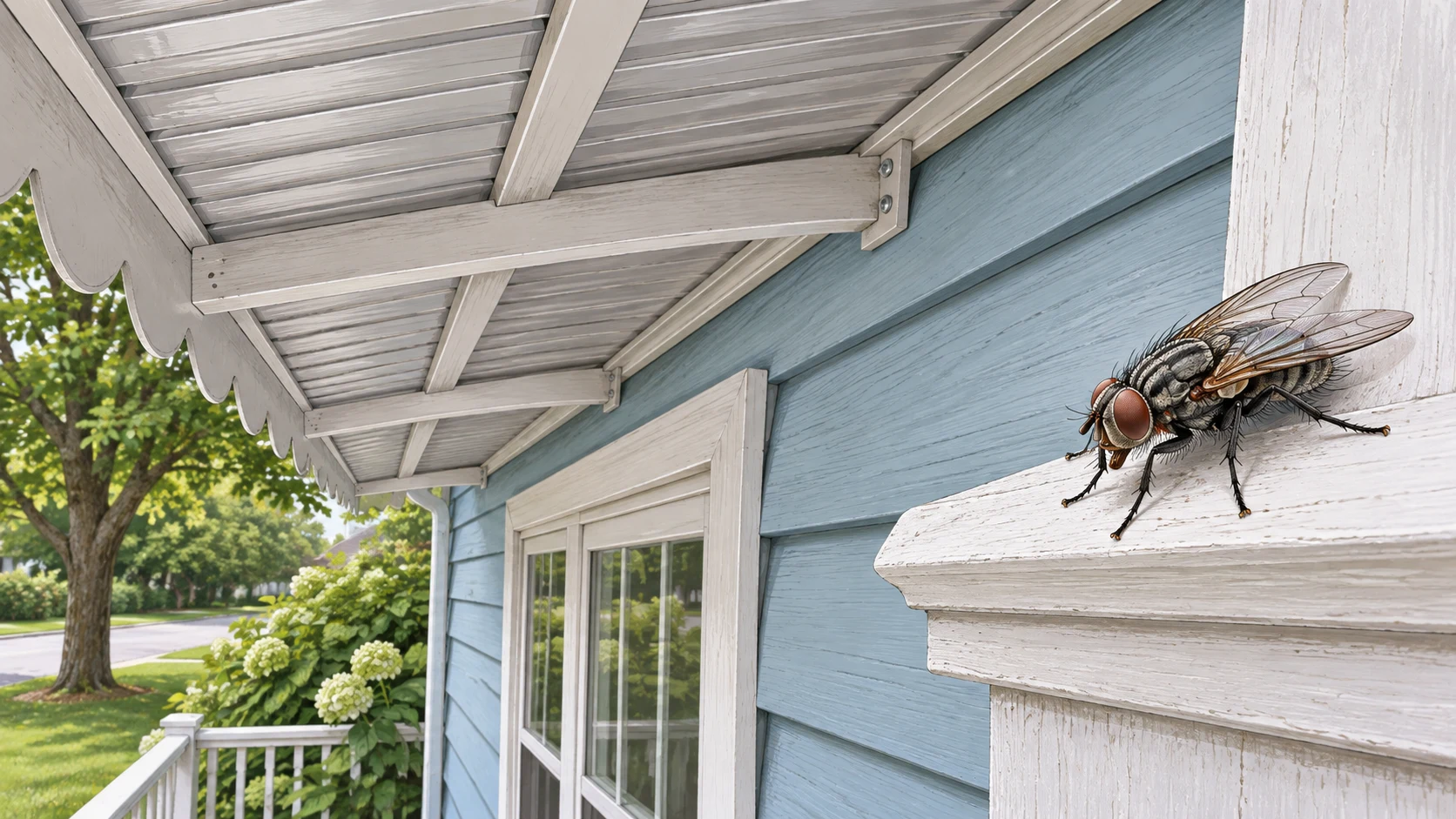
House flies gathering on your siding can be discouraged by cleaning the surfaces where they repeatedly rest, removing nearby food residues and inspecting openings around the exterior of your home. The most useful approach is to identify why flies favor a particular wall before attempting to treat the entire surface.
A few flies resting on siding during warm weather are usually nothing unusual. However, repeated gatherings around windows, doors, soffits or the same section of wall deserve closer attention. Flies can leave unsightly deposits, and those gathering near entrances have more opportunities to enter the house.
The common house fly (Musca domestica) is a daytime-active insect that regularly rests on walls and other exposed surfaces. Its presence on siding does not automatically mean it is breeding there. House flies generally develop in manure, garbage and other moist, decaying organic material rather than on clean exterior siding.
Why House Flies Gather on House Siding
House siding provides convenient resting surfaces for adult flies moving between feeding locations. A wall may be exposed to sunlight during part of the day, sheltered from strong winds or positioned close to an attractive food source.
House flies are active in warm conditions and commonly rest on exterior walls, fences and other structures. Their resting behavior changes with temperature, sunlight and time of day. A wall that attracts flies in the afternoon may have very few by evening.
The house fly management guidance from UC Integrated Pest Management describes their tendency to rest on walls and leave dark fecal and regurgitation spots. These marks can become particularly noticeable on light-colored surfaces.
Pay attention to where the flies gather. A concentration beside a garbage storage area suggests a different cause from a few flies resting on an otherwise clean, sunlit wall.
Flies may also land around exterior door frames, window trim and overhangs. Those locations provide convenient resting places near openings into the building.
Clean the Siding Where Flies Repeatedly Rest
Start with the sections where you consistently see flies or their deposits. Cleaning these areas removes fly spots, spilled organic material and other residues that can accumulate on the siding.
Use a soft brush or cloth with water and a mild cleaner approved for your siding material. Vinyl, painted wood, fiber cement and metal siding have different cleaning requirements, so follow the manufacturer’s instructions.
Work from an accessible position and rinse without forcing water behind siding panels, around electrical fixtures or into wall openings. Avoid aggressive scrubbing that could damage paint or protective finishes.
Dark specks around window frames, sheltered corners and beneath overhangs may be fly deposits. The resting-site information for house flies explains how fecal and regurgitation marks accumulate where adult flies spend time.
Removing these deposits improves the appearance of the siding and makes fresh activity easier to recognize. Cleaning alone, however, will not prevent flies from returning to a favorable resting surface.
We would prioritize the sections closest to entrances and areas with visible residue rather than repeatedly washing every exterior wall.
Check for Residues Around Exterior Fixtures
Certain sections of siding collect more debris than others. Look beneath outdoor light fixtures, near waste-storage areas and around ledges where food-related residues or dirt may accumulate.
Remove accessible organic debris and clean the surrounding surface. If flies repeatedly gather near a particular fixture, check whether something nearby is attracting them before assuming the siding itself is responsible.
A clean wall can still attract resting flies. The purpose of targeted cleaning is to remove contributing residues and establish whether the problem continues without them.
How Sunlight and Heat Affect Flies on Siding
Temperature and sunlight can influence where flies settle on exterior walls. Sun-exposed siding may provide a favorable resting location during cooler periods, while shaded or sheltered surfaces can become more suitable under different conditions.
House flies are generally more active during warm daylight hours. Their activity also changes as temperatures rise or fall, so the number visible on a wall may fluctuate considerably throughout the day.
The household fly guidance from Missouri Extension identifies temperature and exterior lighting among the factors that influence fly activity around buildings.
Observe the wall at different times before deciding it needs treatment. A cluster appearing only during a particular afternoon period may reflect temporary resting behavior rather than a persistent attraction associated with the siding.
There is also an identification issue worth considering. Large numbers of flies gathering on sunny upper walls in late summer or fall may be cluster flies, which resemble house flies but have different habits.
Cluster flies often congregate on sun-warmed walls while seeking sheltered places to overwinter. Their behavior is described in the Colorado State University Extension information on cluster flies.
House flies should not automatically be blamed for every group of flies resting on siding, particularly when the insects appear seasonally around upper-story walls.
Does Exterior Lighting Attract House Flies to Siding?
Exterior lighting can influence fly activity around buildings, although its effects differ among fly species. House flies are primarily active during daylight, so a porch light should not automatically be considered the cause of a daytime gathering.
Outdoor lights can attract various flying insects after dark. If flies consistently appear around an illuminated doorway, observe whether the insects are actually gathering at the fixture or resting elsewhere on the wall.
Where lighting appears to contribute, consider reducing unnecessary illumination near entrances or directing light away from the doorway. Choose fixtures and lighting arrangements that still provide adequate security and visibility.
Changing bulbs or turning off lights will not necessarily stop house flies from resting on siding during daylight. Their presence may be associated with temperature, shelter or nearby organic waste instead.
Keep Nearby Attractants From Drawing Flies Toward the Wall
A wall beside an outdoor garbage container may receive frequent fly visits because of the material stored nearby. Flies attracted to food waste can land on the siding between feeding and resting.
Look for leaking garbage bags, residue beneath containers or spills against the wall. Clean contaminated surfaces promptly and avoid leaving food waste directly beside the siding.
Keeping waste containers clean and properly closed helps reduce fly activity in these locations. The specific placement and maintenance of bins are addressed in how to keep house flies away from outdoor garbage.
If flies repeatedly appear despite cleaning the wall and nearby surfaces, consider whether an outdoor breeding source is supplying new adults. House flies reproduce in suitable decaying organic material, and adults can travel from those sites to nearby buildings.
The relationship between breeding materials and recurring outdoor fly activity is covered in how to stop house flies from breeding in your yard.
For siding-specific prevention, concentrate on what is immediately adjacent to the affected wall. A wall beside a frequently contaminated waste area requires a different response from an exposed wall used only for resting.
Check for Gaps Where Flies Could Enter the House
Flies resting on siding near windows, doors and other exterior openings may eventually find their way indoors. The risk increases when an opening provides direct access to the living space.
Inspect the siding around window frames, exterior door trim, utility penetrations and other joints. Look for deteriorated caulk, loose trim or visible openings that could allow insects through.
Pay particular attention to areas where siding meets another building material. Small gaps can develop around penetrations and joints as materials expand, contract or deteriorate.
Not every opening behind siding leads into the house. Some exterior wall assemblies contain designed drainage and ventilation spaces. Do not seal these openings without checking their function, because trapping moisture can damage the building.
The practical repair methods for accessible entry points are explained in how to seal door and window gaps against house flies.
Flies collecting near a doorway may also enter whenever someone opens it. The broader prevention measures are covered in how to prevent house flies from entering your home.
Should You Spray Your House Siding to Repel Flies?
Spraying the siding is usually unnecessary when the problem involves a small number of resting house flies. Cleaning and correcting nearby attractants are better starting points.
Residual insecticides may be used on certain exterior resting surfaces when the product is specifically labeled for the pest and application site. However, these treatments kill exposed insects rather than reliably preventing every fly from landing.
Some formulations can damage finishes or leave residues. Exterior applications also introduce risks involving runoff, nearby plants, pollinators, pets and people who may contact treated surfaces.
Never assume that a product labeled for outdoor insects can be sprayed across vinyl siding, painted wood or another exterior material. The exact label must authorize the intended application.
Avoid spraying near open windows, ventilation intakes, drains or other locations where the product could enter the building or contaminate water. Follow all label restrictions, including weather conditions and precautions for people and animals.
For a recurring, substantial problem, a licensed pest-control professional can evaluate whether a targeted exterior treatment is justified. The Illinois Department of Public Health guidance on house flies describes residual treatments on outdoor resting surfaces while emphasizing sanitation and appropriate pesticide use.
We would avoid routine whole-wall spraying simply because a few flies are visible on a sunny afternoon. It exposes a much larger surface to pesticide without addressing why new flies continue arriving.
How to Tell Whether Your Siding Cleanup Is Working
Choose one affected section of siding and observe it at approximately the same time of day over several days. Compare conditions when the weather is similar, since a cooler or windier day may naturally produce fewer resting flies.
A simple comparison can help separate the effect of cleaning from ordinary changes in fly activity.
|
Observation |
What it suggests |
|---|---|
|
Fewer flies after nearby waste residue is removed |
The nearby attractant may have contributed |
|
Flies return to a clean wall during sunny periods |
The wall may remain a favorable resting location |
|
Fresh fly spots repeatedly appear beneath an overhang |
Flies are continuing to use that sheltered area |
|
Flies gather near a door and are also appearing indoors |
Entry points or door-opening activity deserve attention |
|
Large groups appear on upper sunny walls in fall |
Check whether they are cluster flies rather than house flies |
These observations help prioritize the next action, but they do not prove exactly what attracted the flies.
If the same area continues attracting substantial numbers after cleaning, record where and when they gather. Repeated activity can help a pest-control professional distinguish a resting-site issue from a nearby breeding source or seasonal fly invasion.
For persistent problems following previous control efforts, why house flies keep coming back after treatment examines the causes of renewed activity.
Questions About House Flies on Exterior Walls
Do house flies lay eggs on house siding?
House flies generally lay eggs in suitable moist, decaying organic material rather than on clean siding. Finding adults resting on a wall is not evidence that they are breeding there. However, decomposing material trapped against the exterior may provide an attractive location.
Will pressure washing siding keep house flies away?
Pressure washing may remove fly deposits and accumulated dirt, but it will not permanently discourage flies from resting on the wall. Excessive pressure can also damage siding or drive water behind panels. Gentle cleaning is preferable when it can remove the residue safely.
Why are there so many flies on one side of my house?
Sun exposure, temperature, shelter and nearby attractants can make one side more favorable than another. If large numbers appear on upper walls during fall, verify whether they are house flies or seasonal cluster flies before choosing a control method.
Can flies damage vinyl or wood siding?
House flies do not feed on or bore into siding materials. Their deposits can leave visible spots, particularly on light-colored finishes. Any staining should be cleaned using methods appropriate for the material.
What to Do When Flies Keep Returning to the Same Wall
When flies repeatedly gather on one section of siding, begin with the immediate surroundings. Remove visible deposits, clean accessible residues and inspect nearby openings. Observe whether fly activity changes with sunlight, temperature or the removal of an attractant.
A few resting flies outdoors generally do not justify extensive treatment. Persistent gatherings near entrances, fresh deposits accumulating quickly or flies regularly entering the house warrant a closer inspection.
The goal is to correct identifiable conditions without damaging the siding or applying unnecessary pesticides to large exterior surfaces.