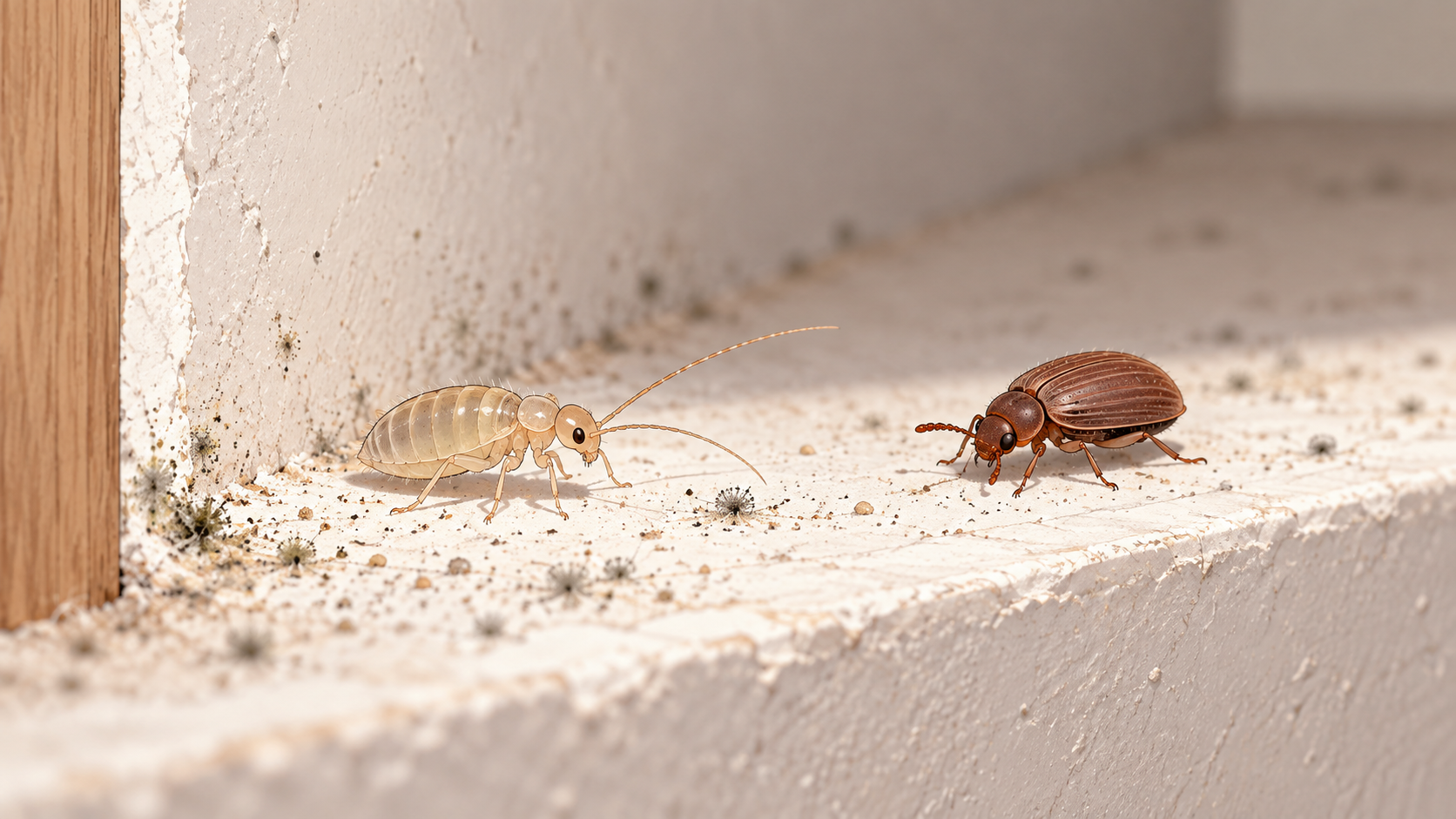
Booklice and plaster beetles are unusually easy to confuse because both can become numerous in damp buildings where mold is growing. Their appearance separates them. Booklice are soft-bodied insects with a broad head and long threadlike antennae. Plaster beetles are tiny, hard-bodied beetles with distinct wing covers and a more compact body.
Mold Can Put Both Pests in Exactly the Same Place
Finding tiny insects around damp plaster, wet wallboard, a humid basement, stored cardboard, or a recently completed building does not immediately tell you which pest is present. Booklice thrive where elevated moisture supports microscopic fungi, and mold is an important part of the booklice diet. Their close connection with excessive moisture is strong enough that conservation guidance treats psocids as indicators of damp conditions.
Plaster beetles occupy remarkably similar environments because they are fungus-feeding beetles. The name commonly applies to members of the minute brown scavenger beetle family Latridiidae, including Cartodere constricta, which is formally recognized as a plaster beetle in the family Latridiidae. These beetles feed on mold and commonly occur in moist environments. Moist building materials, fungal growth behind walls, and recently constructed spaces that have not completely dried can all support fungus-feeding beetles.
The shared habitat explains much of the identification confusion. Nebraska Extension lists both plaster beetles and booklice among insects associated with damp or newly constructed buildings. Location is therefore unusually weak evidence in this comparison. The insect itself needs to be examined.
The Beetle Shell Separates Them More Reliably Than Size
A plaster beetle has the structural features of a beetle. Its hardened forewings, called elytra, cover the abdomen and create a firm outer shell. Common plaster beetles may be reddish brown, with a compact body and a clearly defined pronotum behind the head. Some are only about 1/16 inch long, putting them close enough to booklice in size that an unaided glance can reduce either insect to a tiny brown dot.
Booklice have no comparable shell. Common household species are soft-bodied and usually about 1 to 2 millimeters long, with a relatively broad head, narrow thorax, long antennae, and more delicate proportions. Canadian grain identification material describes booklice as minute insects with very long threadlike antennae and soft bodies. Their normal body shape lacks the smooth pair of wing covers running down the back of a beetle.
A good overhead photograph can expose this difference even when exact measurements are unavailable. Two hard wing covers meeting along a straight line over the abdomen favor a plaster beetle. A soft-looking insect with a large head and no elytral seam favors booklice.
Their Antennae Have Different Proportions
Booklice often look disproportionately antenna-heavy. The antennae are slender, threadlike, and conspicuous relative to the rest of the insect. That feature is particularly noticeable in common wingless household psocids and can remain visible even when finer anatomical details are lost in a photograph.
Plaster beetle antennae do not have the same long, filament-like appearance. Minute brown scavenger beetles generally have segmented antennae ending in a small club or thickened terminal segments. Texas A&M describes comparable mold-feeding beetles as having antennae with a three-segmented club, alongside the harder reddish-brown beetle body.
The head also contributes to the difference. A booklouse has an enlarged clypeus that can make the front of its head look bulbous, while a plaster beetle has the smaller head-to-body proportions expected of a minute beetle. Magnification strong enough to resolve the antennae and head is often sufficient to settle the identification.
New Construction Can Produce Either One
Recently built or renovated homes provide one of the few situations where both pests may appear for nearly the same environmental reason. Construction introduces substantial water through plaster, drywall compounds, concrete, lumber, paint, and other materials. A building can look finished while concealed materials are still drying.
Booklice can exploit the resulting humidity and microscopic fungal growth, which is why newly built homes sometimes develop booklice populations. Fungus-feeding beetles can also develop where high moisture supports mold on new building materials. Research on mold-associated stored-product beetles documents structural infestations in wall voids, crawl spaces, and other humid areas where fungi grow on incompletely dried wood, plaster, or wallboard.
A sudden appearance at windows does not automatically favor booklice. Adult plaster beetles can fly, and small fungus beetles may leave concealed breeding areas and move toward light. Common indoor Liposcelis booklice are wingless. Numerous tiny beetles appearing on windows shortly after construction therefore deserve close inspection for elytra rather than being assumed to be psocids.
Their Young Stages Follow Different Body Plans
Booklice use incomplete metamorphosis. Their eggs hatch into nymphs that already have the basic appearance of the adult, including legs, antennae, and the broad-headed psocid shape. The booklice life cycle progresses from egg through several nymphal stages to adulthood without a larva or pupa.
Plaster beetles, like other beetles, undergo complete metamorphosis. Their development includes egg, larva, pupa, and adult stages. A beetle larva therefore does not look like a miniature plaster beetle with hardened wing covers.
This can clarify a mixed collection of specimens. Several tiny insects that all share the same basic booklouse outline but differ in size may simply be booklice at different nymphal stages. Adults with hard wing covers accompanied by distinctly larval immature forms point toward beetles instead.
Neither Pest Is Eating the Plaster Itself
The common name plaster beetle can make the insect sound like a structural borer, but plaster is not its food. The beetles are associated with plaster because damp construction materials can support the fungi they eat. Minute brown scavenger beetles are mold-feeding insects associated with moist environments, not organisms that excavate intact plaster.
Booklice have a similar reputation problem around books, paper, and walls. Their feeding is heavily associated with microscopic fungi and other suitable organic material rather than structural tunneling. Their presence around plaster or drywall therefore says more about environmental conditions than about direct damage to the wall.
Visible holes, powder, tunnels, or substantial missing material should not be assigned to either pest merely because tiny insects are nearby. Those signs require another explanation.
The Infestation Pattern Can Support What the Specimen Shows
A population of soft-bodied specks spread through damp cardboard, shelving, stored foods, or humid wall surfaces fits the usual pattern of an indoor booklice infestation. Booklice can multiply heavily when humidity remains favorable, especially where fungal food persists.
Plaster beetles may instead appear as recognizable minute beetles crawling or flying away from a fungal breeding source. Adults can be conspicuous around windows and lights even when the mold supporting their development is concealed inside a wall cavity or another inaccessible space.
Neither pattern should override anatomy. Damp buildings can support multiple mold-feeding arthropods at once, so two visibly different insects found in the same basement or newly built room may genuinely represent two pests rather than different stages of one species.
Questions About Booklice and Plaster Beetles
Are plaster beetles the same as foreign grain beetles?
No. Both are small mold-associated beetles and can appear in damp buildings, but they belong to different beetle groups. The name plaster beetle commonly refers to minute brown scavenger beetles in Latridiidae, while the foreign grain beetle is Ahasverus advena in Silvanidae.
Can plaster beetles fly?
Adult plaster beetles can have functional wings beneath their hardened wing covers. Common household booklice such as Liposcelis are wingless, so a confirmed tiny beetle repeatedly flying toward windows is not a typical indoor booklouse.
Can both appear after a water leak?
Yes. A prolonged leak can raise humidity and support fungal growth, creating conditions that suit booklice as well as fungus-feeding beetles. Correct identification still requires examining the insect because the environmental clue fits both.
Does finding plaster beetles mean the wall is structurally damaged?
Not by the beetles themselves. Their presence is more useful as evidence that mold and excessive moisture may exist somewhere nearby. The underlying water source or persistently damp building material deserves attention independently of the insects.
What feature should you photograph first?
Photograph the insect from directly above with enough magnification to show its back. A hard pair of wing covers with a central seam indicates a beetle. A soft body, conspicuously broad head, and long threadlike antennae support booklice, while insects matching neither form may belong among other small pests that resemble booklice.