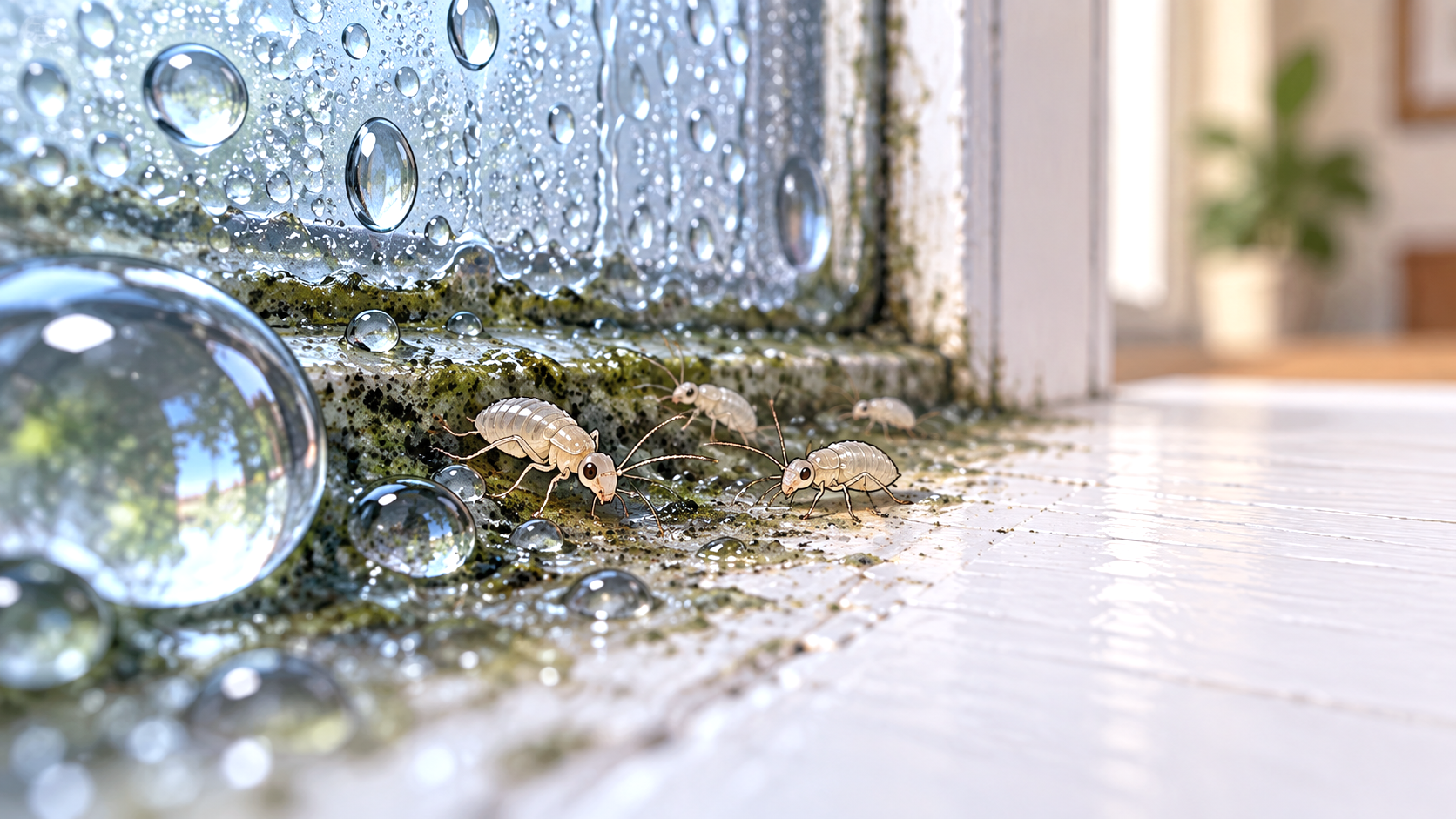
Booklice have such a strong relationship with humidity that finding many of them indoors is often a clue that something is too damp. Moist air helps them maintain the water balance their small bodies require, while the same moisture encourages the mold and fungi that provide much of their food.
Booklice need humidity because they are highly vulnerable to dry conditions. Their survival, development, and reproduction depend strongly on relative humidity, and damp conditions also support the fungi they commonly eat. Different species tolerate dryness differently, but sustained low humidity can stop populations from developing and eventually kill the insects. That relationship is why reducing moisture usually works better against household booklice than repeatedly spraying the insects you can see.
Booklice Lose the Battle in Dry Air
Booklice are extremely small, soft-bodied insects. Common indoor species are often only about 1 to 2 millimeters long, giving them little margin for maintaining adequate body water when surrounding conditions become unfavorable.
Relative humidity describes how much water vapor is present in the air compared with the amount the air could hold at that temperature. For booklice, changes in that moisture availability can determine whether they survive and reproduce.
Experiments on several Liposcelis species demonstrate just how consequential the difference can be. When four stored-product psocid species were maintained at 30°C, exposure to 43% and 50% relative humidity eventually killed every life stage tested. Populations in the 75% relative-humidity controls continued increasing.
The exact threshold is not identical for every booklouse species or life stage, but the overall pattern is clear. Dry conditions are biologically hostile to them.
Humidity Affects More Than Adult Survival
A room does not have to kill every adult immediately to stop a booklice infestation from succeeding.
Humidity influences survival across the booklice life cycle, including eggs, nymphs, and adults. It also affects development and population growth.
For example, Liposcelis fusciceps failed to survive at 43% relative humidity across all temperatures tested. Some populations survived and multiplied at 55% under suitable temperatures, while substantially stronger population growth occurred under more favorable humidity.
Another species, Liposcelis brunnea, also failed to survive at 43% relative humidity in laboratory experiments but could increase at higher humidity levels under suitable temperatures.
Those differences are important. There is no scientifically sound universal percentage at which every booklouse instantly dies. Species, life stage, temperature, exposure time, and the humidity immediately surrounding the insects all influence the result.
Humidity Also Determines How Much Food Is Available
Booklice do not depend on moisture only because their bodies are sensitive to drying. Humidity also changes their environment.
Indoor booklice commonly feed on microscopic molds and fungi. Those organisms need suitable moisture to grow, so a persistently damp room can provide booklice with both favorable physical conditions and an expanding food supply.
This explains why booklice frequently turn up around damp cardboard, books, stored foods, cupboards, condensation, and moisture-affected building materials. Their association with these objects is often really an association with the fungal growth the moisture supports.
Penn State describes indoor booklice as insects of humid, damp areas where they feed on fungi and mold. In stored-product environments, increased humidity can similarly promote fungal growth and make additional food available to booklice.
Understanding what booklice eat therefore helps explain why their humidity requirement is so important. Drying an infested area attacks two parts of the problem at once.
Mold and Booklice Often Increase Together
Suppose a cardboard box is stored against a slightly damp basement wall.
The box absorbs moisture, air circulation behind it is poor, and microscopic fungal growth develops. Booklice now have a protected environment with both moisture and food. If conditions remain favorable, they can reproduce until enough insects are present that you begin noticing them crawling outside the box.
This is why mold and booklice are so closely connected. The insects are not appearing because cardboard itself magically produces booklice. Moisture changes the small environment around the material and makes it suitable for both fungi and the insects feeding on them.
The same pattern can occur behind wallpaper, around leaking pipes, inside damp cupboards, beneath plant pots, and around stored foods that have absorbed moisture.
How Much Humidity Do Booklice Need?
For household control, keeping relative humidity below approximately 45 to 50 percent is a commonly recommended target.
Indoor psocids do not survive when humidity remains below roughly 45 to 50 percent, which is why moisture reduction is recommended as the most effective household management strategy. The University of Minnesota specifically recommends reducing humidity rather than relying on insecticides.
Penn State similarly recommends lowering relative humidity to less than 50 percent to prevent mold growth and booklouse development.
However, that number should not be interpreted as an instant kill switch. Controlled research illustrates why. At 30°C and 50% relative humidity, complete mortality across four tested Liposcelis species and their life stages took different amounts of time, with maximum survival extending from about 10 to 16 days, depending on the species and stage.
Humidity control therefore works through sustained environmental change, not by briefly lowering the reading on a hygrometer for an afternoon.
Some Booklice Tolerate Dryness Better Than Others
“Booklice” does not refer to one species with one precise humidity requirement.
Indoor booklice include multiple species, many belonging to the genus Liposcelis. Their responses to humidity differ enough that laboratory studies have produced different survival and population-growth thresholds.
For example, L. brunnea could multiply at 55% relative humidity under suitable temperatures, while L. pearmani performed poorly at that humidity under several temperature conditions and showed its greatest population growth at 75% relative humidity.
These differences explain why we would not claim that 49% relative humidity kills every booklouse while 51% allows every species to flourish.
The useful household principle is simpler. Persistently lowering humidity makes the environment progressively less favorable to booklice, while high humidity makes survival, reproduction, and fungal food more likely.
That distinction is worth remembering when considering booklice humidity requirements throughout different parts of a building.
A Room’s Humidity Reading May Not Tell the Whole Story
A hygrometer reading of 45% does not prove that every crack and crevice in the room is equally dry.
Booklice can occupy tiny microenvironments. The space beneath a wet plant pot, inside damp cardboard, beside a sweating pipe, or within a moisture-affected wall void can remain much more humid than the surrounding room.
This explains situations where someone lowers the general room humidity but continues finding booklice in one particular location. The local moisture source may still be present.
Penn State notes that moisture can even become trapped inside wall voids in new construction, sometimes requiring the enclosed area to be opened so it can dry properly.
That makes persistent booklice useful clues. Instead of assuming the dehumidifier has failed, look closely at where the insects remain concentrated.
Why Booklice Are Common in Damp New Buildings
A new building can have booklice even when it is clean and contains very little clutter.
Construction materials can retain moisture. If walls, plaster, concrete, timber, or other materials have not dried adequately, concealed areas can remain humid enough for fungal growth and booklice.
This is one reason booklice can appear in new builds. Their presence does not require an old, dirty house.
As the structure dries and moisture levels fall, conditions become progressively less favorable. A persistent infestation, however, deserves investigation for trapped construction moisture, leaks, condensation, inadequate ventilation, or another continuing source of dampness.
Cleaning alone cannot correct a wet wall.
Does a Dehumidifier Kill Booklice?
A dehumidifier can be highly useful, but it works by changing the environment rather than poisoning the insects.
If excessive ambient humidity is supporting booklice, a properly sized dehumidifier can keep the room below the humidity range favorable to them. Over time, this interferes with survival and development while also reducing the moisture available for fungal growth.
A dehumidifier is less useful when the real problem is localized water. A leaking pipe, wet wall cavity, roof leak, or persistently damp cabinet needs to be repaired and dried directly.
That is why using a dehumidifier for booklice should be part of moisture management rather than treated as a substitute for finding the source.
A simple digital hygrometer can help you see whether the room actually stays dry instead of relying on how dry the air feels.
Why Spraying Booklice Without Drying the Area Often Fails
Killing visible insects does not change the conditions that produced the infestation.
If moisture remains high and fungi continue growing, surviving booklice still have a favorable environment. Additional insects developing in concealed areas can replace those removed from visible surfaces.
This is why insecticides are normally unnecessary for household booklice. Moisture correction addresses the ecological reason they are there.
The most useful response is to inspect for leaks, condensation, wet cardboard, damp stored foods, inadequate ventilation, moisture beneath plant containers, and water trapped within building materials. Vacuuming visible insects can reduce their numbers while the environment dries.
The long-term goal when getting rid of booklice is not merely to kill individual insects. It is to make the location unsuitable for the population.
Other Questions About Booklice and Humidity
Can booklice survive at 50% humidity?
Some species and life stages can survive for a period at 50% relative humidity, so 50% should not be treated as an instantaneous lethal threshold. Controlled experiments have nevertheless found substantial mortality during sustained exposure to 50% RH, and household guidance generally recommends keeping humidity below approximately 45 to 50%.
How quickly will booklice die when humidity drops?
Not immediately. In one controlled study at 30°C, complete mortality among four Liposcelis species exposed to 43% relative humidity took approximately 8 to 12 days across all life stages tested. At 50%, complete mortality took approximately 10 to 16 days. Conditions in a home are more variable than laboratory conditions.
Can booklice survive without visible mold?
Yes, visible mold is not required. Fungal growth can be microscopic, and booklice can consume other suitable materials as well. Not seeing a patch of mold therefore does not rule out an environment capable of supporting them.
Will opening a window lower humidity enough to kill booklice?
Only when outdoor conditions allow ventilation to make the affected area consistently drier. Opening a window during humid weather may provide little benefit. Measure the actual relative humidity and correct any localized source of water.
Drying the Environment Breaks the Conditions Booklice Depend On
Humidity matters to booklice on two fronts. These tiny insects perform poorly when the surrounding air becomes sufficiently dry, and damp conditions encourage the fungi that provide much of their food.
That combination explains why booklice are such useful indicators of moisture problems and why simply killing the insects you see rarely addresses the underlying cause.
Keep affected areas consistently dry, repair leaks, improve ventilation where necessary, remove water-damaged materials, and investigate any location that stays damp despite acceptable room humidity. Those changes form the basis of preventing booklice from returning because they remove the conditions the insects need rather than merely removing today’s visible population.
2 thoughts on “Why Do Booklice Need Humidity to Survive?”