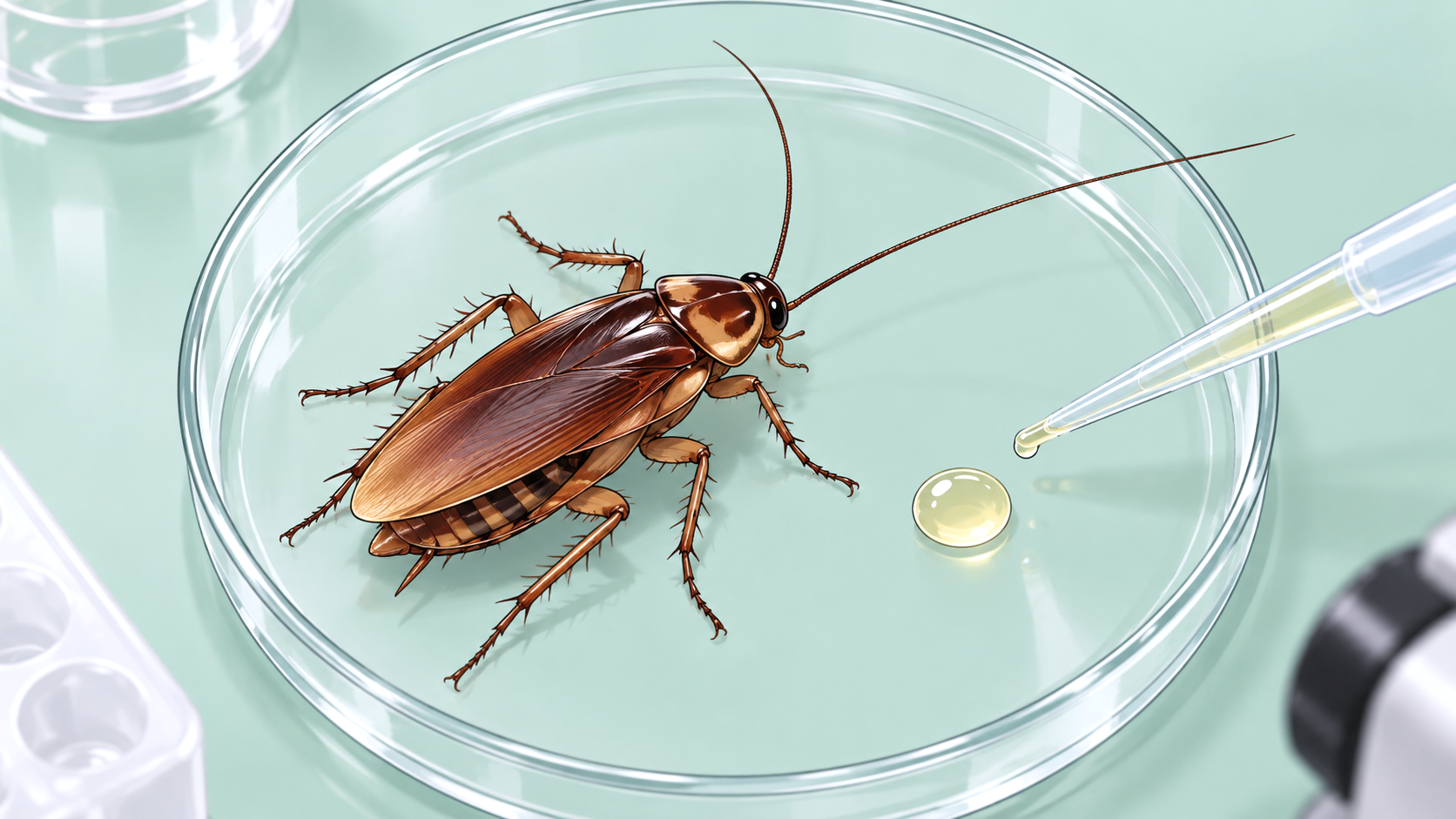
Cockroaches have blood, but it is not red like human blood. Their circulating body fluid is called hemolymph, and it is usually clear, pale yellow, or faintly greenish. Hemolymph carries nutrients, hormones, metabolic wastes, and immune cells throughout the insect’s body. Unlike human blood, it does not normally contain red blood cells or use hemoglobin to transport oxygen.
Cockroaches also have a heart, although their circulation works differently from the closed system of arteries, veins, and capillaries found in humans. Their hemolymph moves through an open body cavity, bathing internal organs directly.
What Color Is Cockroach Blood?
Fresh cockroach hemolymph is generally pale rather than bright red. Depending on the species, its composition, and the conditions under which it is observed, it may appear nearly transparent, yellowish, or slightly green.
The absence of red blood cells explains why cockroach hemolymph does not have the characteristic red color of human blood. In people, most of that color comes from hemoglobin concentrated inside red blood cells. Cockroach hemolymph contains a different mixture of dissolved substances and circulating cells.
A scientific account in the Encyclopedia of Insects describes hemolymph as the circulating fluid of insects, emphasizing its lack of erythrocytes, or red blood cells, and its relatively high concentration of free amino acids.
The appearance can also change after hemolymph leaves the body. Oxidation, clotting, and reactions involving enzymes may darken a sample, so a brown or darkened residue does not necessarily reflect the fluid’s original color.
The different external colors of cockroaches provide no reliable indication of hemolymph color. A dark brown Oriental cockroach and a lighter German cockroach do not have correspondingly dark brown or tan blood.
How Cockroach Blood Circulates Without Veins
Human blood remains within a network of blood vessels, apart from exchange across microscopic vessel walls. Cockroaches use an open circulatory system, in which hemolymph moves through a body cavity called the hemocoel and directly surrounds internal tissues.
A muscular vessel running along the upper side of the insect is the principal pump. Its posterior portion functions as the heart, while the anterior portion acts as an aorta that helps direct hemolymph forward. Openings in the heart, called ostia, allow hemolymph to enter during the pumping cycle.
The Annual Review of Entomology examination of insect circulation describes this arrangement and explains that insects also possess accessory pumping structures that help move fluid through their appendages.
Open circulation does not mean that hemolymph is completely motionless between heartbeats or flows randomly throughout the body. Internal membranes, organs, and muscular movements help establish organized pathways. Fluid moves around tissues before returning toward the principal pumping vessel.
This system operates at a fundamentally different pressure and structural arrangement from mammalian blood circulation. Cockroaches do not have a vertebrate-style network of veins collecting blood from every organ, but they still maintain active fluid movement throughout the body.
What Is Actually Inside Cockroach Hemolymph?
Hemolymph is not simply water. Its liquid component contains dissolved substances essential for the insect’s normal physiology, while specialized cells circulate within it.
| Component | Principal role |
|---|---|
| Water and dissolved ions | Maintain fluid balance and suitable conditions around cells |
| Sugars and other nutrients | Distribute materials required for metabolism |
| Lipids and transport proteins | Move energy-rich substances between tissues |
| Hormones | Carry chemical signals involved in growth and reproduction |
| Metabolic wastes | Transport substances for processing or elimination |
| Hemocytes | Participate in immune defense and clot formation |
The composition changes with age, nutritional condition, reproductive activity, and other physiological demands. Hemolymph is a dynamic tissue rather than a fixed mixture.
For example, researchers isolated vitellogenin, an egg-yolk precursor protein, from the hemolymph of female American cockroaches. Their 1992 biochemical study demonstrated how the circulating fluid transports reproductive materials.
Another study found that American cockroach females produce vitellogenin in the fat body before the protein appears in their hemolymph and is incorporated into developing eggs.
This illustrates a central function of insect circulation: materials produced in one tissue can be delivered to another without being transported through a vertebrate-style vascular network.
Does Cockroach Blood Carry Oxygen?
In adult household cockroaches, hemolymph is not the principal oxygen-delivery system. Oxygen reaches most tissues through air-filled respiratory tubes rather than being transported throughout the body by a blood pigment.
This differs from humans, whose red blood cells contain hemoglobin, and from many crustaceans, whose hemolymph contains the copper-based oxygen carrier hemocyanin.
There is an interesting exception during cockroach development. Researchers investigating the dubia cockroach (Blaptica dubia) discovered that hemocyanin is produced primarily during late embryonic development. The protein was also detectable in newly emerged nymphs but not in later developmental stages.
Their study published in the Journal of Insect Physiology suggested that hemocyanin may help supply oxygen to embryos developing within the egg case.
A broader review of respiratory proteins across insects and crustaceans found similar developmental patterns in cockroaches and grasshoppers, with adult oxygen delivery relying on the tracheal system.
The presence of hemocyanin during embryonic development does not mean adult cockroaches ordinarily have blue blood. The evolutionary relationship between cockroaches and crustaceans helps explain why related respiratory proteins occur in these animals despite their different adult physiologies.
The mechanism by which cockroaches breathe operates largely independently of hemolymph circulation, although both systems contribute to maintaining normal cellular conditions.
How Cockroach Blood Protects Against Infection
Cockroach hemolymph contains immune cells called hemocytes. These cells recognize and respond to foreign materials, participate in clotting, and help contain microorganisms.
Some hemocytes can engulf foreign particles through phagocytosis, a process also performed by certain human immune cells. Other defense mechanisms involve proteins dissolved in the hemolymph.
A 2025 study published in Developmental & Comparative Immunology identified functionally distinct hemocyte populations in American cockroaches. Researchers found evidence of particle engulfment and production of reactive oxygen species in different immune-cell populations.
Cockroach hemolymph also contains proteins involved in recognizing foreign material. A 2017 study of American cockroach hemolymph isolated a lectin with phenoloxidase activity, supporting the role of circulating proteins in insect immune defenses.
These mechanisms form part of the insect’s innate immune system. They provide protection against microorganisms but do not make cockroaches immune to infections or environmental injury.
Can Cockroach Blood Clot?
Yes. Cockroach hemolymph can coagulate in response to tissue damage.
Insect clotting differs chemically from the clotting system of vertebrate blood, but it serves some comparable functions. A clot helps restrict fluid loss and may prevent foreign particles or microorganisms from spreading through the body cavity.
Experiments involving American cockroaches found that clotting influenced the distribution of foreign particles and localized immune activity near damaged tissue. The findings were published in Developmental & Comparative Immunology as part of a study of the functional consequences of insect hemolymph coagulation.
Clot formation involves interactions among circulating cells and dissolved proteins. Enzymes associated with the phenoloxidase system can also participate in immune reactions and the darkening of damaged tissue.
Cockroaches use hemolymph pressure for functions beyond circulation and immunity. During cockroach molting, internal fluid pressure helps the insect expand its body and separate from its old exoskeleton. The fluid also contributes to the expansion of newly exposed tissues before the replacement cuticle hardens.
Hemolymph is therefore essential to normal growth and physiological function, even though its composition and circulation differ considerably from those of human blood.