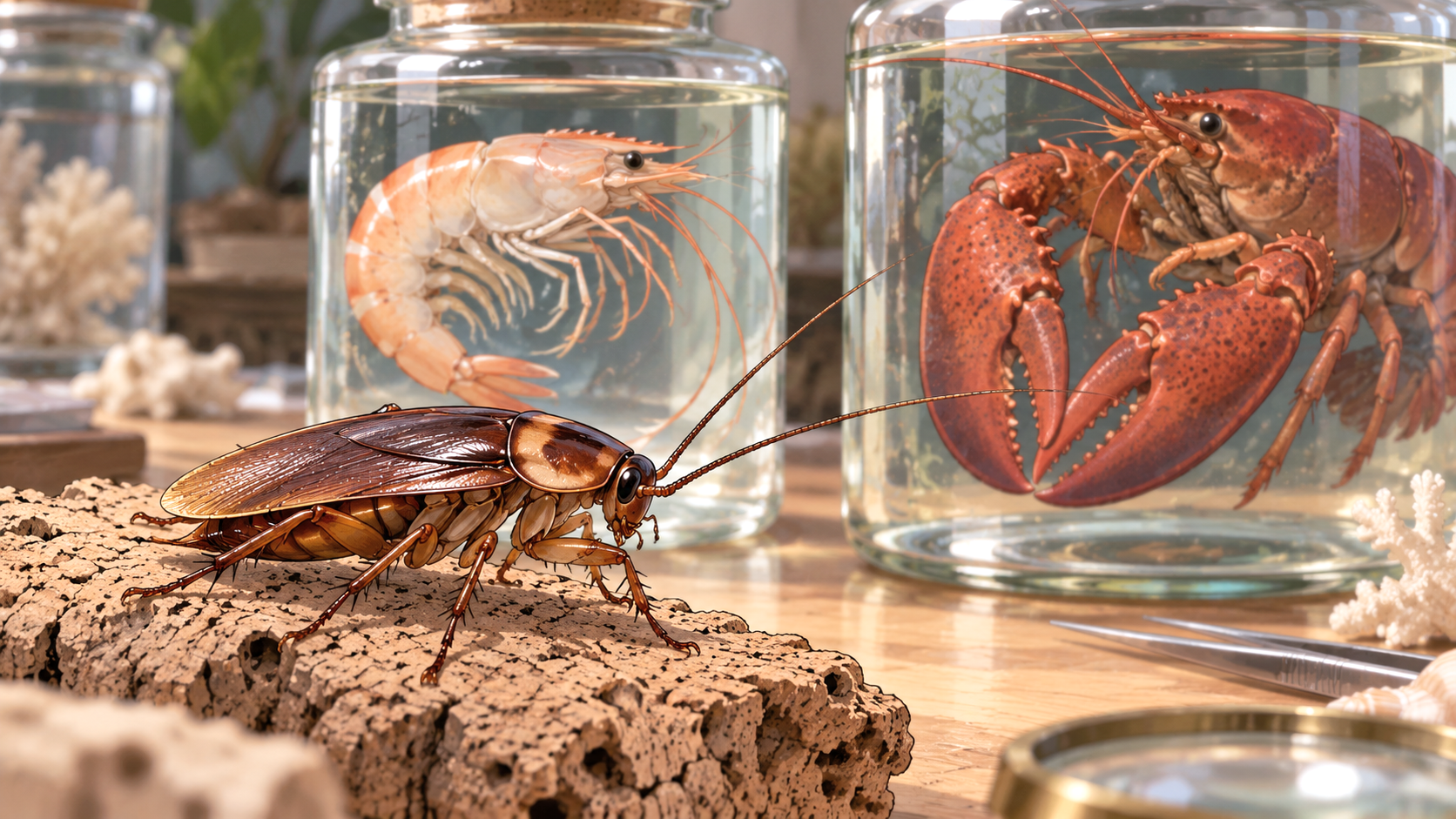
Cockroaches are evolutionarily related to shrimp, lobsters, crabs, and other crustaceans. Although cockroaches are insects and shrimp and lobsters are traditionally classified as crustaceans, genetic research shows that insects evolved within the broader crustacean evolutionary lineage. Scientists call this larger group Pancrustacea.
The relationship is much more substantial than a resemblance between hard shells and jointed legs. Cockroaches and marine crustaceans inherited characteristics from ancient common ancestors, but their lineages subsequently evolved different body structures, respiratory systems, and lifestyles. A cockroach is not a miniature lobster, and modern shrimp did not evolve from cockroaches.
How Closely Related Are Cockroaches to Shrimp and Lobsters?
Cockroaches, shrimp, and lobsters all belong to Arthropoda, the animal group characterized by segmented bodies, jointed appendages, and external skeletons.
However, shrimp and lobsters are not simply distant relatives connected to cockroaches through the arthropod family tree. Modern evolutionary studies place insects within the same major lineage as crustaceans.
A landmark study published in Nature analyzed protein-coding genes from 75 arthropod species and found strong support for Pancrustacea as an evolutionary group containing insects and crustaceans.
The relationship can be represented through several nested groups:
| Group | Cockroaches | Shrimp and lobsters |
|---|---|---|
| Arthropoda | Yes | Yes |
| Pancrustacea | Yes | Yes |
| Hexapoda | Yes | No |
| Insecta | Yes | No |
| Malacostraca | No | Yes |
| Decapoda | No | Yes |
Pancrustacea represents shared evolutionary ancestry. Hexapoda contains insects and their closest six-legged relatives, while Malacostraca includes shrimp, lobsters, crabs, and numerous other crustaceans. Decapoda is the narrower group containing the familiar ten-legged shrimp, crabs, and lobsters.
The Smithsonian National Museum of Natural History likewise places insects and familiar crustaceans together within Pancrustacea.
Cockroaches are therefore related to shrimp and lobsters through a common lineage, although they occupy different branches within it.
Did Cockroaches Evolve From Shrimp?
No living shrimp species is the ancestor of modern cockroaches.
The evolutionary relationship goes much further back, to ancient arthropods from which different crustacean lineages and the ancestors of insects eventually descended.
Shrimp and lobsters continued evolving along their own branches. The ancestors of insects followed another evolutionary path, developing the characteristic six-legged body organization that eventually gave rise to cockroaches and other insects.
A 2013 study published in Nature Communications combined fossil and molecular evidence to investigate arthropod evolutionary relationships. The researchers placed hexapods within the crustacean lineage and found support for a particularly close relationship with remipedes.
Remipedes are unusual crustaceans that inhabit underwater cave systems. Their bodies are elongated and divided into numerous similar-looking segments, giving them an appearance quite unlike familiar shrimp or lobsters.
This result illustrates an important point: insects are not necessarily closest to the crustaceans most familiar to people.
The evolutionary relationship between insects and remipedes has subsequently received additional support from phylogenomic research, although the precise arrangement of some ancient crustacean branches remains an active scientific question.
Are Cockroaches Technically Crustaceans?
Under an evolutionary classification that includes an ancestor and all its descendants, insects fall within the broader crustacean lineage. In that sense, cockroaches can be described as highly modified terrestrial descendants of crustacean ancestors.
However, the word crustacean also has a traditional meaning that excludes insects. Under that conventional usage, cockroaches are insects rather than crustaceans.
Both descriptions can appear in scientific and educational material because they use different definitions.
A 2025 Smithsonian Magazine examination of insect origins explains why recent evolutionary research has encouraged scientists to describe insects as terrestrial members of the broader crustacean lineage.
The distinction concerns ancestry rather than present-day appearance. Cockroaches retain the anatomical characteristics of insects, including six legs and a body divided into a head, thorax, and abdomen. They do not possess the same body organization as shrimp or lobsters.
The term Pancrustacea avoids much of the ambiguity by explicitly including both traditional crustaceans and insects.
Why Do Cockroaches and Lobsters Have Similar Body Features?
Their shared ancestry is reflected in several fundamental anatomical characteristics.
Both possess an external skeleton composed primarily of chitin and associated proteins. This protective covering supports the body and provides attachment points for muscles.
Both also have jointed appendages and segmented bodies, although their appendages have undergone extensive evolutionary modification.
Cockroaches have three pairs of walking legs attached to the thorax. Lobsters possess five pairs of thoracic walking legs, with the first pair often modified into large claws. They also have specialized abdominal appendages that participate in swimming, reproduction, and other functions.
The resemblance extends to sensory systems. Many insects and crustaceans possess compound eyes made from repeated visual units called ommatidia. Research published in Evolution: Education and Outreach found that important aspects of compound-eye construction were inherited from ancient common ancestors.
However, these shared features should not be mistaken for identical anatomy.
Cockroaches generally breathe through a system of spiracles and internal tracheal tubes that deliver air to their tissues. Lobsters and most shrimp use gills to obtain oxygen from water.
Their appendages also differ in number, structure, and function. Similarities reflect common evolutionary foundations, while the differences reflect adaptation to distinct environments.
Why Cockroaches Are Not Closest to Lobsters
Among crustaceans, lobsters and shrimp belong to the decapod lineage. Insects occupy a different part of the pancrustacean evolutionary tree.
Scientists have investigated which living crustaceans are the closest relatives of Hexapoda, the group containing insects.
A phylogenomic study published in Current Biology analyzed hundreds of groups of corresponding genes and found support for Remipedia as the closest living sister group of hexapods.
The researchers also evaluated alternative hypotheses involving branchiopods and cephalocarids. Their results suggested that some earlier relationships arose from methodological problems in reconstructing evolutionary history.
The study of insect origins within Crustacea demonstrated that familiar decapods are not the closest living crustacean relatives of insects. This does not make shrimp and lobsters unrelated to cockroaches. They still share a common pancrustacean ancestry, but that ancestor existed before the evolutionary branches leading to modern decapods and insects became distinct.
Nor should modern remipedes be described as the ancestors of cockroaches. They are living relatives that descended from their own evolutionary branch.
Are Cockroaches More Closely Related to Shrimp Than to Spiders?
Yes. Modern evolutionary evidence places insects and crustaceans together in Pancrustacea, whereas spiders belong to a separate major arthropod lineage called Chelicerata.
Spiders, scorpions, ticks, and mites are members of the chelicerate branch. Centipedes and millipedes belong to Myriapoda.
Research published in Molecular Biology and Evolution found strong molecular support for a shared insect-crustacean lineage. This supports the conclusion that cockroaches are evolutionarily closer to shrimp and lobsters than to spiders.
The comparison also demonstrates why shared habitat is not a dependable indicator of evolutionary relationships.
Cockroaches and spiders commonly occupy terrestrial environments, while shrimp and lobsters are predominantly aquatic. Nevertheless, cockroaches share a more recent common ancestor with the crustacean lineage than with the spider lineage.
The differences between earwigs and cockroaches also illustrate how insects can belong to separate orders while remaining part of the broader hexapod lineage.
Evolutionary relationships cannot be established simply by comparing which animals live in similar places or move in similar ways.
Does Their Relationship Explain Cockroach and Shellfish Allergies?
The evolutionary relationship provides context for why cockroaches and shellfish can possess similar proteins, but ancestry alone does not establish that everyone allergic to one will react to the other.
One protein of particular interest is tropomyosin, which plays a role in muscle function across many animal groups.
Certain versions of tropomyosin act as allergens. Because related arthropods can possess structurally similar forms of the protein, antibodies directed against one allergen may recognize proteins from another organism.
A study published in the Journal of Allergy and Clinical Immunology identified American cockroach tropomyosin as a potential cross-reactive allergen. The researchers found substantial sequence similarity between cockroach tropomyosin and corresponding proteins from shrimp and dust mites.
More recent research published in Frontiers in Allergy examined cross-reactivity among cockroach, mite, and shellfish allergens. It emphasized that laboratory sensitization does not always correspond to a clinically significant food allergy.
Consequently, a positive allergy test involving cockroach proteins does not automatically establish a shellfish allergy. Similarly, a shrimp allergy does not mean that every encounter with a cockroach will cause an allergic reaction.
Clinical interpretation depends on individual symptoms, exposure history, and appropriate testing.
The relationship between these allergens is a specific biochemical connection, not evidence that cockroaches and shrimp have identical health effects.
Does Being Related Mean Cockroaches Can Survive Underwater?
Shared evolutionary ancestry does not mean that modern cockroaches retain the aquatic adaptations of shrimp and lobsters.
Most familiar household cockroaches are terrestrial insects that obtain oxygen through spiracles connected to a tracheal respiratory system. Their bodies are not equipped with the functional gills used by lobsters and many shrimp.
Some insects have independently evolved adaptations for aquatic environments, but household cockroaches are not aquatic crustaceans in the ordinary ecological sense.
The Smithsonian’s discussion of insect and crustacean evolution explains how insect ancestors became adapted to terrestrial life while other crustacean lineages remained predominantly aquatic.
An evolutionary connection therefore does not establish that a cockroach can breathe underwater, use lobster-like gills, or live permanently in submerged environments.
Its capacity to tolerate temporary immersion is a separate physiological question from its ancestry.
Are Lobsters and Shrimp Basically Sea Cockroaches?
Calling shrimp or lobsters sea cockroaches is an informal comparison rather than a scientific designation.
The nickname probably persists because all three animals have jointed limbs, protective external skeletons, and behaviors associated with searching for food in their environments. Some shrimp and lobster species are scavengers, as are many cockroaches, but feeding habits vary widely within each group.
Lobsters are decapod crustaceans, while cockroaches are insects. Their evolutionary connection is real, yet the name sea cockroach does not identify a taxonomic group.
The same caution applies to claims that lobsters are simply oversized marine insects. The Smithsonian’s scientific classification of pancrustaceans recognizes their shared ancestry without treating modern decapods as members of Insecta.
The comparison is useful as a reminder that apparently different animals can share deep evolutionary roots. It becomes misleading when used to imply identical anatomy, behavior, or biological characteristics.