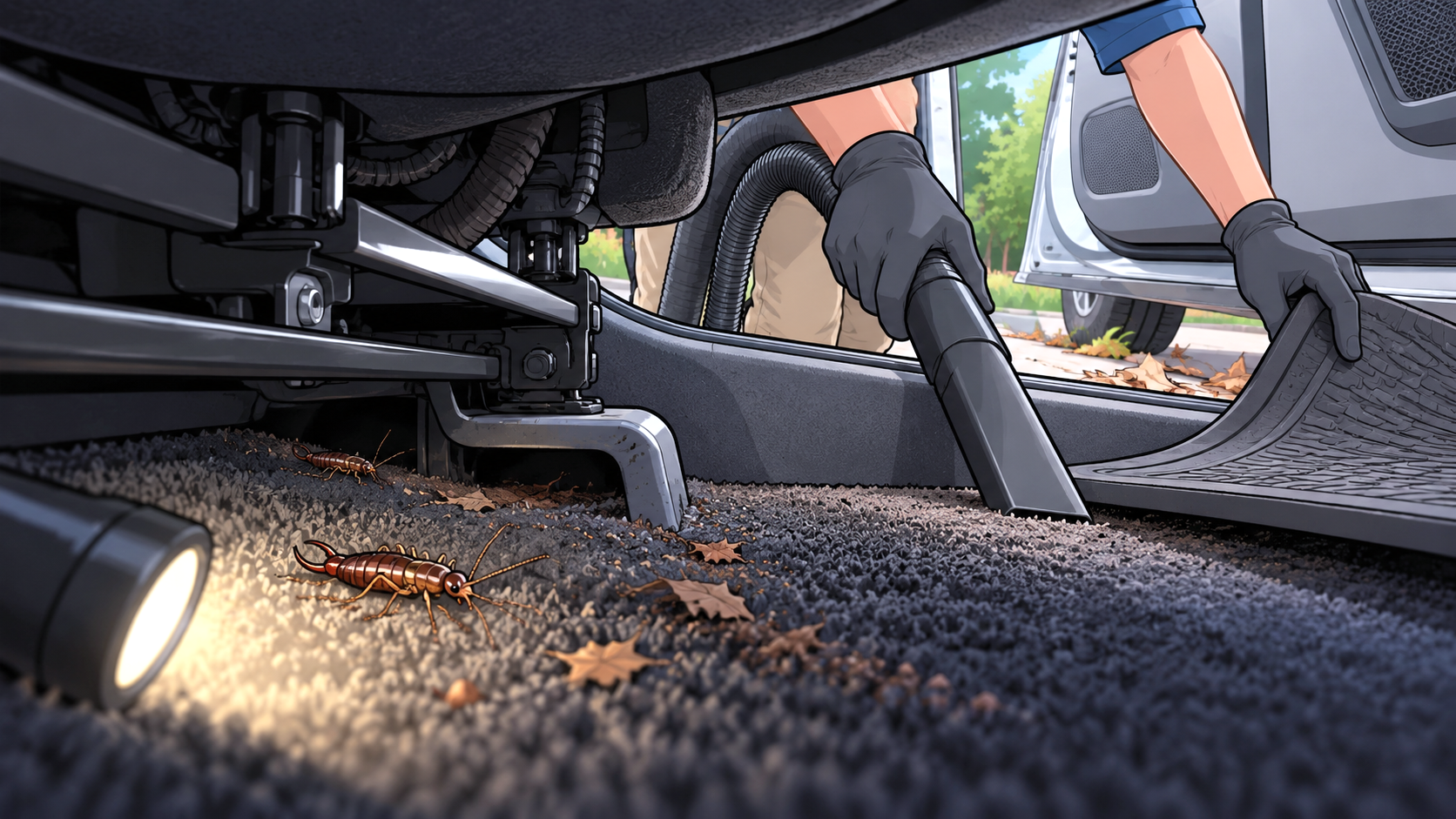
An earwig appearing on the dashboard can make the entire car feel infested, especially when another one turns up under a floor mat a few days later. Before reaching for an insecticide, though, it helps to think about what makes a car different from a house. Earwigs can hide in tight, dark spaces during the day, but they do not need to be breeding inside the vehicle for several of them to appear there.
Getting rid of earwigs in the car starts with removing the insects and everything that can conceal them. Vacuum the interior thoroughly, empty the trunk and storage compartments, inspect objects that have recently been carried in the vehicle, and correct any persistent dampness. When earwigs keep returning, investigate where the car is parked and what contacts the vehicle rather than repeatedly treating the cabin.
Empty the Car Before You Try to Treat It
The first useful move is surprisingly ordinary. Take things out.
Remove loose bags, reusable grocery totes, cardboard boxes, blankets, sports equipment, gardening supplies and anything else that has been sitting on the floor or in the trunk. Lift the floor mats as well. Earwigs are nocturnal and seek dark, confined places during daylight, so an object that has remained undisturbed can provide exactly the kind of temporary shelter they use.
Inspect each removable item outside the vehicle before putting it back. Pay particular attention to objects that previously sat outdoors, in a garage, shed, basement or garden. An earwig hidden inside a folded tarp or beneath a cardboard box can be transported into the car without ever entering through the vehicle itself.
This is why we would empty the car before doing anything more aggressive. Otherwise, you can vacuum the seats perfectly while leaving the actual hiding place untouched in the trunk.
Vacuum Where an Earwig Can Disappear
Once the loose items are out, vacuum the interior systematically rather than only cleaning the visible carpet. Start with the floor and work into the seams around the seats. Move the front seats forward and backward so you can reach the areas underneath them. Vacuum around seat rails, beneath removable mats and along the edges where carpeting meets interior trim.
The trunk deserves the same treatment. Lift the removable cargo floor if your vehicle has one and inspect the accessible storage area underneath. Check the spare-tire compartment or other manufacturer-designed storage spaces that can be opened normally. There is no reason to start dismantling fixed interior panels to chase a nuisance insect.
Physical removal is a standard response to earwigs that wander indoors. They can be swept or vacuumed rather than treated with an indoor pesticide, and the same basic principle makes sense inside a vehicle. Vacuuming also gives you something spraying does not. It removes insects immediately while cleaning out the material around which they might be hiding.
The Stuff You Carry May Explain How Earwigs Reached the Car
A recurring car problem can sometimes travel with the cargo.
Think about what entered the vehicle shortly before the first earwig appeared. Garden tools, nursery plants, bags of soil or mulch, outdoor furniture accessories, camping equipment, damp sports gear and boxes stored on a garage floor all deserve inspection when they fit your situation. The point is not that every one of these objects attracts earwigs. Rather, an item kept in a suitable outdoor hiding place can accidentally carry one into the vehicle.
Earwigs primarily disperse by crawling, and they commonly shelter in protected spaces during daylight. Corrugated cardboard is suitable enough as a refuge that rolled cardboard is deliberately used to trap and monitor earwigs. A cardboard box that spent the night beside vegetation and then went straight into your trunk is therefore more interesting than the dashboard where you eventually noticed the insect.
Once you identify a plausible carrier, inspect and clean it before it goes back into the car. For plants specifically, our guide to earwigs in potted plants covers the problem at its source.
Check for Damp Areas Inside the Vehicle
A dry car interior offers earwigs less of the cool, moist refuge they normally seek. Therefore, repeated sightings alongside persistent interior dampness deserve attention.
Feel the carpeting and floor mats rather than relying only on appearance. A soaked mat from rain or snow can remain damp underneath after its upper surface feels better. Spilled drinks and water entering through a vehicle defect can also leave moisture where you cannot immediately see it. Remove wet removable mats and dry them properly before returning them to the vehicle.
Persistent unexplained water inside a car is a vehicle-maintenance problem as well as a pest consideration. If carpeting repeatedly becomes wet without an obvious spill, identify and repair the source rather than trying to compensate with pest products.
Moisture alone does not prove why an earwig entered. However, because earwigs characteristically use dark, tight and moist places as daytime refuges, eliminating an avoidably damp hiding place makes the vehicle less suitable once one gets inside.
When Earwigs Return, Inspect the Parking Spot
This is where a car-specific earwig problem becomes more interesting.
Earwigs primarily move by crawling. Consequently, a vehicle that repeatedly sits beside a large outdoor population has more opportunities for accidental encounters than one that only carried a single hidden insect home in a box. Look at the exact environment where the car spends long periods, particularly overnight.
Dense groundcover, accumulated leaves, boards, plant debris and other protected materials can provide earwig shelter outdoors. Excess moisture also favors the conditions they use. Established earwig-management guidance recommends reducing hiding places and unnecessary moisture where populations are causing problems.
The practical experiment is simple. After cleaning the car, park somewhere different for several nights when that is realistically possible. If sightings stop, the usual parking environment deserves closer inspection. That does not prove exactly where every earwig entered the vehicle, but it gives you a much better lead than spraying the cabin again.
This is especially useful when a car normally sits next to an irrigated garden bed, dense vegetation or accumulated organic debris. Addressing the surrounding earwig population may do more than anything you can apply to the upholstery. Our broader guide to what attracts earwigs explains why certain outdoor conditions support larger numbers.
Do Not Assume Earwigs Are Reproducing Somewhere in the Dashboard
Seeing several earwigs over a short period naturally raises the question of whether they have established themselves somewhere deep inside the car. That should not be the starting assumption.
European earwigs that enter buildings do not reproduce indoors. Their normal reproductive cycle is tied to protected nests in soil rather than an indoor population spreading through rooms. A vehicle is therefore better approached initially as a place earwigs entered or were transported into, not as the equivalent of a cockroach breeding site.
That changes how we interpret repeat sightings. Five earwigs found over several days could represent multiple insects that arrived together inside an object, several separate entries from the parking environment, or insects that were already concealed and emerged at different times.
For that reason, the useful question is not “Where is the nest in my dashboard?” It is “What keeps introducing earwigs into this car?”
Skip the Bug Bomb
A confined vehicle may seem like the perfect place to release a fogger and shut the doors. It is not a treatment we would improvise.
Pesticide labels specify where and how a product can legally be used. A product labeled for particular indoor residential sites is not automatically labeled for passenger compartments in vehicles. Applying a pesticide somewhere the label does not permit is not an acceptable shortcut.
More importantly, an earwig problem in a car often gives you several nonchemical avenues before pesticide use even becomes relevant. Emptying the vehicle, vacuuming accessible hiding areas, drying wet materials, inspecting transported objects and investigating the parking environment all target plausible routes without adding pesticide residues to a small space where people spend time.
We would apply the same caution to household remedies. A car interior is full of upholstery, plastics, electronics and finished surfaces. Turning it into a test site for bleach, vinegar, essential oils or other mixtures can create a second problem without explaining how the earwigs arrived.
Use Repeat Sightings to Narrow the Source
After the first thorough cleanout, resist the urge to keep changing tactics every day. Give the clean car a chance to tell you whether the source is gone.
A single new earwig soon after cleaning could have escaped the vacuum in an inaccessible crevice. Continued sightings over a longer period are more useful because they tell you that something may still be introducing insects. At that stage, compare where the car has been parked and what has recently been loaded into it.
You can also pay attention to where the insects appear. Several discoveries associated with one removable item make that object worth inspecting again. Sightings that resume only after the car returns to its normal parking location point the investigation in a different direction.
For a larger earwig problem around the property, outdoor trapping can help reduce numbers. Refuge traps made from rolled cardboard or newspaper exploit the places earwigs seek during the day, while oil-based traps can capture them in areas where they are active. Our DIY earwig trap guide covers those methods without turning the car itself into the trapping area.
Know When the Car Is Actually Clear
You do not need to keep treating a vehicle merely because an earwig was once found inside it.
After removing clutter, vacuuming thoroughly and correcting any dampness, continue using the car normally and watch for additional activity. When no more earwigs appear, there is little value in continuing to apply control measures to an already-clean vehicle.
Persistent sightings call for another source check rather than automatically escalating to chemicals. Reinspect transported items and reconsider the parking environment. If the vehicle is parked at home and earwigs are also appearing around the house, garage or garden, you may be dealing with a broader outdoor population rather than a problem confined to the car. The signs of an earwig infestation can help distinguish an isolated encounter from a recurring property-wide pattern.
That is ultimately the advantage of treating a car problem as an introduction problem. Once you stop whatever is bringing the earwigs in, there is no indoor colony that needs to be eradicated from the vehicle.
Other Questions About Getting Earwigs Out of a Car
Can earwigs damage a car?
Earwigs are nuisance insects rather than pests that feed on buildings or household property. Finding one inside the vehicle is unpleasant, but its presence does not mean it is eating the upholstery or damaging the car’s structure.
Can an earwig hide in a car overnight?
Yes. Earwigs seek protected, dark spaces during daylight and can remain concealed in suitable crevices or beneath objects. An insect that entered earlier may therefore become noticeable well after the actual entry occurred.
Could earwigs get into a parked car from the ground?
Earwigs primarily disperse by crawling, so accidental entry from the environment around a parked vehicle is possible. However, finding an earwig inside does not reveal the exact route it used. Transported objects are another possible route and should be considered before blaming the parking spot alone.
Why do earwigs keep appearing after I vacuum the car?
Repeated appearances can mean some insects escaped the initial cleaning, an infested or sheltered object remains inside, or new earwigs continue entering. Instead of simply vacuuming the same visible areas again, compare when and where the new insects appear and use that pattern to investigate the source.
Should I call an exterminator for earwigs in my car?
An isolated vehicle sighting normally lends itself to physical removal and source investigation. If earwigs are appearing throughout the surrounding property in substantial numbers, the broader population may be the issue. Our guide to when an earwig exterminator makes sense covers that decision separately.