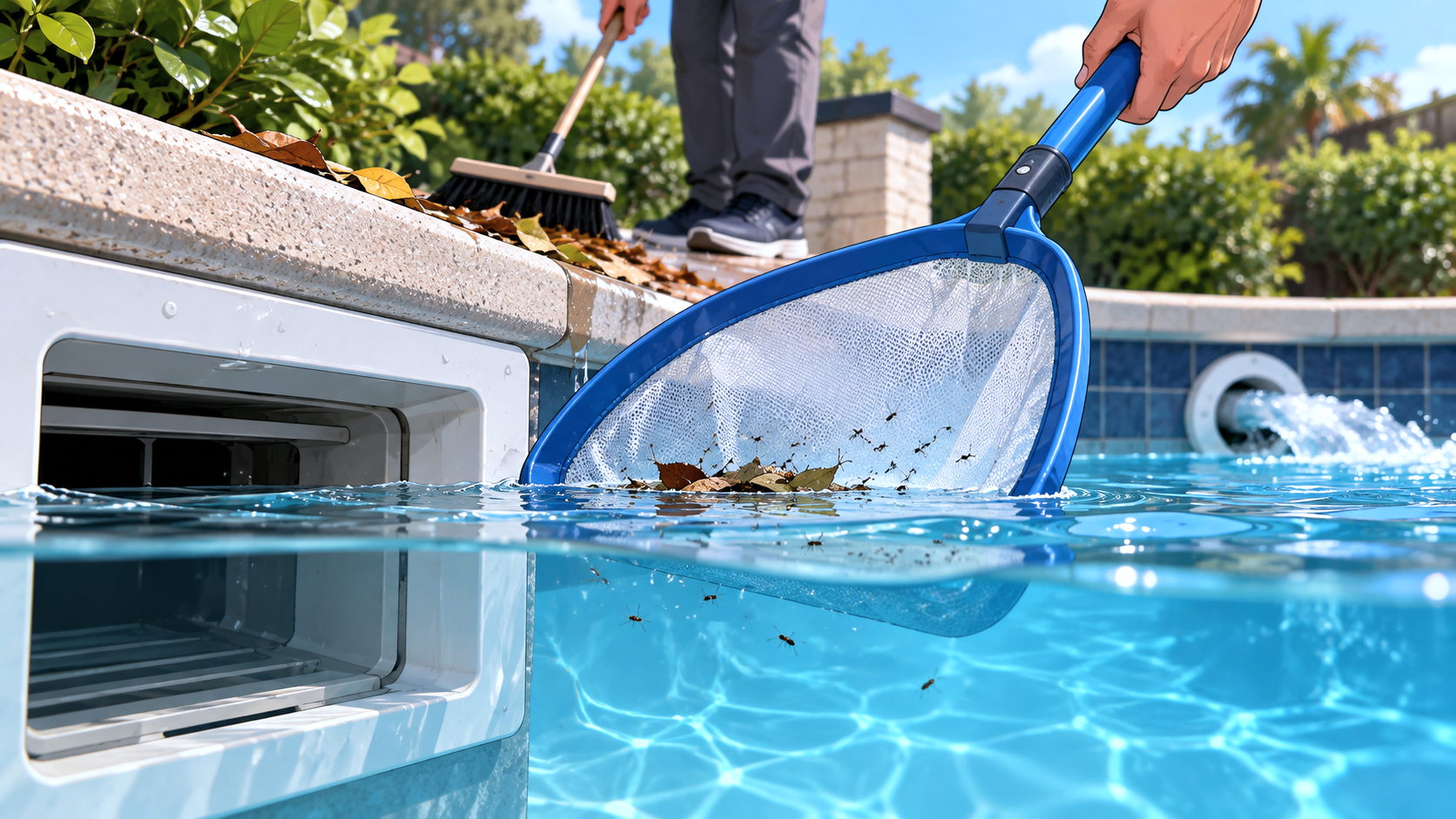
A pool covered with tiny jumping specks can look as though something has started breeding in the water. With springtails, the more useful place to investigate is usually the landscaping around the pool. They normally develop in moist soil and organic material, then end up on the water surface after moving from nearby habitat.
To get rid of springtails in a pool, skim the insects from the surface and let the pool’s normal filtration remove the rest. Then reduce the damp habitat feeding the problem around the pool, especially lush vegetation, excessive mulch, wet leaves, and persistently moist soil. Treating the pool water with insecticide is unnecessary.
Skim Springtails Off the Pool Surface First
For springtails already floating in the water, a pool skimmer is the simplest response. Normal pool filtration also removes them, so there is no need to turn a nuisance-pest problem into a complicated pool treatment. Springtails that collect in swimming pools can be removed by filtration or manually with a skimmer.
This is one case where physical removal really is enough for the insects already in the water. Springtails may accumulate in large numbers and can even coat parts of the surface, but they do not bite people or pets. The unpleasant-looking layer of insects is therefore a nuisance rather than evidence that the pool has become unsafe because of springtails.
We would resist the temptation to make the water itself the focus of the investigation. Once you have skimmed the pool, walk around its perimeter instead. That is where the recurring problem usually becomes easier to understand.
Springtails in a Pool Usually Come From Nearby Damp Habitat
Springtails thrive where moisture and organic material occur together. Outdoors, they are commonly found in soil, leaf litter, compost, mulch, beneath decaying wood, and other damp environments. They feed largely on fungi, algae, bacteria, and decaying plant material.
A swimming pool can sit right beside several of those habitats. Dense planting beds, irrigated turf, layers of mulch, accumulated leaves, and permanently damp soil can support large populations only a short distance from the water. In fact, springtails are specifically documented around swimming pools and on sidewalks bordering pools.
That makes a perimeter inspection far more useful than repeatedly skimming without asking where the insects are coming from. Our guide to springtails outside the house covers their normal outdoor habitat in greater detail.
Reduce Mulch and Dense Vegetation Right Beside the Pool
When springtails repeatedly cover the water, start with the landscaping closest to the pool edge. Limiting lush vegetation and mulch immediately around a swimming pool can reduce recurring springtail problems.
That does not mean stripping the entire yard bare. Instead, look for areas where dense vegetation and organic material remain consistently wet. Excess mulch is especially worth examining because large numbers of springtails can inhabit it. Wet leaves and other decaying plant material can create similarly favorable conditions.
We would concentrate first on the side of the pool where springtails appear most heavily. If that edge borders a damp planting bed while the opposite side borders dry paving, the difference gives you a useful lead. Remove excessive organic debris and avoid maintaining unnecessarily wet habitat immediately beside the water.
This is the same underlying issue discussed in our guide to what attracts springtails, although a pool adds the complication of a large water surface that makes migrating springtails especially noticeable.
Check How Much Water the Landscaping Is Getting
Springtail control around a pool can become oddly self-defeating when the surrounding landscape is watered heavily every day. Reducing excessive irrigation and allowing soil to dry somewhat between waterings can make outdoor habitat less favorable to large springtail populations.
Inspect sprinkler coverage and other irrigation near the affected area. You are looking for persistently saturated ground rather than ordinary plant watering. Poor drainage or low spots that remain wet also deserve attention because moisture is fundamental to springtail survival.
The goal is not to dry landscaping until plants suffer. It is to correct unnecessary wetness. Our broader guide to getting rid of springtails outside is the better place for dealing with a yard-wide population rather than springtails limited to the pool perimeter.
Do Not Assume the Springtails Are Breeding in the Pool
Seeing hundreds of tiny organisms on water naturally makes the pool look like the source. Springtails complicate that assumption because some can remain on the surface of water, and large groups have been observed forming floating masses.
Their normal developmental habitat, however, is associated with moisture and organic matter rather than maintained swimming-pool water. Springtails commonly develop in soil and similar damp terrestrial environments. They can then migrate when conditions change.
That difference saves a lot of wasted effort. Repeatedly attacking the insects after they reach the pool deals with the endpoint. Finding the damp bed, mulch layer, or irrigated soil supplying them deals with the recurring population.
If the identification itself is uncertain, check what springtails look like before changing anything around the pool. Their characteristic jumping behavior can also help, and our guide to how springtails jump explains the movement in more detail.
A Sudden Pool Invasion Can Follow Changing Weather
Not every large appearance means the landscaping has been poorly maintained. Springtail populations can become extremely abundant in moist soil, and changing environmental conditions can trigger mass movement. Soil drying and overcrowding can induce migration, while prolonged wet conditions can also contribute to nuisance populations.
A pool then becomes an obvious collection point. Thousands of tiny springtails spread through the surrounding landscape are difficult to notice. The same insects concentrated on a smooth water surface suddenly look like a major infestation.
This is why one dramatic appearance and a recurring daily problem deserve slightly different responses. Skimming may be all that is needed after a temporary migration. Repeated accumulation points toward nearby habitat that deserves closer inspection.
Keep Insecticides Out of the Pool
Adding an insecticide to swimming-pool water is not an appropriate springtail-control method. The pool already has two effective ways to remove the insects that reach it: filtration and manual skimming. Meanwhile, pesticide sprays are generally unnecessary for springtail management and do not provide lasting control when favorable habitat remains.
Pool chemicals should not be improvised as pest-control products either. Products used to maintain pool water have their own intended purposes and safety instructions. Pool chemicals should remain in their original containers and be handled according to their directions, and different pool chemicals should never be mixed together.
The practical divide is simple. Manage the pool as a pool, and manage the springtail habitat around it as a pest problem. Mixing those two jobs creates unnecessary chemical risk without addressing why springtails keep reaching the water.
Our general springtail control guide covers the wider control strategy when they are appearing in several parts of the property.
What to Do When Springtails Return Every Day
When another layer of springtails appears shortly after skimming, stop treating each batch as a separate event. Walk the entire pool perimeter and compare conditions from one side to another. Check where mulch is deepest, where leaves collect, where vegetation is densest, and where irrigation or drainage keeps the soil wet.
Then make the smallest useful changes first. Remove accumulated organic debris, reduce excessive mulch near the pool edge, and correct unnecessary irrigation or persistent wetness. Keep using the skimmer and normal filtration while those changes reduce the nearby population.
A recurring pool problem can also reveal a larger outdoor population. If springtails are simultaneously collecting along the house foundation, doors, or windows, use their distribution to widen the investigation. Our guide to how springtails get into a house explains how outdoor populations can become an indoor nuisance when they migrate.
Other Questions About Springtails in Swimming Pools
Can springtails walk on pool water?
Springtails can occur on the surface of water, sometimes gathering in conspicuous floating masses. Their presence on top of the water is therefore consistent with springtail behavior and does not by itself mean another aquatic pest has been mistaken for them.
Can springtails come back after the pool has been skimmed?
Yes. Skimming removes the springtails currently on the water but does not remove populations living in nearby moist landscaping. New individuals can reach the pool afterward, which is why recurring problems call for attention to the surrounding vegetation, mulch, soil moisture, and organic debris.
Why are springtails gathering on the concrete around my pool?
Springtails can occur on sidewalks bordering swimming pools as well as in nearby moist landscaped areas. Finding them on the deck can therefore be part of the same outdoor population that is ending up in the water.
Are springtails around a pool likely to get inside the house too?
Outdoor springtails can migrate toward buildings when their habitat becomes unfavorable, particularly as moist habitat dries. Because they are tiny, they can enter through openings around doors, windows, screens, and other gaps. A large population between the pool and the house is therefore worth addressing before indoor sightings become part of the problem.
Break the Cycle Around the Pool, Not in the Water
After skimming the pool, watch where the next springtails appear instead of immediately reaching for another treatment. A concentration beside one mulched bed, irrigated border, or damp patch gives you something actionable.
Reduce the favorable habitat there and continue normal filtration while you monitor the water. If numbers fall, you have found a meaningful source area. If they keep returning from several directions, expand the inspection into the surrounding yard rather than adding chemicals to the pool.