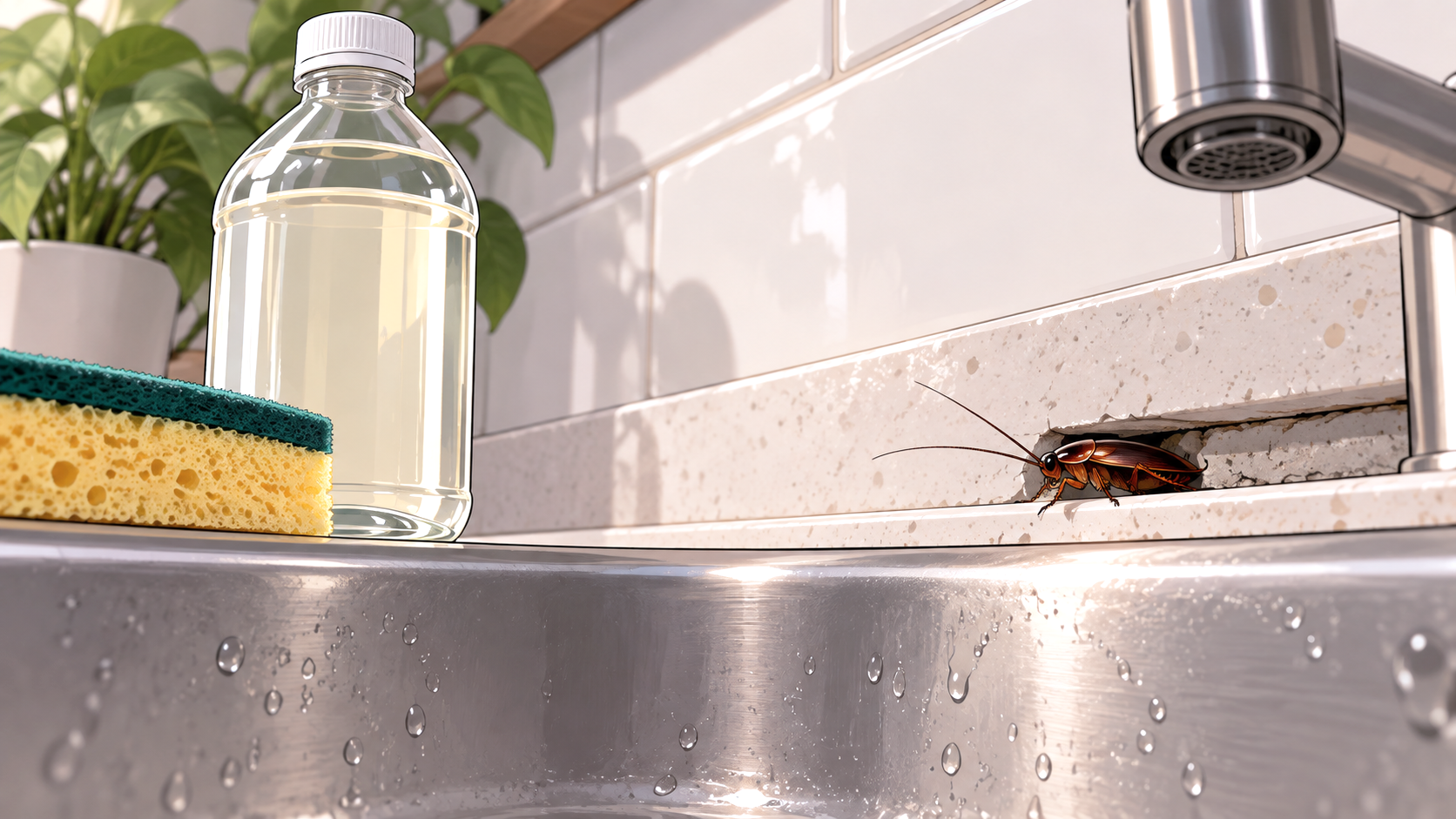
Vinegar appears in countless homemade pest-control recipes because it is inexpensive, strongly scented, and acidic. None of those qualities establishes ordinary kitchen vinegar as an effective cockroach treatment. Household vinegar is mostly water with a relatively low concentration of acetic acid, and there is little reason to expect wiping or spraying it around a room to eliminate an established population.
Ordinary household vinegar is not a reliable way to kill cockroaches or eliminate an infestation. Vinegar typically contains about 4% to 6% acetic acid, and authoritative pest-control guidance does not support using household vinegar as a cockroach insecticide. It can still be useful for ordinary cleaning on compatible surfaces, but cleaning and cockroach control are different jobs.
Household Vinegar and Concentrated Acetic Acid Should Not Be Confused
The word vinegar can describe products with substantially different strengths. Common household vinegar generally contains around 4% to 6% acetic acid, diluted in water. Much stronger acetic-acid products exist for purposes such as vegetation control, with some formulations containing 20% acetic acid or more. Those concentrated products can cause severe skin and eye injuries and should never be treated as stronger versions of a kitchen cockroach remedy.
Acetic acid does have pesticidal uses. That fact sometimes gets turned into the broader claim that household vinegar must therefore work as an insecticide. Pesticide performance depends on concentration, formulation, target organism, exposure, and the use for which a product has actually been evaluated. In the United States, vinegar up to 8% acetic acid can serve as an inert ingredient in certain minimum-risk pesticides, but vinegar is not permitted as a minimum-risk active pesticidal ingredient. A registered acetic-acid pesticide intended for a particular pest should therefore not be treated as evidence that grocery-store vinegar will control cockroaches.
Spraying Vinegar Around the Kitchen Does Not Reach an Infestation
Cockroaches spend much of their time inside protected harborages rather than exposed on counters and floors. A liquid sprayed along a baseboard does not automatically penetrate the cabinet void, appliance cavity, wall space, or narrow crevice containing the insects. Even direct contact with a cockroach would say little about the rest of the population unless the treatment reliably affected insects beyond the one that happened to be visible.
An infestation can include adults, nymphs and concealed evidence of reproduction, so successful control has to work at the population level. Vinegar also leaves no useful residual insecticidal barrier after the dilute acetic acid dissipates. Its strong smell may make a freshly sprayed surface seem hostile, but odor alone is not evidence of lasting repellency or control.
A cockroach running across a countertop is better removed mechanically than chased around the room with vinegar. Repeated sightings require methods capable of reaching the places the insects actually occupy. Monitoring, sanitation, moisture correction, targeted treatments, and follow-up all have defined roles in getting rid of an established cockroach population.
Cleaning With Vinegar Can Still Remove Things Cockroaches Use
Using vinegar as a cleaner is different from expecting it to function as an insecticide. Dilute acetic acid is commonly used in household surface and glass-cleaning applications, provided the surface is compatible with acidic cleaners. Wiping away food residue can indirectly make an area less favorable to cockroaches because these insects consume crumbs, grease and many other organic materials.
The useful action there is removal of the residue. Soap, detergent, another suitable cleaner, or physical scrubbing may accomplish the same sanitation goal without any need to attribute special cockroach-killing properties to vinegar. Vinegar can also damage certain stone, finishes, grout, metals, and appliance components, so a manufacturer’s cleaning instructions should take priority over a homemade pest recipe.
Cleaning alone will not correct leaking pipes, condensation, or other moisture sources. Because water availability can support cockroach survival, fixing a leak beneath the sink usually contributes more to cockroach management than repeatedly spraying that cabinet with vinegar.
Vinegar Is Not a Reliable Treatment for Cockroach Eggs
A homemade vinegar spray should not be expected to eliminate concealed cockroach egg cases. Oothecae may be hidden in cracks, furniture, appliances, and other protected locations that a surface cleaner never reaches. Some species also carry their egg cases for much of their development, further reducing the usefulness of treating random household surfaces.
Continued appearance of small cockroach nymphs is more informative than whether a room has recently been cleaned with vinegar. Nymphs indicate that young cockroaches are present and that the infestation needs effective control rather than additional applications of a household cleaner.
Never Combine Vinegar With Bleach
Vinegar is acidic. Chlorine bleach should never be mixed with acids because the combination can release chlorine gas. Household chemical safety guidance specifically warns against mixing bleach with vinegar or other acidic cleaners, and chlorine exposure can injure the eyes and respiratory tract and cause coughing, chest tightness, breathing difficulty, and more severe effects at higher exposures.
This risk is particularly relevant to homemade cockroach advice because someone may try several remedies in the same sink, drain, cabinet, or bathroom without considering what was applied first. If bleach has been used, do not follow it with vinegar in an attempt to make the treatment stronger. Dangerous chlorine gas can be released when household bleach encounters incompatible cleaning chemicals.
Concentrated acetic-acid products introduce additional hazards of their own. Higher concentrations can be corrosive to skin and severely damaging to eyes, while vapors can irritate the respiratory tract. Increasing the concentration therefore does not turn an unsupported household remedy into a sensible DIY cockroach treatment.
Where Vinegar Fits in a Low-Pesticide Approach
Someone trying to minimize pesticide use has better options than converting vinegar into an improvised insecticide. Vacuuming accessible cockroaches and debris, using sticky monitors, removing food residues, correcting moisture, reducing clutter, and maintaining physical barriers can all contribute to nonchemical cockroach management. These methods address measurable parts of the infestation rather than depending on the smell or acidity of a homemade spray.
Home-remedy recipes deserve particular skepticism when they provide no tested concentration, application method, exposure precautions, or evidence of performance. Homemade pesticides can lack directions needed to judge both effectiveness and risk. Vinegar’s familiarity in the kitchen does not answer any of those questions.
A Few Vinegar Questions Worth Settling
Does vinegar repel cockroaches?
There is not good evidence for treating household vinegar as a dependable cockroach repellent. A strong odor may affect an insect’s immediate movement without creating lasting protection, and driving cockroaches away from one exposed surface would not remove them from hidden harborages.
Can I pour vinegar down the drain for cockroaches?
Vinegar should not be poured down a drain as a cockroach treatment. When cockroaches appear around drains, the route may involve gaps around plumbing or nearby harborages rather than the drain opening itself. Mixing vinegar with bleach or another incompatible drain product can also create a serious chemical hazard.
Does apple cider vinegar work better than white vinegar?
There is no sound basis for choosing apple cider vinegar over ordinary white vinegar as a cockroach insecticide. Differences in color, odor, and food ingredients do not establish reliable cockroach-control efficacy.
Can vinegar be used around pets instead of pesticides?
Do not assume that a household substance is automatically the safest pest-control choice simply because it is familiar. Use vinegar only for an appropriate household purpose on compatible surfaces, and choose pest-control methods according to their demonstrated effectiveness and the specific risks to people and animals.