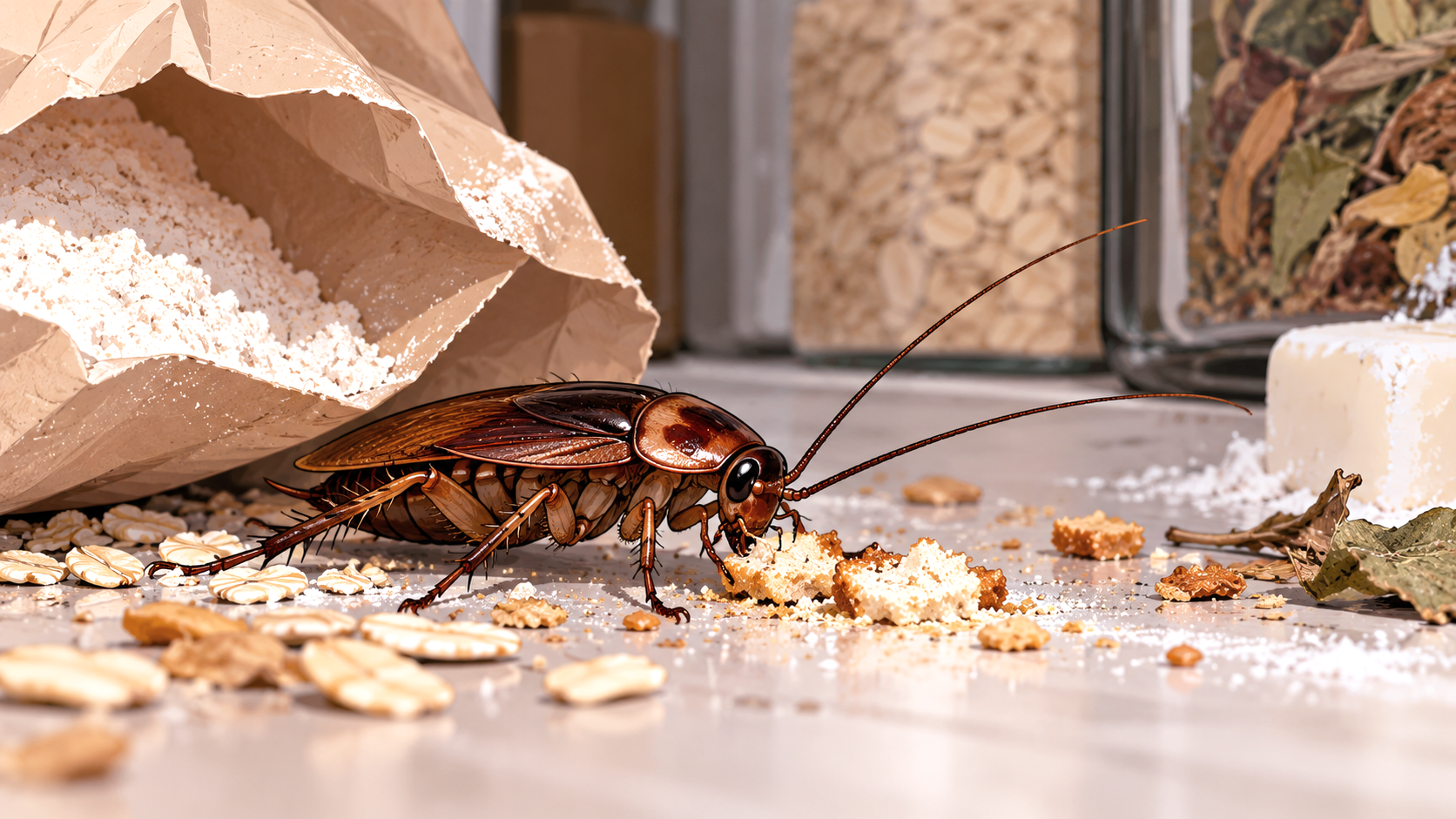
A cockroach wandering through a kitchen is not searching for one favorite food. Its advantage is flexibility. Crumbs beneath an appliance, grease around a stove, pet food left overnight, food residue in garbage, and other organic material can all become feeding opportunities. Even so, describing cockroaches as insects that simply “eat anything” misses how selective their feeding can be. Cockroaches are omnivorous scavengers that can eat many plant- and animal-based foods. Common sources include starches, sugars, fats, meat, crumbs, pet food, food waste, and decaying organic matter. They can survive on varied diets and may switch among available foods to obtain different nutrients.
Human Food Gives Cockroaches Plenty of Choices
The foods people store, prepare, spill, and discard contain the same broad nutrients cockroaches need. Bread, cereal, rice, baked goods, sweets, meat residues, cooking grease, fruit, vegetables, and pet food can all provide usable nutrition. German cockroaches in occupied apartments have been studied as generalist omnivores exposed to highly variable food resources, rather than specialists dependent on one particular ingredient.
Small quantities can be enough to create feeding opportunities. Grease films, crumbs beneath appliances, residue inside food packaging, dirty dishes, spills beside garbage containers, and particles under cabinets may be insignificant to a person while remaining accessible to an insect. Their flattened body and mobile legs also let them reach narrow spaces where these residues accumulate.
They Do Not Choose Food at Random
Cockroaches have broad diets, but broad does not mean indiscriminate. German cockroaches can regulate their intake by feeding from nutritionally different foods. Controlled experiments have shown that they combine protein- and carbohydrate-rich foods to approach a preferred nutrient balance. Studies inside apartments have also found substantial variation among populations, suggesting that local food availability and previous feeding conditions influence what cockroaches consume.
Their nutritional requirements can shift with physiological state. Growing nymphs need resources for development, while adult females invest nutrients in reproduction. German cockroaches collected from different apartments showed variation in food intake, yet males, females, and nymphs from the same locations tended to display related patterns of protein consumption and diet preference. A food that attracts one population strongly should therefore not be assumed to be universally preferred by every cockroach.
Sugary Foods Can Be Attractive, but Even That Has Exceptions
Sugars commonly stimulate feeding in German cockroaches, which is one reason sweet ingredients have historically been useful in cockroach baits. Their taste system can recognize individual sugars before food is accepted. Some populations, however, have evolved an unusual response to glucose after generations of exposure to glucose-containing toxic baits. In these cockroaches, glucose can activate sensory pathways associated with deterrence rather than normal feeding stimulation, causing them to avoid it. Glucose-aversion is a documented form of behavioral resistance.
Saliva can complicate the response further because digestive enzymes begin altering certain sugars while the insect feeds. Research has shown that salivary digestion can expand sugar aversion in German cockroaches. The familiar claim that cockroaches “love sugar” is therefore useful only as a broad observation, not a rule that predicts every population’s feeding behavior.
Grease and Food Residue Can Support Feeding Without Looking Like Food
A kitchen does not need an uncovered plate of food to provide resources. Thin films of cooking fat, splatter beside a stove, residues in recycling, crumbs trapped under equipment, and organic material around garbage can remain available after obvious food has been put away. Field research in apartments has found abundant fats around kitchen surfaces and suggested that fats can contribute substantially to what German cockroaches consume in homes.
Pet feeding areas deserve similar attention. Dry kibble, crumbs, spilled treats, and residues around bowls provide concentrated organic material. Removing these scattered sources reduces the number of feeding opportunities, although food sanitation alone does not prove that an established population has disappeared. Cockroach infestation evidence needs to be evaluated independently of how clean a room appears.
Scarcity Expands What Counts as a Meal
When preferred foods are unavailable, cockroaches can exploit less conventional organic material. Their scavenging biology allows them to use resources that would never resemble a normal meal to a person. Dead insects and other animal remains can become food, and cannibalism can occur under certain conditions. Experimental work has documented cannibalistic interactions among German cockroaches, particularly when circumstances alter access to normal resources.
Not every material a cockroach chews should be treated as an equally valuable food source. Feeding, incidental nibbling, and surviving on a material as a major diet are different claims. Cellulose-containing household materials create especially common misconceptions, so whether cockroaches actually eat wood and how they interact with paper and cardboard are better judged by what those materials can realistically provide rather than by bite marks alone.
Feeding Usually Happens Away From the Open Room
Indoor pest cockroaches commonly remain sheltered during much of the day and emerge to forage when conditions are quieter and darker. Food can therefore disappear without the insects spending long periods beside it. Their antennae and other sensory systems help them investigate the environment and locate resources while moving between harborages and feeding sites.
Foraging can extend beyond the immediate crack or appliance where cockroaches hide. Experiments with German cockroaches show that they can travel between separated food sources and still adjust nutrient intake while foraging over greater distances. Finding cockroaches around food consequently does not establish that their main harborage is directly beside it. The reasons cockroaches enter and remain in a house can involve the combination of accessible resources and suitable shelter rather than a single visible food source.
Questions About What Cockroaches Eat
Can cockroaches live on only one kind of food?
Some foods can sustain them for meaningful periods, but nutritional composition affects performance. German cockroaches given dietary choice can regulate protein and carbohydrate intake, and balanced nutrient selection can improve reproductive performance. Survival on a food does not mean it provides an ideal diet.
Do cockroaches eat other insects?
They can consume dead insects and other animal material as scavengers. Cannibalism can also occur, although it should not be interpreted as the normal or exclusive diet of household cockroaches.
Does keeping food in sealed containers remove every food source?
No. Sealed storage removes important opportunities, but grease, crumbs, garbage residue, pet food, dirty dishes, and food trapped beneath appliances can remain available. Cleaning those overlooked areas removes resources that ordinary countertop cleaning may leave behind.
Will cockroaches leave if there is no food?
Food scarcity can stress a population and increase foraging, but cockroaches can persist on small and easily overlooked resources. Their ability to tolerate deprivation also varies with species, life stage, temperature, and access to moisture. How long cockroaches survive is therefore not determined by food availability alone.
3 thoughts on “What Do Cockroaches Eat?”