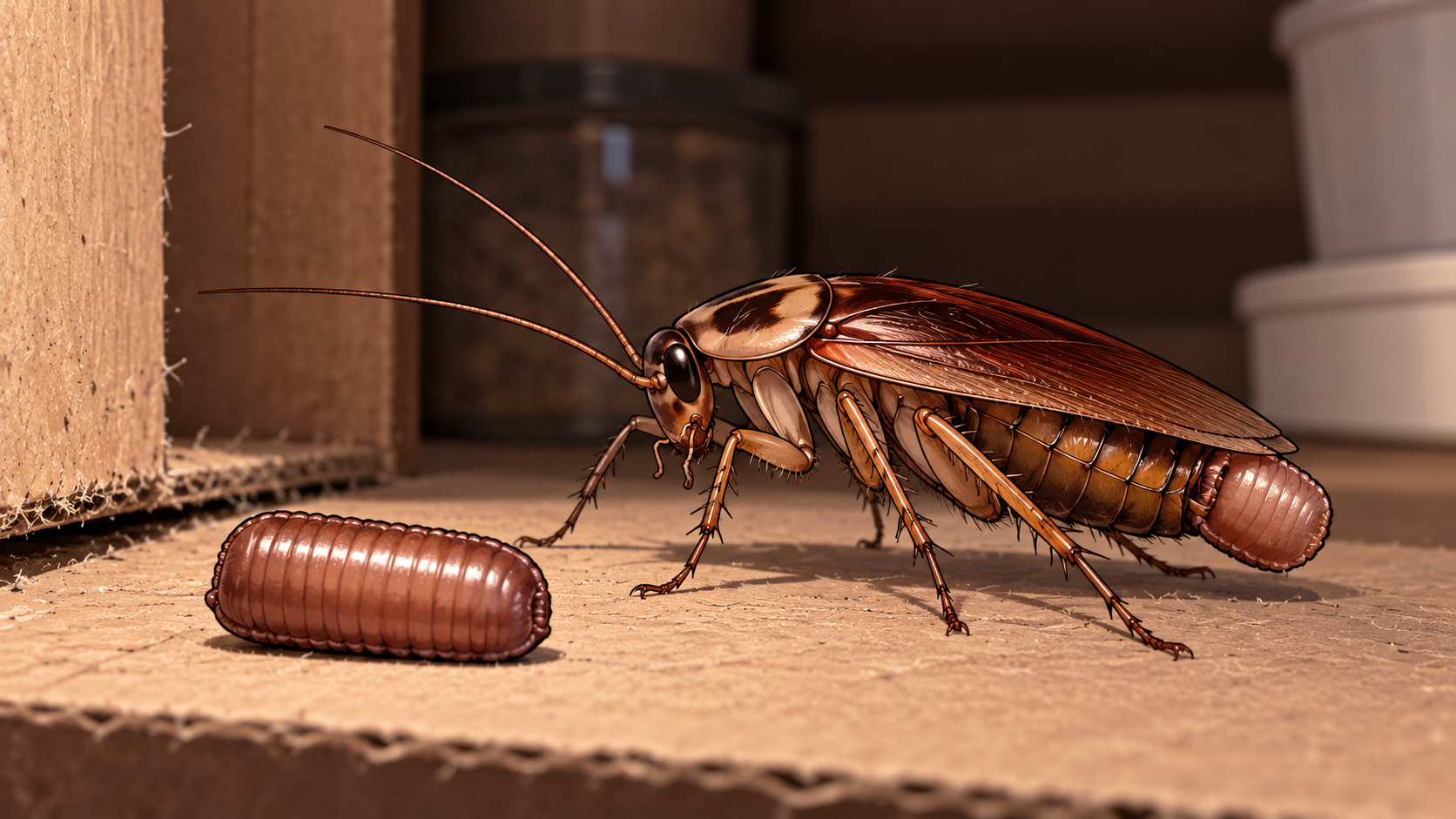
If you are searching for cockroach eggs, looking for individual white eggs is likely to send you in the wrong direction. Household cockroaches generally enclose multiple eggs inside a protective capsule called an ootheca, and this capsule is what you are most likely to recognize.
Cockroach egg cases usually look like small tan, brown, reddish-brown, or dark capsules with a hardened outer surface and a distinct seam or ridge along one edge. Their exact shape and size depend on the species. Some are carried by the female, while others are deposited or attached in protected locations.
An Ootheca Looks More Like a Tiny Capsule Than a Loose Egg
A cockroach ootheca is a compact case containing multiple developing eggs. Its outer covering is sufficiently distinctive that cockroach oothecae can be identified alongside adults and nymphs, although the details vary enough between species that there is no universal cockroach egg-case appearance. Most household species produce cases measured in millimeters rather than inches, and the capsule may be oval, rectangular, purse-like, or somewhat barrel-shaped.
One edge typically has a raised or ridged seam associated with the individual egg compartments inside. A hatched case can remain behind after the nymphs emerge, so finding an empty ootheca does not necessarily mean viable eggs are still present. It can still contribute to the collection of physical signs associated with cockroach activity.
German Cockroach Egg Cases Are Often Still Attached to the Female
The German cockroach produces an elongated light-brown to medium-brown ootheca measuring roughly 1/4 inch, or about 6 mm, long. The capsule projects from the end of the female’s abdomen and is carried through most of its development rather than being deposited soon after formation. Females normally retain the ootheca until close to hatching, which changes where homeowners are likely to encounter it.
A brown capsule visibly protruding from a small tan cockroach is therefore a particularly useful clue. A detached German cockroach ootheca may occur in a secluded part of an infested area, but finding one still carried by the female is normal for this species. The two dark longitudinal stripes on an adult German cockroach can help connect the capsule with the correct cockroach type when both are visible.
American Cockroach Oothecae Are Darker and More Compact
American cockroaches produce substantially different cases. Their oothecae are roughly 5/16 inch long and 3/16 inch wide, giving them a short, sturdy appearance rather than the more elongated look of a German cockroach case. Females deposit the capsule soon after it forms, and American cockroach oothecae may be left in protected out-of-the-way locations.
The case becomes dark reddish brown to brown and can blend easily with debris, wood, cardboard, or dark crevices. Its ridged upper edge is especially useful under magnification. Because the female does not continue carrying it through most of incubation, a loose dark capsule can be genuine evidence even when no adult cockroach is nearby.
Brown-Banded Cockroaches Put Their Small Cases in Unusual Places
Brown-banded cockroach oothecae are among the smallest produced by common indoor pest species. They are approximately 1/8 inch long, oval, and light tan to brown. More distinctive than the size is what the female does with them: she attaches the case to a protected surface rather than simply leaving it loose. Cases may be glued beneath furniture, behind drawers, or inside cabinets.
They can also occur away from the kitchens and bathrooms where people commonly expect cockroach evidence. Brown-banded cockroaches use relatively warm, dry areas and may occupy furniture, closets, wall-mounted objects, and electrical equipment. Their egg cases can be attached beneath furniture or behind objects on walls, so an inspection limited to floor-level cracks can miss them.
Oriental Cockroach Cases Can Resemble Other Dark Oothecae
Oriental cockroaches also deposit their oothecae rather than carrying them until hatching. The capsules are dark reddish brown and can be close enough in general size and appearance to other larger cockroach oothecae that identifying the species from a single damaged case may be difficult.
Context can narrow the possibilities. Oriental cockroaches favor cool, damp environments and are frequently associated with basements, drains, crawl spaces, and similar sheltered areas. Their adults are also distinctly dark brown to nearly black, which can provide stronger evidence than the capsule alone. Since adult cockroach appearance varies markedly among species, an intact adult found in the same harborage can make an otherwise ambiguous ootheca easier to interpret.
Where Cockroach Egg Cases Hide Depends on the Species
There is no single “cockroach nest” where every female deposits eggs. German cockroaches complicate the search because the female carries her case for most of its incubation period. American and Oriental cockroaches deposit cases in protected locations, while brown-banded cockroaches deliberately attach theirs to surfaces. These differences explain why an ootheca may turn up in a cabinet crevice, beneath furniture, behind a drawer, near plumbing, or somewhere above floor level.
Small protected spaces deserve more attention than exposed room centers. Cockroaches generally seek narrow harborages, and different household species favor different parts of a building. Finding several capsules in one protected location is more informative than assuming eggs must be wherever an adult happened to run across the floor.
Objects Commonly Mistaken for Cockroach Egg Cases
A suspected ootheca should have a defined capsule shape and recognizable casing rather than looking like an irregular crumb. Seeds, rodent droppings, fly pupal cases, food fragments, and debris can all create false alarms when size and color are considered without structure.
Cockroach droppings are an especially common source of confusion. They are fecal material rather than containers and therefore do not have the organized capsule construction of an ootheca. The appearance of cockroach droppings varies with the size and species of the insect, so a dark object should not be identified from color alone. Magnification and a clear photograph from several angles are more useful than crushing or opening an unknown case.
Questions About Cockroach Egg Cases
Can cockroach egg cases be white?
A newly formed ootheca can initially be much lighter before its outer covering darkens. A mature case from the common household pest species is more likely to be tan, brown, reddish brown, or dark brown than bright white.
Can an empty cockroach egg case still be useful for identification?
Yes. An empty ootheca retains much of its external shape and can confirm that cockroaches have reproduced in or reached that location. Damage may make species-level identification less certain.
Will every female cockroach carry an egg case where I can see it?
No. Carrying behavior varies by species. German cockroach females are notable for retaining the ootheca for most of incubation, whereas American, Oriental, and brown-banded cockroaches deposit or attach theirs much earlier.
Can you identify the exact cockroach species from an ootheca alone?
Sometimes, particularly when the case is intact and its size, shape, placement, and associated adults are known. Similar or damaged cases can be ambiguous, so the ootheca should be considered together with other evidence rather than forced into a species identification.
4 thoughts on “What Do Cockroach Eggs Look Like?”