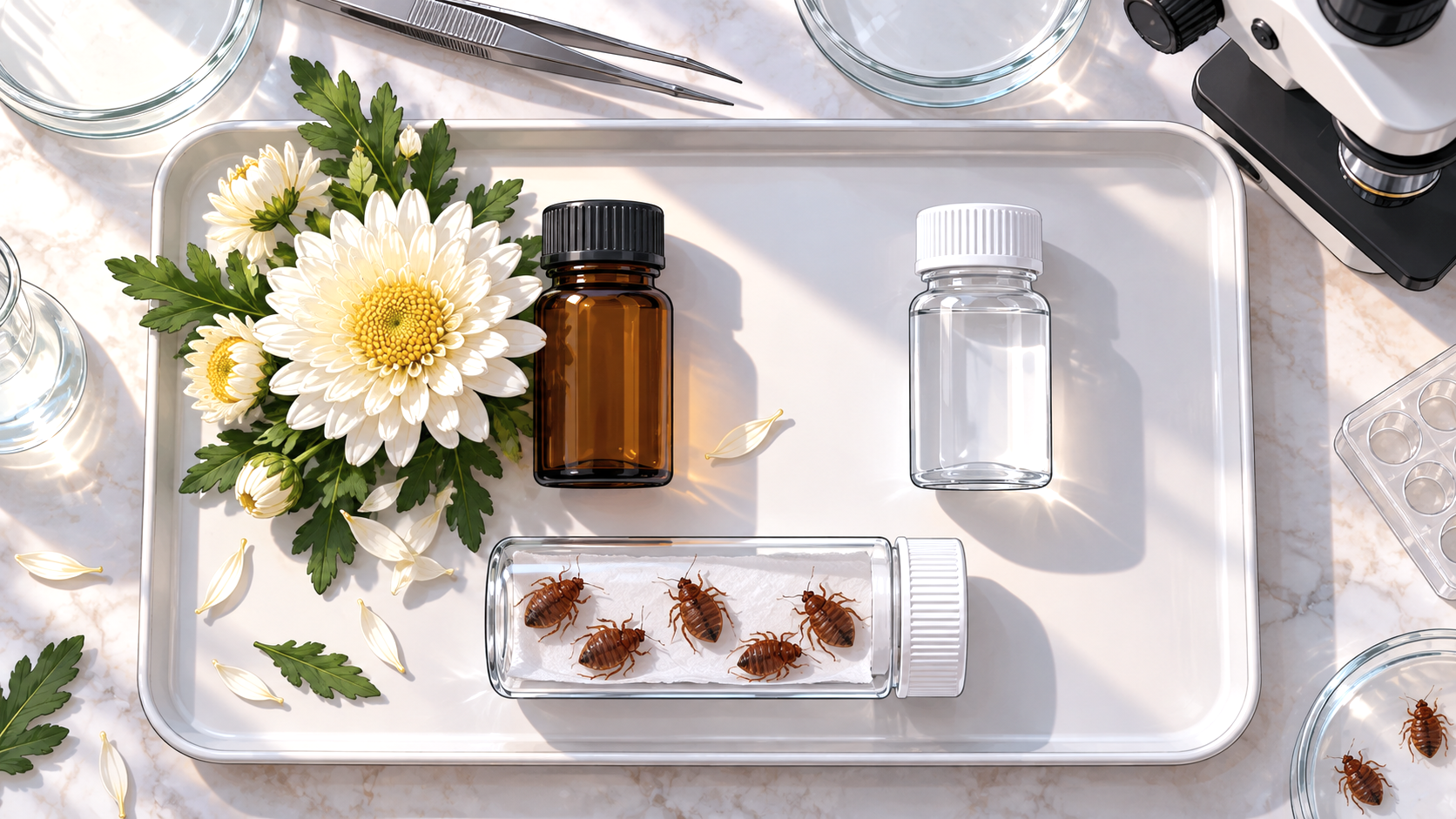
Pyrethrins and permethrin can both kill susceptible bed bugs, but they are not equivalent treatments. Pyrethrins are short-lived botanical insecticides valued mainly for rapid contact activity, while permethrin is a synthetic pyrethroid developed to persist longer after application. Widespread resistance to this insecticide family can substantially reduce the effectiveness of either one.
Pyrethrins Are Natural Compounds, While Permethrin Is a Synthetic Pyrethroid
Pyrethrins are a mixture of six insecticidal chemicals obtained from certain chrysanthemum flowers. Permethrin was designed to imitate the insecticidal action of these natural compounds while producing a more stable pesticide. The chemical relationship between pyrethrins and synthetic pyrethroids explains why they affect insects in similar ways even though their origins and persistence differ.
Both disrupt normal nerve signaling by affecting voltage-gated sodium channels. Once a susceptible bed bug receives a sufficient dose, uncontrolled nerve firing can cause excitation, paralysis, and death. Permethrin’s pyrethroid mode of action therefore overlaps closely with the mechanism used by natural pyrethrins.
Their shared biological target also limits the value of simply alternating between them when resistance is involved. The broader range of chemical classes available for bed bug control includes options that attack insects through entirely different mechanisms.
Pyrethrins Usually Provide Faster Knockdown but Less Residual Activity
Pyrethrins are well known for rapidly affecting susceptible insects after direct exposure. Their weakness is persistence. Natural pyrethrins degrade comparatively quickly, particularly under light, whereas synthetic pyrethroids were developed partly to create longer-lasting insecticidal activity.
That difference changes their practical roles. A pyrethrin-based aerosol may rapidly flush or knock down bugs contacted during application, but little useful residue may remain later. Permethrin can persist on an approved treated surface and potentially affect bugs that cross the residue after the original application has dried.
Longer persistence does not automatically make permethrin more effective. Residual performance depends on formulation, dose, treated material, cleaning, and whether the insects are susceptible. Laboratory research has shown that pyrethroid performance against bed bugs can change substantially with insecticide type and aged residues.
The specific behavior of permethrin against bed bugs therefore cannot be predicted solely from its reputation as a longer-lasting pesticide.
Resistance Is a Major Weakness Shared by Both
Bed bug resistance is the main reason neither pyrethrins nor permethrin deserves an automatic recommendation. EPA recognizes resistance to both pyrethrins and pyrethroids and notes that resistant bugs may survive treatment or simply be flushed into different harborages. Switching to another pesticide mode of action can be more useful than remaining within the same insecticide family.
Resistance has become geographically widespread. A large systematic review reported very high pyrethroid resistance in both common and tropical bed bugs, with resistance mechanisms documented in populations from many regions.
Those mechanisms can include mutations that reduce sensitivity at the sodium-channel target, faster metabolic detoxification, and changes that reduce pesticide penetration. Several mechanisms may exist in the same population, helping explain why apparently strong bed bug insecticides can produce disappointing results.
A resistant infestation can therefore perform poorly against both a natural pyrethrin formulation and permethrin despite obvious differences in their chemistry and residual life.
Piperonyl Butoxide Can Improve Some Pyrethrin Products Without Solving Resistance
Pyrethrins are commonly formulated with a synergist such as piperonyl butoxide, or PBO. PBO has little insecticidal effect by itself but interferes with some enzymes insects use to detoxify pesticides. Slowing that detoxification can allow a pyrethrin dose to remain active inside the insect for longer.
This is why a product containing pyrethrins plus PBO should not be evaluated as though it were plain pyrethrin. Synergists can increase the toxicity of pyrethrins and pyrethroids when metabolic detoxification contributes to survival.
Bed bug resistance, however, is not controlled by one enzyme system alone. Experiments with resistant populations found that PBO greatly improved pyrethroid susceptibility in some strains but produced much smaller benefits in others. Target-site mutations and other mechanisms can remain even after metabolic enzymes are inhibited.
A synergized pyrethrin formulation may therefore outperform an unsynergized one without becoming a reliable answer for every resistant infestation.
The Product Formulation Matters More Than Choosing a Name in Isolation
Comparing only the words “pyrethrin” and “permethrin” leaves out much of what determines whether a pesticide succeeds. A product may contain several active ingredients, a synergist, solvents, or another pesticide class. Its label may permit crack-and-crevice applications, certain furniture treatments, or other specific uses that a different formulation does not allow.
EPA requires bed bug pesticide claims to be supported by efficacy data and emphasizes that performance depends on application coverage, infestation size, life stages, and resistance. A bed bug-labeled combination product can consequently be a more meaningful choice than selecting a general-purpose permethrin or pyrethrin spray because of the active ingredient name alone.
The same formulation differences explain why bed bug sprays do not all perform equally. Concentration, residual behavior, permitted surfaces, co-active ingredients, and application technique can outweigh the simple distinction between botanical and synthetic chemistry.
Only use a product for bed bugs when the pest appears on its pesticide label. The EPA bed bug product database can also be used to confirm registered consumer products and permitted treatment locations.
Neither Is a Good Stand-Alone Choice for an Established Infestation
Pyrethrins can miss insects protected inside deep harborages once the brief contact treatment has dissipated. Permethrin can leave a longer residue, but resistant bugs or insects occupying untreated spaces may survive it. Neither characteristic addresses every stage and location in a developed infestation.
Repeatedly applying the same pesticide class can also waste time when resistance is the reason activity continues. Treatment failure may instead involve missed harborages, inadequate coverage, untreated adjacent areas, surviving eggs, or poor follow-up. These are among the reasons pesticide treatments can fail even when the product itself is capable of killing bed bugs.
A broader bed bug elimination strategy can combine appropriate pesticides with monitoring, physical removal, heat or steam, encasements, laundering, and desiccant dusts. The exact combination should reflect where the bugs are located and how extensively the infestation has spread rather than relying on repeated applications of pyrethrin or permethrin.
Questions About Pyrethrin and Permethrin
Is permethrin stronger than pyrethrin?
Not in every sense. Pyrethrins can provide rapid contact knockdown, while permethrin generally persists longer after application. Susceptibility and formulation determine actual mortality.
Which lasts longer after spraying?
Permethrin generally has greater residual persistence. Natural pyrethrins degrade much more rapidly, particularly when exposed to light.
Can bed bugs be resistant to both at the same time?
Yes. Because pyrethrins and pyrethroids affect closely related nerve targets, resistance mechanisms can reduce susceptibility across both groups.
Does “natural pyrethrin” mean it is safer to spray on bedding?
No. Natural origin does not determine where a pesticide may safely be applied. Bedding, mattresses, furniture, and other surfaces may be treated only when the exact product label permits that use.
Is pyrethrin the same thing as pyrethrum?
Not exactly. Pyrethrum refers to the botanical material or extract derived from chrysanthemum flowers, while pyrethrins are the specific insecticidal compounds within it.
Can pyrethrins flush bed bugs out of hiding?
Yes, pyrethrins and pyrethroids can cause susceptible or irritated bugs to leave harborages. Flushing is not the same as killing them and can complicate control if survivors relocate.
Should you switch to permethrin after a pyrethrin spray fails?
Not automatically. Because the two act through closely related mechanisms, resistance can affect both. A product using a genuinely different pesticide class may make more sense when resistance is suspected.
Can either treatment prove that an infestation is gone?
No. Pesticide application should be followed by monitoring for live insects and other signs of continuing bed bug activity. Immediate knockdown does not establish that concealed survivors or eggs have been eliminated.