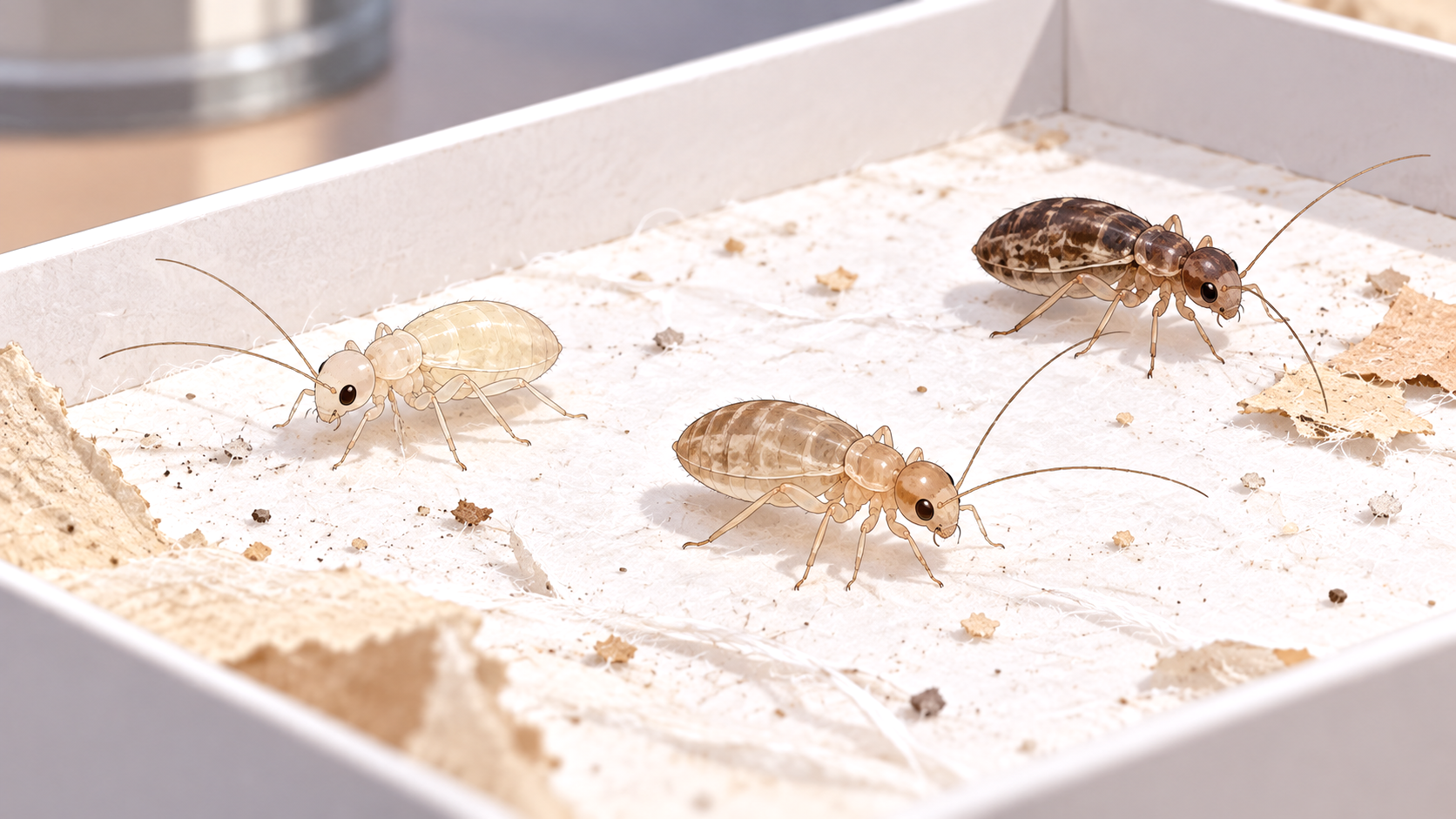
Booklice are not a single species. The name covers several tiny psocids that can live in buildings, stored foods, warehouses, museums, and other protected environments. Most household booklice are wingless species in the genus Liposcelis, while other psocids found around stored products belong to different genera. Their appearance and habitat can overlap enough that identifying an exact species usually requires magnification.
Most Household Booklice Belong to Liposcelis
The booklice most often encountered indoors are tiny, wingless members of the genus Liposcelis. They have soft flattened bodies, long antennae, and enlarged heads, although those features can be difficult to resolve without magnification. Their general booklouse appearance is more useful for confirming the pest group than for separating one Liposcelis species from another. Minnesota’s household psocid guidance likewise describes indoor booklice as usually belonging to Liposcelis, while distinguishing them from the many winged psocids that normally live outdoors.
Several Liposcelis species can occur around stored foods and other indoor materials. USDA identification material lists Liposcelis bostrychophila, L. brunnea, L. corrodens, L. decolor, L. entomophila, L. paeta, and L. rugosa among species associated with stored grain in North America. The same source notes that stored-product psocid infestations can contain multiple species, so finding slightly different-looking booklice in one storage environment does not automatically mean one of them has been misidentified.
Liposcelis bostrychophila
Liposcelis bostrychophila is one of the best-known booklice associated with buildings and stored products. USDA research describes it as one of the most widespread species in the genus and an important stored-product pest. It can reproduce in warm, humid environments containing suitable food, including grain-based materials and fungi.
This species illustrates why the common name “booklouse” can be misleading. An insect does not have to live inside a book to qualify. Different Liposcelis species can occupy grain stores, food-processing environments, packaging, damp cardboard, wall spaces, and household storage. Their diet can include fungal material, damaged grain, insect fragments, and other suitable foods, which fits the broader range of things booklice eat.
Liposcelis entomophila, paeta, brunnea, and decolor
Several other Liposcelis species are significant enough in stored products to be studied separately. USDA research has examined L. entomophila, L. paeta, and L. brunnea as individual stored-product pests, while grain-identification material also includes L. decolor among North American species. They can differ in coloration, microscopic surface structures, bristles, eye characteristics, and other anatomical details that are unlikely to be visible in an ordinary household photograph.
Color therefore has limits for species identification. Booklice can range from almost translucent through gray, tan, brown, orange-brown, or darker shades, and the site’s broader guide to booklice color variation explains why shade alone should not be used to assign a species. Even USDA’s identification pages for species such as Liposcelis brunnea rely on highly magnified structural characters, including bristles and microscopic patterns on the body.
Some Stored-Product Booklice Are Not Liposcelis
The household conversation often treats Liposcelis as synonymous with booklice, but other psocids can occur in the same types of stored environments. One important example is Lepinotus reticulatus, which belongs to a different family from Liposcelis. USDA identifies Lepinotus reticulatus as a stored-product psocid in the family Trogiidae. It has been found in grain-storage environments alongside species from the family Liposcelididae.
Canadian grain guidance broadens the group further by listing Liposcelis bostrychophilus, Trogium pulsatorium, and psocids from several families among booklice and related psocids found around stored commodities. For a homeowner, the practical lesson is not to memorize every scientific name. A pantry, warehouse, grain bin, museum, or damp storage room can contain more than one psocid species, and identifying the exact one may require microscope-level characters rather than simply comparing body color.
Their shared need for favorable environmental conditions is often more useful than their taxonomic differences. Many indoor psocids become abundant where moisture and food are available. The strong relationship between population growth and moisture explains why humidity plays such a large role in booklice problems even when several different species are involved.
Barklice Are Close Relatives, but They Are Not Typical Household Booklice
Outdoor psocids are often called barklice rather than booklice. Many have functional wings and live on tree bark, leaves, shrubs, stones, and other outdoor surfaces where they consume fungi, lichens, pollen, decaying material, and similar foods. Minnesota guidance notes that most psocids live outdoors and that many barklice are winged. Common indoor Liposcelis species are generally wingless.
A winged psocid entering through a window is therefore not automatically evidence that a population of household booklice is breeding inside the property. The distinction also prevents a common identification error when photographs of unrelated psocids appear in image searches. The site’s discussion of whether booklice have wings separates the usual wingless indoor forms from the much broader psocid group.
The difference between barklice and booklice is largely ecological rather than a clean taxonomic boundary that divides every species into two formal groups. Both names are common labels applied to psocids according to where people usually encounter them. A tiny wingless psocid reproducing inside a humid cupboard fits what homeowners normally call booklice, while a winged relative grazing on fungi across tree bark is more likely to be called barklice.
Different Sizes and Colors Do Not Necessarily Mean Different Species
A patch of booklice may contain insects of noticeably different sizes because nymphs and adults live together. Booklice develop through incomplete metamorphosis, so immature stages resemble reduced versions of the adults rather than larvae with a completely different body form. The booklice life cycle consequently produces several size classes within a single species.
Age can also alter how individuals look. Young booklice may be particularly pale or almost transparent, while adults can show stronger pigmentation. Background, lighting, recent molting, and species differences all influence apparent color. Seeing a clear 1-millimeter insect beside a darker 2-millimeter one therefore does not prove that two species are present.
Common indoor booklice are themselves extremely small. Many are roughly 1 to 2 millimeters long, while Canadian grain guidance notes that some psocids are 1 millimeter or less. Species-level identification at that scale often depends on details invisible to the unaided eye. For an ordinary household infestation, confirming that the insects are booklice and locating the moisture source usually matters more than determining whether the specimen is L. bostrychophila, L. brunnea, or another closely related species.
Questions About Booklice Species and Types
How many species of booklice are there?
There is no useful household number because “booklice” is a common name applied to multiple psocid species rather than a formal species group with a simple fixed count. The broader psocid lineage contains many outdoor and indoor species, while only a subset regularly becomes associated with homes or stored products.
Can two types of booklice live in the same building?
Yes. Stored-product researchers specifically note that psocid infestations can contain multiple species. A humid warehouse, food-storage area, or other suitable environment can therefore support more than one species at the same time.
Are brown booklice a different type from white booklice?
Not necessarily. Color varies with species, age, and lighting, while young individuals can be much paler than mature ones. Species identification should not be made solely from whether a specimen looks white, gray, tan, or brown.
Do different booklice species require different treatment in a house?
For ordinary household infestations, the environmental response is usually similar because indoor booklice depend heavily on moisture and fungal growth. Correcting leaks, condensation, damp storage, and excessive humidity is generally more important than establishing the exact species. The visible insects may differ, but the conditions supporting mold-associated booklice populations often provide the more useful target.