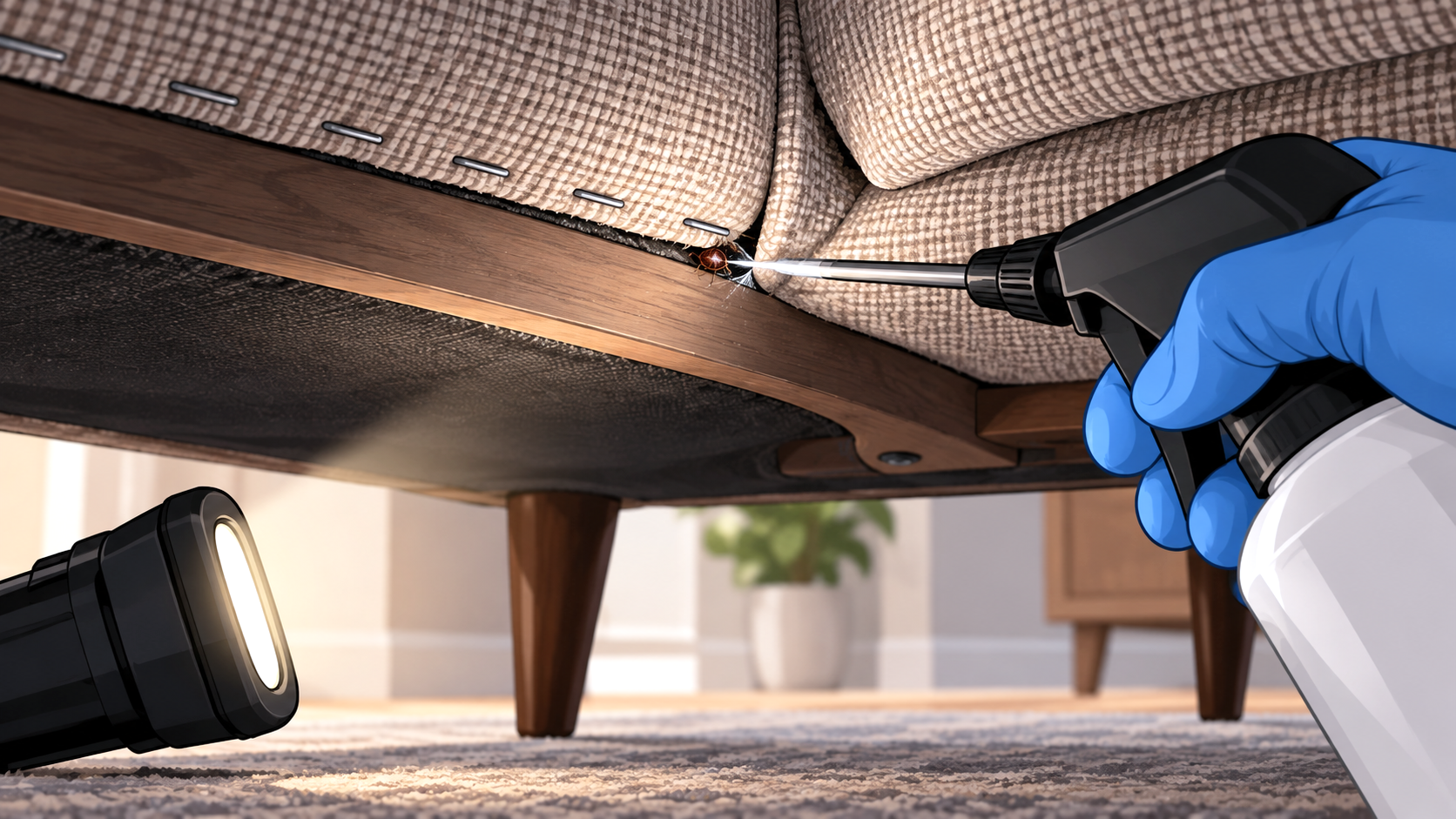
A bed bug spray can be registered for the right pest and still perform very differently from another registered product. In one head-to-head laboratory study, several sprays produced 70% mortality or less on every surface tested, while another remained above 89%. The name “bed bug spray” tells you surprisingly little about how well a particular formulation will perform.
Yes, bed bug sprays can work, but their effectiveness varies substantially by product, active ingredient, bed bug population, surface, and application. Laboratory studies show that some formulations kill far more bed bugs than others, while resistance and the insects’ ability to avoid treated areas can reduce performance. A spray should be one part of bed bug control, not the entire strategy.
The Same Test Produced Very Different Results Between Sprays
One of the more useful comparisons tested commercial bed bug products side by side rather than evaluating each one under unrelated conditions.
Researchers compared the liquid formulations Tandem, Temprid SC, Transport GHP, and Demand CS, along with the ready-to-use aerosols Alpine, Bedlam, Bedlam Plus, and Phantom. The products were tested against a field-collected bed bug population with moderate pyrethroid resistance on fabric, unpainted wood, painted wood, and vinyl.
Bed bugs were confined on treated surfaces for four hours, and the resulting mortality differed considerably by both product and substrate.
Bedlam, Demand CS, and Temprid SC produced 70% mortality or less across all four surfaces. Transport GHP was more consistent in this experiment, producing at least 89.7% mortality regardless of substrate. Other products varied more noticeably according to the surface.
Those figures should not be treated as a permanent ranking of today’s bed bug sprays. They describe specific formulations, a particular bed bug population, particular substrates, and the conditions of that experiment. They do demonstrate something more durable: products sold for the same pest can perform very differently.
The Surface You Spray Can Change the Result
A bedroom is not one uniform treatment surface. Bed bugs may encounter pesticide residues on fabric, finished or unfinished wood, vinyl, baseboards, furniture, mattress components, and other materials. The comparison study found that substrate significantly affected several of the tested products.
A spray that performs strongly on one surface therefore cannot automatically be assumed to produce the same result everywhere else.
This also makes the pesticide label particularly important. Where a product may legally and safely be applied depends on its current label, and applying it somewhere the label does not permit is not a solution to poor performance elsewhere. We think this is one of the easiest details to overlook when choosing a spray. People understandably focus on the product name and active ingredients, while the surface receiving the treatment can be another part of the result.
Resistance Can Make an Otherwise Lethal Insecticide Less Effective
The bed bugs used in the comparison study were not completely susceptible insects. The field strain had moderate pyrethroid resistance, which matters when interpreting products containing pyrethroid ingredients.
Resistance is now a well-established problem in bed bug control. Bed bug populations can possess several resistance mechanisms, including changes that reduce sensitivity to an insecticide and mechanisms that help detoxify it.
That means a formulation capable of killing a susceptible bed bug population may perform differently against a resistant one. Our deeper look at why bed bugs are becoming resistant to pesticides explains how those mechanisms complicate chemical control.
Resistance also explains why switching brand names is not necessarily the same thing as changing the treatment. Two products may use ingredients from the same pesticide class or otherwise expose the insects to similar modes of action.
A Strong Direct-Spray Result Still Doesn’t Guarantee Infestation Control
Laboratory testing can answer whether a product kills exposed bed bugs. Eliminating an infestation is a harder test.
Bed bugs spend much of their time concealed in mattress seams, bed frames, furniture joints, baseboards, cracks, and other protected locations. A spray cannot kill an insect that never receives a lethal exposure unless its residue remains effective somewhere the insect later crosses.
Research on plant-derived sprays illustrates the gap particularly well. In laboratory testing of several so-called natural products, EcoRaider and Bed Bug Patrol were the only two tested products that produced more than 90% mortality in direct-spray assays. Performance under residual conditions was considerably less impressive.
That does not mean those products never work. It means direct contact mortality answers only one part of the question.
A product can be capable of killing a bed bug while still being insufficient to eliminate a population hidden throughout a room.
Avoidance Gives Bed Bugs Another Way to Escape Exposure
Residual performance matters because bed bugs are not necessarily forced to remain on a treated surface in a real home.
The conventional-product comparison deliberately confined insects to treated substrates during exposure. A bedroom gives them alternatives. Cracks, seams, voids, furniture joints, and other untreated spaces may allow insects to avoid residues entirely.
Some insecticides can also affect bed bug movement. Pyrethrins and pyrethroids can flush bed bugs from hiding places, but resistant populations may respond by moving to new hiding places instead of receiving a lethal dose.
That is a particularly undesirable outcome. Moving a bed bug is not the same thing as controlling it. The problem helps explain why bed bugs are so difficult to get rid of. The chemical must do more than possess insecticidal activity. Enough of the infestation has to encounter an effective treatment.
“Natural” and “Professional” Don’t Tell You Whether a Spray Works
Broad product categories make poor shortcuts for efficacy.
An essential oil-based spray should not be assumed effective because its ingredients are plant-derived. Likewise, a product associated with professional pest control should not be assumed superior to every consumer product simply because of where it is normally sold.
Specific formulation matters.
The same principle applies to active ingredients. Knowing the ingredient helps identify its pesticide class and potential resistance issues, but the finished formulation, concentration, application method, residue, permitted treatment sites, and supporting efficacy data all contribute to performance.
That is why understanding the major chemicals used against bed bugs is more useful than choosing a spray from marketing language alone.
A Bed Bug Spray Needs the Right Label Before Anything Else
Before comparing mortality percentages, check whether the pesticide is actually registered and labeled for bed bug control where you live.
In the United States, EPA registers hundreds of pesticide products for use against bed bugs, spanning several pesticide classes. Registration does not mean every product will perform identically against every infestation. It means the product has a legally defined use that includes bed bugs when applied according to its label.
The label also tells you where the pesticide may be applied, how much to use, how frequently it may be reapplied, and what precautions are required.
Never increase the amount or frequency because a treatment seems slow. More pesticide than the label permits is not a stronger treatment plan. It is misuse.
Spraying Visible Bed Bugs Is Not Enough
A spray can be genuinely effective and still leave an infestation behind.
Hidden nymphs, adults, and eggs may escape the original application. Residual effectiveness can differ by formulation and surface, while resistance can further reduce mortality. Reaching the infestation therefore matters as much as choosing a capable product.
A more dependable approach combines appropriate pesticide use with other control measures. Depending on the situation, that can include inspection, vacuuming, heat treatment of suitable belongings, encasements, interceptors, clutter reduction, and follow-up monitoring. EPA similarly recommends integrated pest management rather than relying on pesticides alone.
So do bed bug sprays actually work? Some absolutely can kill bed bugs. The mistake is turning that fact into the much larger claim that spraying alone will reliably eliminate an infestation.
Questions About Bed Bug Sprays
How quickly should a bed bug spray work?
It depends on the formulation. Some products are designed to kill insects through direct contact, while others leave residues that bed bugs encounter later. Use the timing and application instructions on the current product label rather than assuming every spray should produce immediate mortality.
Can you spray a mattress with bed bug pesticide?
Only when the specific product label permits application to the relevant parts of a mattress, and only in the manner stated on that label. A product being labeled for bed bugs does not automatically authorize application to every surface where bed bugs may hide.
Should you switch sprays if bed bugs survive treatment?
Survival can have several explanations, including missed harborages, inadequate exposure, resistance, incorrect application, or insufficient follow-up. Repeatedly switching products without identifying the reason for failure can simply repeat the same problem, especially if the replacement uses a similar mode of action.
Can two different bed bug sprays be used together?
Do not mix pesticides or improvise combinations unless the labels specifically permit that use. An integrated treatment can involve more than one compatible control method without physically mixing pesticide products.
One thought on “Do Bed Bug Sprays Actually Work?”