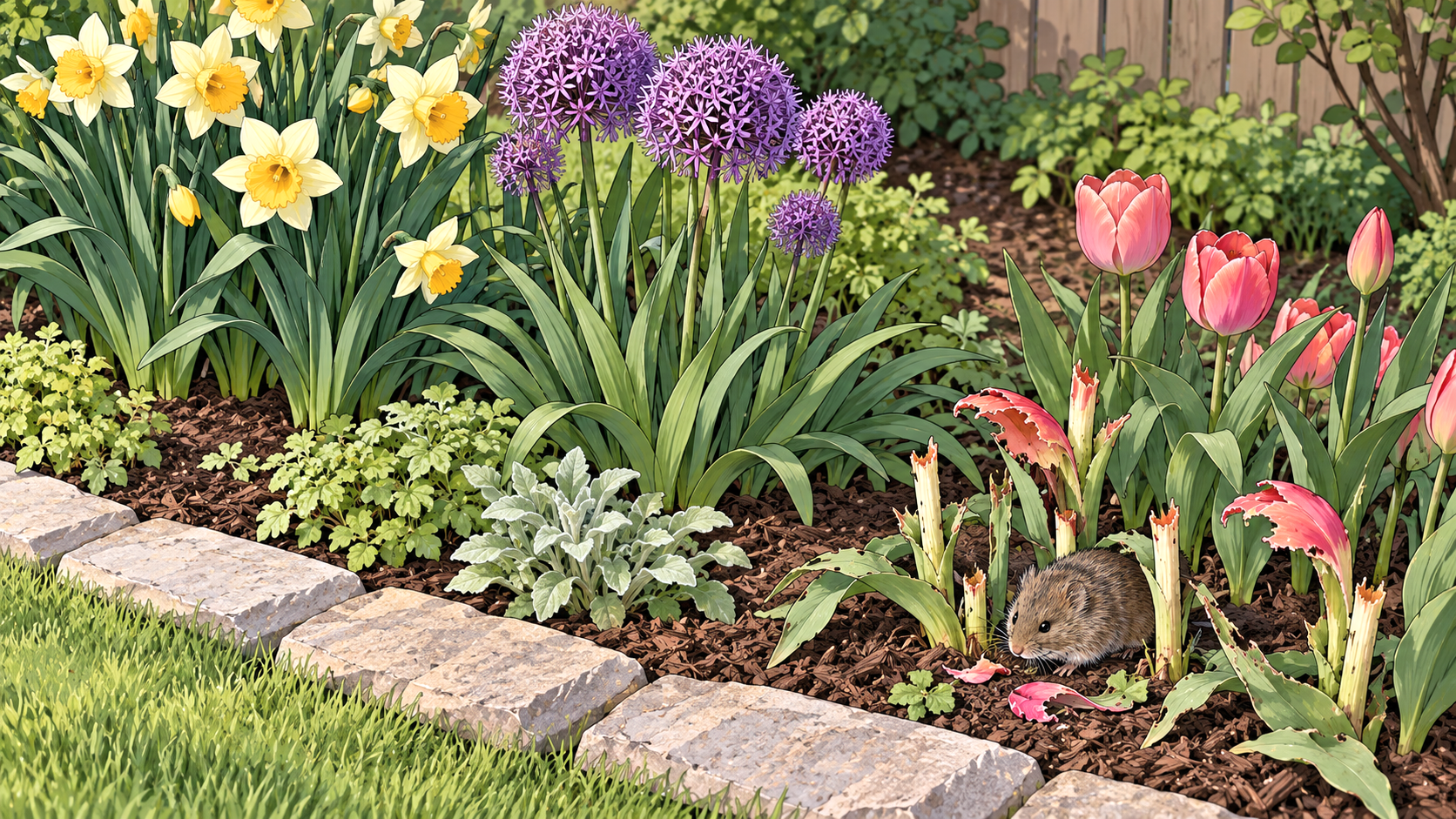
Daffodils, snowdrops, ornamental alliums, and several other spring-flowering bulbs are less attractive to voles than plants such as tulips and crocuses. However, no garden plant has been proven to reliably drive voles away simply by growing nearby. Choosing less palatable plants can reduce feeding losses, but it cannot protect every neighboring flower, vegetable, shrub, or tree.
The most useful planting choices are those that voles are less inclined to eat themselves. A garden full of resistant bulbs may suffer less damage than one planted predominantly with tulips, even when voles remain in the surrounding soil. Planting a ring of garlic or marigolds around vulnerable crops is a different claim, and one that lacks dependable evidence.
Which Plants Do Voles Tend to Avoid?
Several spring bulbs have a consistent reputation for suffering less rodent damage. Their resistance varies, and much of the available guidance concerns small garden rodents collectively rather than controlled feeding trials involving individual vole species.
| Plant | Scientific name | What the evidence supports |
|---|---|---|
| Daffodils | Narcissus spp. | Less frequently eaten than tulips and crocuses; bulbs contain toxic alkaloids |
| Snowdrops | Galanthus spp. | Generally resistant to feeding by voles and other rodents |
| Ornamental alliums | Allium spp. | Commonly listed among bulbs that rodents tend to leave alone |
| Grape hyacinths | Muscari spp. | Often suffer less rodent feeding than tulips |
| Siberian squill | Scilla siberica | Commonly recommended where bulb-feeding wildlife is a concern |
| Glory-of-the-snow | Scilla spp., including plants formerly classified as Chionodoxa | Usually considered a lower-risk bulb choice |
| Crown imperial and other fritillaries | Fritillaria spp. | Frequently recommended as less palatable, without proof of reliable protection for nearby plants |
These differences are useful when deciding what to grow. Daffodils, snowdrops, alliums, grape hyacinths, Siberian squill, and glory-of-the-snow are commonly selected because rodents generally leave them alone. However, an animal may still disturb a planting while tunneling, even when it does not eat the bulbs.
The pattern also explains why tulips and crocuses are especially vulnerable in gardens occupied by voles. Their underground storage organs provide accessible food, particularly after planting. Substituting less desirable bulbs changes what the animals encounter without requiring them to abandon the property.
Daffodils Are Among the Strongest Choices
Daffodils are a sensible first choice for gardeners who repeatedly lose spring bulbs. Their tissues contain lycorine and other alkaloids, with particularly high concentrations in the bulbs. These compounds make the plants poisonous when ingested and contribute to their reputation for being avoided by grazing and digging animals.
The toxic compounds in daffodil bulbs also create a safety concern for dogs, cats, and horses. A plant that is less appealing to voles is not automatically safe for household pets.
Daffodils work best as a replacement for bulbs experiencing repeated losses, rather than as a supposed protective border around vulnerable plants. Planting them beside tulips does not prevent a vole from traveling between the daffodils and feeding on the tulips.
This difference affects the value of the planting. Replacing a frequently damaged tulip display with daffodils may reduce losses substantially. Surrounding the same tulips with daffodils leaves their edible bulbs available underground.
Snowdrops, Grape Hyacinths, and Other Spring Bulbs
Snowdrops are another suitable option for gardens with persistent vole activity. Common snowdrops (Galanthus nivalis) are usually left alone by voles and other rodents, making them useful for naturalized plantings beneath deciduous trees and along woodland edges.
Grape hyacinths and Siberian squill offer additional choices for spring color. Both are commonly included among bulbs that digging wildlife tends to avoid. Their growth habits differ, so selection should also consider the available space and whether the plant spreads readily in the local climate.
Ornamental alliums add taller flowers to spring and early-summer borders. Many ornamental alliums prefer sunny locations with well-drained soil, making them useful companions for other drought-tolerant ornamentals. They are not guaranteed vole repellents, and the strong onion-like odor associated with the genus does not establish that an allium planting protects unrelated crops.
Fritillaries are often recommended alongside these bulbs. Crown imperial (Fritillaria imperialis) has a pronounced odor, but odor alone is insufficient evidence of reliable vole deterrence. Its value is as a possible lower-preference ornamental rather than a proven repellent surrounding other plants.
The selection of less palatable flowering bulbs can be particularly useful when the garden’s main losses involve newly planted spring displays. The same selection will not resolve damage occurring elsewhere in a vegetable bed or around a young tree.
Do Garlic, Onions, or Herbs Repel Voles?
Garlic and onions belong to the Allium genus and are often included in lists of plants voles dislike. Their strong odor and chemical constituents offer plausible reasons for lower feeding preference, but planting them around a garden has not been established as a reliable way to keep voles outside that area.
For example, a vole may avoid eating garlic while continuing to feed on a nearby lettuce seedling. The animal does not need to consume every plant along its route. It can move through a mixed planting and select the tissues it prefers.
Lavender, rosemary, thyme, mint, and sage are also commonly promoted as vole-repellent herbs. The evidence is substantially weaker than the claims. Their aromatic leaves do not demonstrate that living plants release enough repellent compounds to exclude voles from the surrounding soil.
Mint introduces a further complication. Its spreading growth can form dense ground-level cover. Voles benefit from vegetation that shelters their movements, so an extensive mint planting may provide concealment even when the foliage is not a preferred food.
Plant herbs because they suit your cooking, growing conditions, and garden design. Their fragrance should not be the reason you trust them to protect vulnerable vegetables.
What About Marigolds, Hellebores, and Other Bitter Plants?
Marigolds, hellebores, foxgloves, and castor bean plants appear on various lists of vegetation that supposedly repels voles. These recommendations often combine three separate characteristics: strong odor, toxicity, and resistance to feeding.
A plant can contain toxic substances without producing an airborne or soil-borne barrier. Likewise, an animal may avoid eating its foliage while continuing to travel through the planting.
Marigolds are frequently promoted as a natural deterrent, but reliable outdoor vole exclusion has not been demonstrated. Hellebores contain toxic compounds and are often considered resistant to browsing by some herbivores. That does not establish protection against vole feeding on neighboring roots.
Castor bean (Ricinus communis) deserves particular caution because its seeds contain ricin, a highly toxic protein. Planting it as an improvised rodent-control measure introduces a hazard unrelated to the original garden damage. A plant’s toxicity to grazing animals also cannot be used as proof of vole repellency.
We would exclude castor bean from a planting plan intended primarily to control voles. There are less hazardous ornamental choices with a clearer record of avoiding rodent feeding.
Can Voles Damage Trees That Are Supposedly Resistant?
Choosing trees and shrubs involves greater uncertainty than selecting bulbs. Voles gnaw bark on numerous woody plants, especially when other food becomes difficult to obtain. A species that rarely suffers damage in one location may still be attacked during periods of high vole activity or limited food.
Apples are particularly susceptible in orchards, but damage is not restricted to fruit trees. The risk of vole injury to woody plants depends on the animal, available shelter, and access to vulnerable bark. A tree’s reputation for resistance does not establish that an exposed young trunk will remain unharmed.
The better planting decision is to select a tree suited to the local climate, soil, and intended use, then account separately for vole pressure. Replacing an otherwise suitable fruit tree with an unfamiliar ornamental merely because it appears on an unsourced resistant-plant list may produce disappointing results.
The severity of vole damage in a garden provides a more useful basis for deciding how much protection a planting requires. Where valuable young trees are involved, plant selection should not substitute for dependable exclusion.
Why Resistant Plants Do Not Form a Protective Border
Imagine a flower bed containing twenty tulips surrounded by a continuous row of daffodils. The outer plants may be less appealing as food, but the tulips remain accessible to an animal traveling through the soil.
A botanical repellent would need to deter the vole from entering or feeding within the protected area. Low palatability establishes only that the animal is less likely to consume the resistant plant itself.
These are different outcomes:
| Claim | What it means |
|---|---|
| Voles tend to avoid eating a plant | The plant is a less preferred food |
| The plant is resistant to vole damage | It experiences less feeding under particular conditions |
| The plant repels voles | It discourages animals from approaching or remaining nearby |
| The plant protects neighboring crops | Its presence measurably reduces damage to other plants |
The first two claims can support useful gardening decisions without proving the final two. A plant’s chemical characteristics may help explain its feeding resistance, but they do not demonstrate reliable protection beyond its own tissues.
The same reasoning applies to castor oil’s limited evidence as a vole repellent. Even a concentrated repellent substance showing some experimental activity does not prove that a living plant can exclude voles from surrounding vegetation.
Choosing Plants for a Garden With Voles
When spring bulbs are repeatedly lost, replacing susceptible varieties with daffodils, snowdrops, or ornamental alliums is a practical way to reduce exposure to feeding damage. Gardeners who particularly want tulips or crocuses should retain those choices only where additional protection is feasible.
A mixed flower border requires more judgment. Voles can use dense ground cover for shelter regardless of whether its leaves are palatable. Spreading plants should be assessed for the concealment they create near vulnerable stems and planting areas, not merely for their aroma.
Food-growing beds also deserve a separate decision. The feeding preferences of voles around vegetables and tomato plants mean that adding garlic or fragrant herbs does not remove access to susceptible crops.
For a new planting, we would choose resistant bulbs where they fit the design, avoid hazardous plants promoted solely as deterrents, and reserve physical protection for anything that cannot tolerate feeding. The use of nonchemical vole management allows those choices to work together without depending on an unproven protective scent.