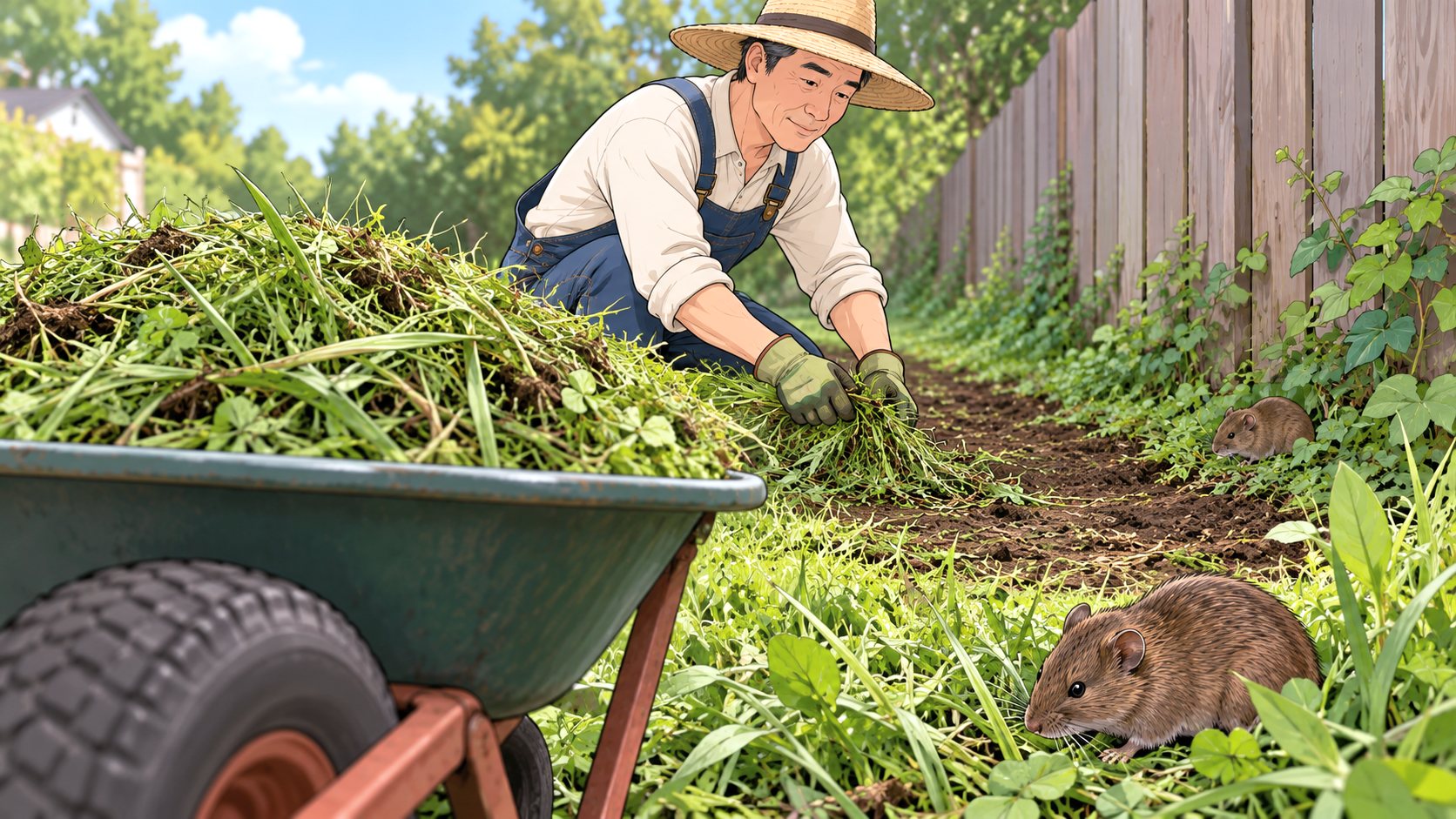
To get rid of voles naturally, remove the thick vegetation sheltering them, protect vulnerable plants with buried wire barriers, and use physical control where necessary and legally permitted. Habitat management and exclusion have stronger evidence than homemade scent repellents, ultrasonic devices, or attempts to attract more predators. These nonchemical methods can prevent serious plant damage, although they do not guarantee that every vole will leave your property.
The most useful approach depends on whether you want to exclude voles from a particular planting or reduce an established population. A hardware-cloth fence protects the enclosed area without killing animals. Removing excessive ground cover can make a feeding area less attractive. Physical trapping can reduce a small population, but its effectiveness and legal requirements differ from those of exclusion.
Keep Voles From Hiding Around Vulnerable Plants
Voles rely on grass, weeds, mulch, and other low vegetation for shelter while feeding. Removing excessive cover exposes their travel routes and makes cultivated areas less suitable for continued activity. Vegetation management can reduce vole populations and plant damage, particularly where thick growth connects surrounding habitat to vulnerable plantings.
Concentrate on the immediate surroundings of the plants being damaged. Mow long grass, remove accumulated weeds, and clear unnecessary piles of leaves or garden debris. Maintaining a vegetation-free circle approximately 4 feet in diameter around a young tree can reduce feeding pressure. Mulch should not accumulate against the trunk, where it can conceal gnawing activity.
There is no need to strip every flower bed or shrub border bare. The ways voles use sheltered habitats explain why an overgrown boundary leading directly to vulnerable plants deserves more attention than vegetation in an unaffected part of the property.
Thick ground cover can remain attractive to voles even when the lawn surrounding it is short. Maintaining the cleared areas matters because weeds and grass eventually regrow. The conditions that encourage voles to return include the restoration of the same sheltered feeding routes that supported earlier damage.
Physical Barriers Offer More Reliable Protection Than Smells
A properly constructed barrier prevents access to the plant instead of depending on the animal’s reaction to an unpleasant odor. Metal mesh, flashing, and suitable trunk guards are useful because voles can feed at ground level and tunnel beneath superficial obstacles.
For a garden perimeter, wire mesh with openings no larger than 1/4 inch can be installed at least 12 inches above ground and buried 6 to 10 inches below the surface. The buried portion prevents animals from simply entering underneath. Every corner, joint, and access gate needs the same protection.
Individual woody plants can be guarded with appropriately fitted cylinders of metal mesh or other durable material. Their lower edges must prevent underground access, while the guards need enough clearance to avoid constricting the plants as they grow. These barriers can prevent vole damage to tree bark without requiring a reduction in the entire local vole population.
Raised beds introduce a different entry point. Animals can reach crops from below when the bed has an open soil base. Installing hardware cloth across the bottom during construction blocks that route, whereas attaching mesh only to the visible sides leaves it available. A targeted approach to voles in vegetable gardens must also account for maintaining access to edible crops without leaving openings in the protection.
Physical exclusion has limits. A fence installed around an area already occupied by voles can leave the animals inside, and deteriorating mesh can develop gaps. Inspect barriers before assuming fresh feeding means that exclusion does not work.
Why Predators Cannot Be Your Entire Vole-Control Plan
Owls, hawks, foxes, weasels, and other predators consume voles. Their presence can contribute to natural mortality, but predation rarely controls a rapidly increasing vole population sufficiently to prevent damage to cultivated plants.
Installing an owl box therefore should not be treated as a dependable replacement for tree guards or garden fencing. A suitable nesting box may support local wildlife, but it does not guarantee that an owl will occupy it or hunt the specific area experiencing vole damage.
Domestic cats create additional problems. They can catch voles, but their hunting is not sufficiently selective or dependable to serve as a complete population-control method. Free-ranging cats also kill birds and other wildlife. The limitations of cats and other predators for vole control make deliberate reliance on predation a poor choice when valuable plants need immediate protection.
Maintaining a healthy outdoor environment and protecting individual crops are compatible goals. A homeowner can tolerate voles in surrounding unmanaged habitat while excluding them from a small orchard or garden.
Do Natural Repellents Actually Work?
Castor oil, capsaicin, predator scents, and various household ingredients are promoted as natural vole deterrents. Their effectiveness is much less dependable than that of physical barriers.
Repellents containing castor oil or capsaicin may discourage feeding under some conditions, but field performance is inconsistent. Treatments can lose effectiveness after rainfall, irrigation, or new plant growth. Voles also feed close to or below the soil surface, where a surface application may not adequately reach the affected area.
Predator odors offer an interesting example of the gap between laboratory results and practical treatment. In experiments involving bank voles, the compounds 2-phenylethylamine and 2-propylthietane reduced contact with food in treated areas. Those results do not establish a dependable outdoor treatment for home gardens.
Castor oil deserves the same scrutiny. A mixture that temporarily discourages an animal does not necessarily protect the area through changing weather or repeated feeding pressure. Any castor-oil treatment for voles must be judged by its actual performance rather than its natural origin.
Do not apply concentrated essential oils, homemade irritant mixtures, or substances intended for other pests to edible plants. Plant damage and unintended exposure are possible, and products sold as repellents must be used only where their labels permit.
Ultrasonic Devices, Flooding, and Other Physical Deterrents
Ultrasonic stakes are attractive because they promise control without chemicals, traps, or barriers. Unfortunately, ultrasonic and electromagnetic devices have not demonstrated effective vole control. An animal continuing to feed near an operating device is not evidence that the sound needs to be made louder or that additional units must be purchased.
Flooding burrows is similarly unreliable. Voles construct shallow systems with multiple openings, allowing water to escape without producing dependable population control. Excessive watering can also damage plants, erode soil, and create conditions unsuitable for garden maintenance.
Collapsing a visible runway presents another limitation. A runway is a travel route rather than the entire population’s living space. Destroying one exposed path may disrupt movement temporarily, but nearby shelter and feeding opportunities can remain available.
Repeatedly disturbing old trails is particularly unproductive when the animals are no longer using them. Fresh vole runways through grass are more informative than bare tracks that persist after activity has declined.
Can Trapping Be Part of Natural Vole Control?
Trapping is a physical, nonchemical method that can reduce small, localized vole populations. Snap traps are capable of killing voles, while live traps capture them without immediate lethal injury. Neither method should be confused with harmless removal.
Where vole numbers are high or activity covers an extensive property, trapping requires substantial effort and repeated monitoring. Small-area trapping is more practical than large-scale trapping, particularly when the animals occupy connected areas of dense vegetation.
Legal restrictions must be resolved before setting equipment. Protected vole species and subspecies exist, and trapping, killing, possession, or relocation can be regulated separately. The legal status of voles and permitted control methods depends on the species and jurisdiction. Where those details cannot be established, nonlethal exclusion and habitat management remain the appropriate choices.
Traps also create injury risks for children, pets, and non-target wildlife. Live capture can subject an animal to confinement, dehydration, or injury, and relocation may be unlawful or unsuccessful. For someone seeking a strictly nonlethal approach, barriers and habitat changes offer a better fit than trapping.
How to Judge Whether Natural Control Is Working
The useful measure is fresh plant damage, not the number of voles seen. Choose a few affected locations and compare new feeding with the condition recorded before treatment. The absence of new bark wounds, newly clipped stems, or renewed activity around protected plants indicates that the measures are reducing the problem where they matter.
A simple comparison can prevent unnecessary escalation. Suppose four young trees have fresh gnaw marks before individual guards are installed. If subsequent inspections show no new injury, the guards are protecting those trees even if voles remain active beyond the planting area. That is a successful exclusion outcome without evidence of population elimination.
A different response is warranted when fresh damage continues despite intact barriers and maintained vegetation. Inspect for overlooked access routes and confirm the animal responsible before adding another method. The extent of ongoing vole damage in a garden determines whether further intervention is justified.
3 thoughts on “How to Get Rid of Voles Naturally”