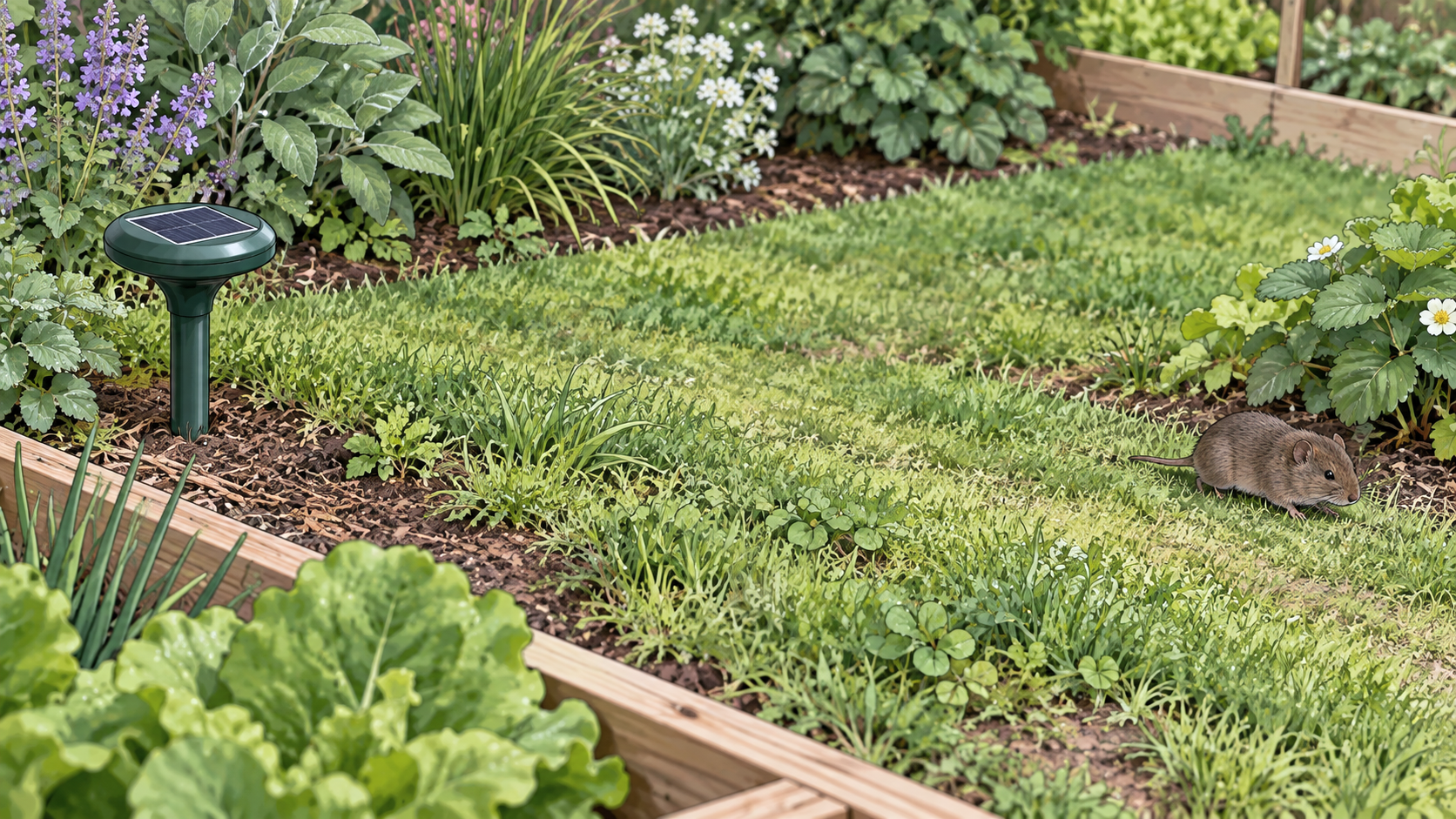
Ultrasonic, electromagnetic, and vibrating vole-repellent devices do not have convincing evidence of reliable outdoor vole control. Some sound-based devices can produce temporary avoidance responses in rodents, but that is different from preventing vole damage over an entire growing season. Solar-powered stakes and plug-in repellers are particularly questionable when manufacturers promise to protect large areas without accounting for underground travel, obstacles, or repeated exposure.
For homeowners, the deciding evidence is whether a device prevents new feeding damage. A vole reacting to a sound or vibration during a demonstration does not establish that the animal will abandon its burrow, avoid a garden, or remain away permanently.
Ultrasonic Sound Can Disturb Rodents Without Controlling Them
Ultrasonic devices emit sound above the normal range of human hearing. Manufacturers promote these signals as unpleasant to rodents, sometimes using changing frequencies or intermittent pulses to discourage animals from remaining nearby.
A rodent’s ability to detect ultrasound does not establish that the signal will repel it reliably. Commercial ultrasonic devices have produced temporary behavioral responses in some rodent experiments, but laboratory reactions have not translated into dependable long-term pest control. Animals can become accustomed to recurring signals, particularly when familiar food and shelter remain available.
The species tested also matters. Experiments involving Norway rats or house mice cannot establish that a product will control meadow voles, prairie voles, or woodland voles. Their habitats and movement patterns differ, and manufacturers rarely provide independent field trials involving the exact vole species advertised on the packaging.
For voles specifically, ultrasonic and electromagnetic devices are considered ineffective in landscape settings. Claims that a device clears an entire garden therefore require stronger evidence than a demonstration that rodents can hear its output.
Why Solar Vole Spikes Have an Exposure Problem
Solar vole repellers are commonly installed as stakes with their lower sections inserted into the ground. Many are designed to emit periodic vibrations, audible pulses, or both. Their advertising often describes the vibrations as a disturbance that encourages underground animals to leave.
There are several obstacles between producing a pulse and protecting plants. Soil composition, moisture, buried objects, and the distance from the stake affect how mechanical vibrations travel. A manufacturer’s advertised coverage area cannot establish that voles receive the same stimulus throughout that area.
More importantly, a vole does not have to occupy the exact point where the signal is strongest. Some vole species travel through surface runways, while others spend more time underground. A stake installed in one location cannot be assumed to expose every feeding route to a meaningful disturbance.
For example, a device advertised to protect a circular area with a 40-foot radius suggests coverage of approximately 5,027 square feet, calculated as π × 40². That calculation describes the advertised geometry, not a scientifically demonstrated protection zone. A single underground passage outside the effective signal range could still connect voles to susceptible plants.
The claim also becomes weaker when a garden contains several separated beds, compacted paths, retaining walls, or varied ground conditions. A radius printed on the packaging provides no assurance that such obstacles have been accounted for.
Do Voles Get Used to Noise and Vibrations?
Habituation is a major limitation of repeated frightening signals. When an animal encounters a stimulus that never produces an actual threat, its response can diminish with continued exposure.
A 2026 review of ultrasonic pest-control experiments described temporary rodent responses that declined with habituation. Those findings concern rodent studies generally and should not be interpreted as a measured habituation timetable for every vole species.
Frequency-changing devices are often marketed as a solution. Altering the sound may change the immediate stimulus, but it does not establish lasting vole repellency. A convincing test would need to show that animals continue avoiding the treated area while comparable untreated areas remain accessible.
The same standard applies to intermittent ground vibrations. A vole’s initial hesitation is a behavioral observation. Sustained reductions in fresh bark gnawing, clipped vegetation, or other feeding damage would be evidence of practical control.
What About Electromagnetic Plug-In Repellers?
Some household devices claim to send electromagnetic pulses through electrical wiring, making rooms or wall cavities uncomfortable for rodents. These products are poorly matched to a vole problem occurring in outdoor soil.
Electrical wiring inside a house does not provide a demonstrated repellent field throughout a lawn or vegetable garden. The advertised idea that wiring pulses drive rodents from buildings has also faced regulatory scrutiny because electromagnetic pest-control claims lacked adequate scientific support.
Similar problems affect combination units that advertise ultrasound and electromagnetic pulses together. Combining two unproven methods does not establish improved effectiveness.
A vole seen near the foundation should first be distinguished from an indoor house mouse. Voles and mice differ in habitat and behavior, and treating an outdoor vole problem with an indoor plug-in device does not address the animals’ feeding routes.
How Strong Is the Evidence Behind Device Claims?
Commercial device advertising often relies on features that sound technical but do not demonstrate effectiveness. Frequency range, pulse interval, solar charging capacity, and advertised coverage describe a product’s operation. They do not establish a measurable reduction in vole populations or plant damage.
Several past claims about ultrasonic rodent devices were challenged because they lacked adequate evidence. The Federal Trade Commission warned manufacturers about unsupported pest-control advertising, including representations that devices eliminated infestations or replaced established treatment methods.
Controlled research offers a better standard than customer anecdotes. Testing commercial ultrasonic rodent repellers under laboratory and field conditions requires comparing activity when devices are operating with equivalent periods when they are switched off. Such tests can measure feeding, tracks, and other observable responses instead of relying on perceived changes.
The following distinctions are useful when evaluating an advertised device.
| Claim or evidence | What it establishes |
|---|---|
| The device emits ultrasonic sound | It produces a signal, not necessarily effective repellency |
| A vole reacts to a sudden pulse | The stimulus causes an immediate response |
| Fewer animals appear near the device | Activity changed, but the cause remains uncertain |
| A controlled test shows less fresh damage | Evidence of protection under the tested conditions |
| Independent field trials show lasting results | Stronger support for practical effectiveness |
A product with a frequency specification but no meaningful vole-specific field evidence has not demonstrated that it protects plants.
Are Ultrasonic Devices Safe Around Dogs, Cats, and Wildlife?
Avoiding poison is an advantage of electronic repellents, but it does not prove that every device is harmless. Some units produce audible sounds alongside ultrasound, and animals can differ in their hearing sensitivity. A household pet may detect a signal that its owner cannot hear.
The absence of an audible noise is also an unreliable way to assess the device. Ultrasonic repellers can produce measurable high-frequency sound, although their output varies by model. Neither a silent room nor an indicator light establishes that the device is operating effectively against voles.
A dog repeatedly avoiding an area near a repeller or showing signs of distress deserves attention. Follow the manufacturer’s precautions and discontinue use if an animal appears affected. No claim of pet safety should be accepted solely because a product uses sound rather than chemicals.
Is Buying an Ultrasonic Vole Repeller Worth It?
We would not recommend purchasing an ultrasonic or vibrating device as the primary protection for a garden experiencing confirmed vole damage. The evidence is too weak to justify depending on it where another feeding incident could destroy a young tree or valuable planting.
If you already own a device, judge it by fresh damage rather than its operating light or periodic buzzing. Photograph the affected plants and check for new feeding in the same locations. Continue observing nearby untreated areas, because a reduction in activity at one point does not establish that the local vole population has declined.
The appearance of active vole damage provides a more useful measure than how often an animal is seen above ground. Where bark injury or plant losses continue, physical exclusion and vegetation management offer more dependable ways to protect vulnerable plants.
A device that cannot demonstrate lasting protection should not delay effective intervention. For vole problems concentrated in a yard, the location of fresh feeding and available shelter provides a better basis for choosing control measures. Where ongoing damage affects valuable plantings, prioritizing proven protection avoids spending another growing season testing electronic promises.