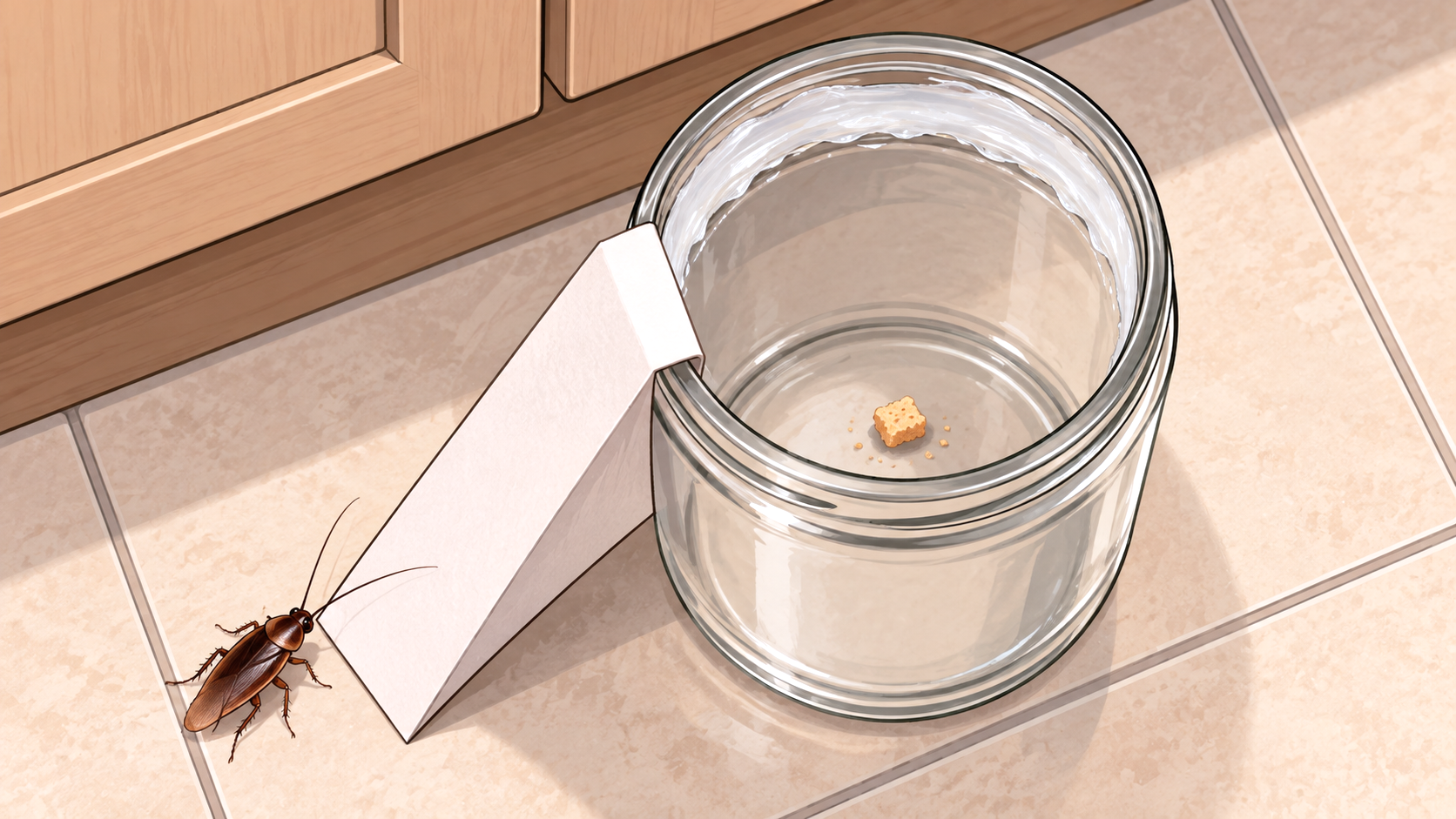
A homemade cockroach trap does not need an elaborate mechanism. A glass jar, a small amount of food bait, and a slippery inner surface can capture cockroaches without insecticide. Sticky traps made from cardboard and suitable adhesive can also intercept insects, although their effectiveness depends on the materials and design.
The best-supported homemade cockroach trap is a baited glass jar with petroleum jelly around its upper interior. Researchers have successfully used jar traps to collect German cockroaches, while studies of sticky traps show that placement, adhesive coverage, and attractants can strongly influence captures.
These traps are most useful for catching exposed cockroaches and monitoring activity. They cannot be relied upon to eliminate an established infestation, particularly when insects remain concealed elsewhere.
Make a Glass Jar Trap With Petroleum Jelly
A glass jar trap works by allowing cockroaches to enter for food while making the upper interior too slippery for them to climb out. Unlike a pesticide bait, the food attracts insects without poisoning them.
You will need:
- A clean, dry glass jar with smooth sides
- Petroleum jelly
- A small piece of bread or a little peanut butter
- A strip of cardboard for an entrance ramp, if necessary
- A secure temporary cover for handling captured insects
Choose a wide-mouthed jar with sides tall enough to prevent easy escape. Apply a continuous band of petroleum jelly, approximately 2 inches (5 cm) wide, around the inside near the rim. Leave the lower interior relatively clean so that insects entering the jar can fall or climb down toward the bait.
Place a small amount of food at the bottom, then position the jar upright against a wall in an area where cockroaches have been seen. A short cardboard ramp can help insects reach the opening if the jar’s exterior is difficult to climb. Keep the ramp outside the jar rather than allowing it to extend down into the container, which could create an escape route.
North Carolina State University’s German cockroach guidance specifically recommends a homemade baby-food jar trap using petroleum jelly, bread, and beer. Its design relies on the slippery interior to prevent captured cockroaches from climbing back out.
Check the jar each morning. Never assume trapped insects are dead; cover the jar securely before moving it and avoid leaving captured cockroaches indoors. Wash the container thoroughly if you intend to reuse it.
Does the Petroleum Jelly Really Prevent Escape?
Petroleum jelly is one of the better-supported components of the jar design, although an incomplete or contaminated band can reduce its effectiveness.
In a 2008 laboratory comparison of German cockroach traps, researchers found that jars with a thin petroleum jelly barrier captured approximately twice as many cockroaches as jars using a powdered clay barrier. The difference reflected improved prevention of escape.
For the slippery band to work, it must extend around the entire interior circumference. Crumbs, dust, or other debris sticking to the coating may provide footholds. Replace the jelly when it becomes contaminated or develops gaps.
Jar construction also affects which insects are caught. The same research found that jar traps captured substantially fewer cockroaches than the most effective commercial sticky traps. Another study comparing jar and adhesive traps found that baby-food jar traps tended to catch proportionally more adults and larger nymphs than sticky traps.
A homemade jar can therefore be useful even when it collects only a few insects, but an empty jar should not be interpreted as evidence that small cockroaches are absent.
Make a Simple Adhesive Cockroach Trap
A second homemade approach uses a piece of stiff cardboard with an adhesive surface to intercept cockroaches traveling along walls. The cardboard supports the adhesive, while a small attractant may increase the likelihood that nearby insects cross it.
For this design, use a commercially manufactured insect-trapping adhesive sheet or a flat glue board as the sticky surface, mounted on a piece of cardboard if extra support is needed. Ordinary double-sided stationery tape may catch some insects but is not a dependable substitute for purpose-made insect adhesive.
Place the adhesive surface flat against a wall edge or inside a shallow cardboard shelter, ensuring that the openings remain unobstructed. A tiny amount of peanut butter or another suitable lure can be placed centrally if it can be added without covering the adhesive.
A 2006 study of German cockroach traps and attractants found that flat sticky traps captured more cockroaches than some folded versions of the same trap. Its results also showed that adding suitable food attractants increased captures compared with unbaited traps.
Avoid homemade mixtures of cooking oil, syrup, and household glue. These materials may become messy, attract other pests, or fail to hold a cockroach securely. Keep exposed adhesive away from pets and children, and use covered traps where unintended animal contact is possible.
This design is useful when you want to observe where insects are moving without opening a jar containing live cockroaches.
Which Homemade Bait Attracts the Most Cockroaches?
Bread moistened with a little beer has some of the strongest experimental evidence among simple food attractants for German cockroaches. In the 2006 trap comparison, this combination increased sticky-trap captures approximately 34-fold compared with an unbaited trap under simulated kitchen conditions. Peanut butter also improved catches, though by a smaller amount.
These results do not guarantee the same performance in an occupied home. Cockroaches may already have accessible food nearby, and the effectiveness of an attractant changes with freshness and location.
University of Maine Cooperative Extension also identifies apples, potatoes, and banana peels as possible jar-trap attractants. Such alternatives are useful when beer is unavailable or undesirable, although they have not all performed equally in controlled comparisons.
Use small amounts and replace them before they dry out, spoil, or develop mold. Larger quantities are not necessarily better, and food left outside a functioning trap can feed insects instead of capturing them. The wide variety of foods cockroaches consume explains why several household ingredients may attract them, but attraction by itself does not establish that a trap will retain them.
Where Should You Put Homemade Cockroach Traps?
Placement often determines whether a simple trap captures anything at all. Cockroaches tend to follow protected edges, so positioning a trap directly against a wall or fixed cabinet is generally more productive than leaving it in an open room.
The EPA’s school pest-management manual recommends placing cockroach monitors along normal travel routes and checking catches after 24–48 hours. Its examples include the edges of kitchen cabinets, accessible spaces beside appliances, and areas near plumbing.
For homemade traps, position each one where the insects can enter without crossing a large exposed area. Keep jars upright and stable, particularly near children or pets, and avoid placing food-baited containers on surfaces used to prepare meals.
If a jar remains empty for two or three nights despite continued sightings, try a different location. The movement patterns of cockroaches mean that a trap only a short distance from an active route may still receive few visitors.
Several traps in different locations can provide a clearer picture than one large trap. Record their positions and compare catches rather than moving all of them every night.
Why Plastic Bottle and Funnel Traps Are Less Dependable
Another popular design uses a plastic bottle cut into two sections, with its upper portion inverted to form a funnel leading into a baited chamber.
The concept is reasonable: insects enter through the funnel and supposedly struggle to find the narrow exit. However, an ordinary plastic bottle does not necessarily prevent cockroaches from climbing back out. Depending on the species and the texture of the bottle, they may climb the inner walls or return through the opening.
There is substantially stronger published evidence for petroleum-jelly jar traps than for homemade bottle funnels specifically targeting household cockroaches. Anyone experimenting with a bottle design should consider it an unvalidated alternative, not a proven replacement.
The ability of cockroaches to climb smooth surfaces makes escape prevention particularly important. A trap that attracts insects but allows them to leave can accomplish little beyond providing an additional food source.
What Can Trap Captures Tell You?
A homemade trap can confirm the presence of cockroaches, but its catches do not represent an exact count of the surrounding population.
Jar traps may favor adults and larger nymphs, while certain adhesive traps capture proportionally more small nymphs. Comparing one night’s jar catch with the following night’s sticky-trap catch therefore does not provide a reliable measure of population change.
For ongoing monitoring, keep the same design, location, bait quantity, and checking interval as consistent as possible. Note whether captures are rising, falling, or concentrated in one area. Replace spoiled bait and ineffective adhesive promptly.
If cockroaches appear repeatedly in traps, the criteria for determining whether an infestation has ended have not been met. Conversely, an empty homemade trap cannot prove absence, especially when its ability to capture smaller insects is limited.
The EPA’s monitoring recommendations emphasize using traps to locate activity and guide decisions. A trap is most informative when its catches are recorded rather than judged by a single inspection.
Can Homemade Traps Eliminate a Cockroach Infestation?
Homemade traps can remove individual insects and occasionally substantial numbers when placed in active locations. Nevertheless, controlled comparisons show that even purpose-made trapping systems vary greatly in effectiveness, and sticky traps alone are generally inadequate for eliminating established German cockroach infestations.
Cockroaches that remain concealed, females carrying egg cases, and insects that do not approach the bait may never enter a trap. The shared hiding places occupied by cockroaches can contain individuals of different developmental stages that are not equally likely to be captured.
For a few insects, a baited jar is an inexpensive, reusable monitoring option. For continuing indoor populations, trapping can identify where further intervention is necessary without requiring homemade poison mixtures or unsupported killing claims.