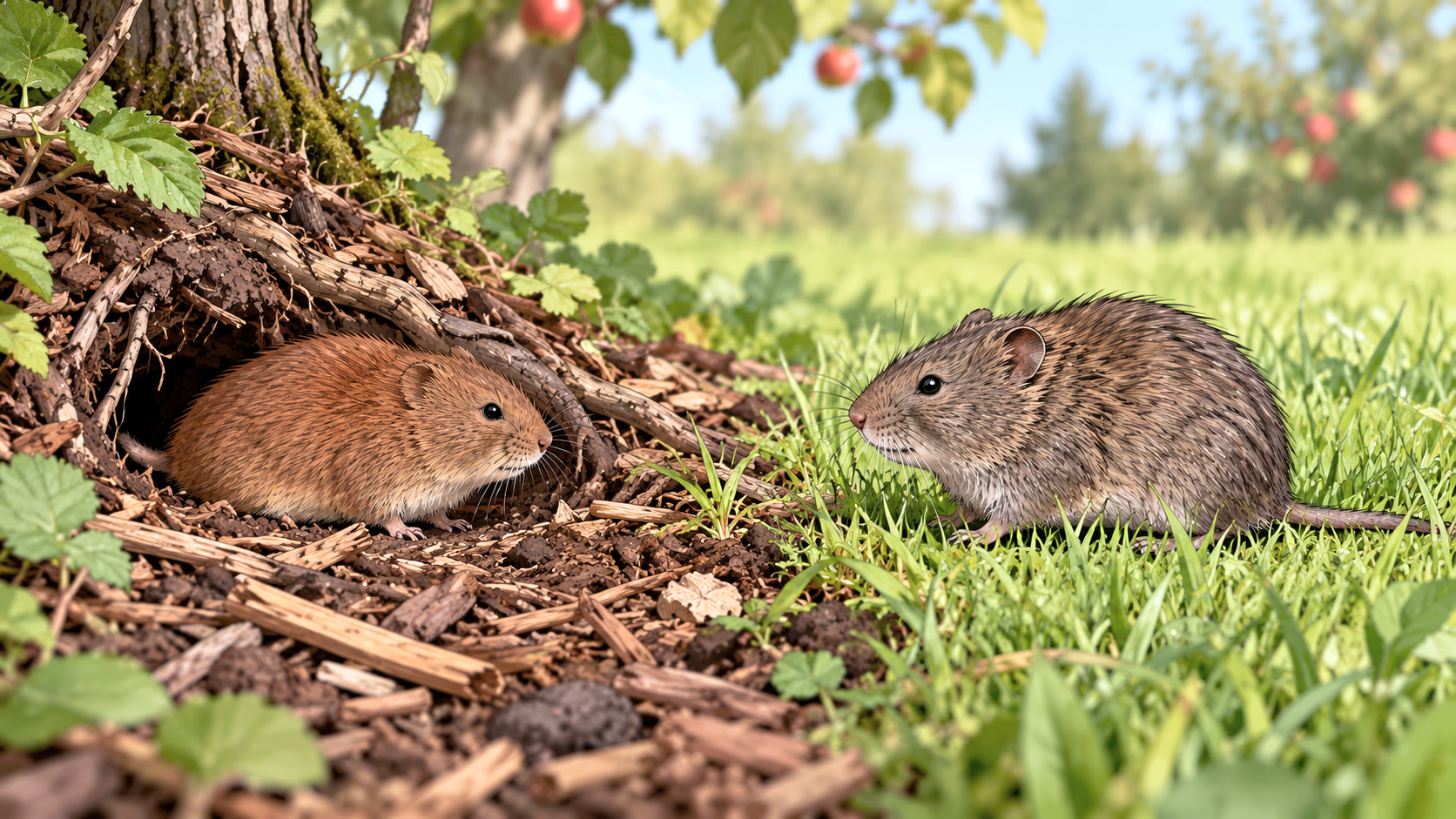
A lawn covered with narrow trails points more strongly toward meadow voles, while an animal leaving little visible surface activity but using underground passages may be a pine vole. Pine voles, also called woodland voles (Microtus pinetorum), are smaller, shorter-tailed, and more specialized for underground living than meadow voles (Microtus pennsylvanicus). Meadow voles are generally larger, with more noticeable eyes, longer tails, and a greater tendency to travel through vegetation at ground level.
Both species occur in parts of eastern North America, sometimes within the same orchard or landscaped property. Their physical differences can help identify an animal that has actually been seen, but damaged roots, holes, and runways are supporting evidence rather than definitive proof of either species.
Start With the Tail, Eyes, and Fur
The tail offers one of the clearest differences. A woodland vole has an extremely short tail, generally about as long as its hind foot, whereas a meadow vole’s tail is typically about twice the length of its hind foot. This difference is more dependable than estimating an animal’s size while it moves through grass.
Pine voles also have very small eyes and ears that are largely concealed by their fur. Their coat is short, dense, and silky, often appearing chestnut or reddish brown. Meadow voles have somewhat more visible eyes and ears, with a coarser coat that is usually brownish gray or dark brown.
The short tail, concealed ears, and distinctive chestnut coat of woodland voles are adaptations associated with their underground lifestyle. Their comparatively strong forelimbs and digging claws also help them excavate and move through soil.
| Feature | Pine or woodland vole | Meadow vole |
|---|---|---|
| Scientific name | Microtus pinetorum | Microtus pennsylvanicus |
| Adult weight | Commonly 17–35 g | Commonly 20–68 g |
| Approximate total length | 10–13 cm | 12–20 cm |
| Tail | Very short, roughly equal to hind-foot length | Longer, commonly about twice hind-foot length |
| Eyes | Small and inconspicuous | More visible |
| Ears | Almost hidden in fur | Partly visible |
| Coat | Short, smooth, reddish or chestnut brown | Coarser, grayish or dark brown |
| Movement | Predominantly underground | Frequently along surface runways |
Measurements vary among individuals and populations. Young meadow voles can overlap in size with adult woodland voles, and coat color changes with season. The typical appearance of meadow voles is therefore more useful when several physical features can be examined together.
The general body proportions of voles explain why both animals look stockier and shorter-faced than ordinary house mice, but those shared features cannot distinguish one vole species from the other.
Surface Runways Favor Meadow Voles
Meadow voles regularly move through narrow pathways beneath grass, weeds, and accumulated vegetation. In an occupied area, the repeated passage of animals can press vegetation aside and leave well-defined tracks across the soil surface. Freshly clipped grass and droppings may accumulate along these routes.
The surface runway systems associated with meadow voles are particularly noticeable after snow melts or dense vegetation is removed. Several tracks may connect feeding areas, burrow entrances, and sheltered resting places.
Woodland voles generally spend much more time beneath the soil. They construct underground networks and may also occupy abandoned tunnels made by moles. Their movements can occur without producing the extensive aboveground trails commonly associated with meadow voles.
A yard showing fresh vole runways through grass therefore provides stronger evidence for meadow vole activity. Yet woodland voles occasionally emerge aboveground, and meadow voles also use burrows. The presence or absence of visible trails should influence the identification, not settle it independently.
The condition of the vegetation matters as well. A closely maintained lawn may reveal old tracks long after they were formed, while an occupied area beneath thick mulch can conceal activity from casual inspection.
Underground Root Damage Raises Suspicion of Pine Voles
Woodland voles are particularly associated with feeding beneath the soil surface. Their diet includes roots, underground plant tissues, and other available vegetation. In orchards and nurseries, they can injure roots without producing obvious aboveground feeding evidence.
Meadow voles more commonly cause visible damage at or near the ground surface, including feeding on stems and lower portions of woody plants. This difference can help explain why a plant appears injured even when few runways are visible.
The underground feeding habits of pine voles make them important suspects where roots show rodent gnawing beneath otherwise intact surrounding vegetation. Meadow voles remain possible, however, because their activity is not restricted to aboveground feeding.
Damage alone is insufficient for species identification. Other rodents can consume roots and underground plant parts, while environmental problems may produce plant symptoms resembling feeding injury.
The different patterns of vole damage to trees are most informative when the affected tissue can be examined directly. A struggling plant with no visible roots or feeding marks cannot establish that woodland voles are present.
Similarly, the consumption of bulbs and roots by voles is not exclusive to one species. The location and character of the damage may support an identification, but they do not replace seeing or otherwise reliably identifying the animal.
Woodland Borders and Mulched Beds Are Important Habitat Clues
Pine voles are associated with forest interiors, woodland edges, and areas containing substantial leaf litter. They also inhabit orchards, nurseries, and residential landscapes where mulch or established vegetation provides cover.
Meadow voles generally prefer grassy environments, particularly fields, meadows, wet pastures, and densely vegetated margins. They can occur in woodland openings or shrub borders when sufficient grassy cover is available.
The woodland vole’s preference for forest edges and leaf-litter habitats can help narrow identification on properties where both species occur. A vole discovered beneath accumulated leaves in a shaded woodland border is more consistent with woodland vole habitat than one regularly crossing an open grassy area.
On mixed properties, the two species may occupy different portions of the same landscape. Orchard rows bordered by woods can provide sheltered underground habitat for woodland voles, while grassy strips between trees may support meadow voles.
The habitat preferences of meadow voles also change with vegetation structure and local conditions. A grassy orchard floor cannot be assumed to support meadow voles exclusively, particularly where underground cover and nearby woodland are available.
Check Whether Pine Voles Actually Occur in Your Region
Geography can eliminate one of the two candidates before close identification becomes necessary.
Woodland voles are native to eastern North America, with their distribution extending through parts of the eastern United States into southern Ontario and Quebec. They reach the northern limits of their range in Canada, where their occurrence is comparatively restricted.
The Canadian distribution of woodland voles is limited to portions of Ontario and Quebec, and Canadian populations have conservation significance. A suspected pine vole in Manitoba, Saskatchewan, or British Columbia would therefore require reconsideration of the species identification.
Meadow voles have a substantially broader distribution. They occupy much of Canada and large portions of the United States, including areas where woodland voles are absent.
The extensive geographical range of meadow voles makes them a more plausible explanation for many grassland sightings across northern and western North America.
Not every short-tailed vole found outside the woodland vole’s range is a meadow vole. Other Microtus species and related small rodents may occupy the same environments. A correct identification begins with determining which species are known from the region rather than choosing between two animals that may not both occur there.
Can Both Species Use the Same Burrow System?
Woodland voles sometimes occupy tunnel networks originally excavated by moles or other voles. This ability can make underground signs difficult to interpret, particularly where several small mammals occur on the same property.
The use of abandoned mole tunnels by woodland voles means that a tunnel’s original excavator and its current occupant may be different animals. Meadow voles can also establish underground passages, so finding a burrow beneath the lawn does not prove pine vole activity.
Evidence gathered at an entrance may indicate current occupation without revealing the animal responsible. An opening can be reused, abandoned, or connected to passages serving more than one part of a property.
The appearance of vole burrows and their entrances can help distinguish ordinary vole activity from the larger earthworks associated with some other burrowing mammals. The visible opening still does not identify Microtus pinetorum or Microtus pennsylvanicus by itself.
An area containing prominent surface runways alongside underground passages may support meadow voles, woodland voles, or both. A reliable species determination requires evidence beyond the tunnel arrangement.
When Is a Photograph Enough for Identification?
A clear side-view photograph showing the entire animal is often sufficient to make a reasonable field identification, particularly when the tail and ears are visible. Including an object of known size in the frame can help establish approximate proportions without handling the animal.
The combination of a very short tail, concealed eyes and ears, small body, and smooth chestnut coat strongly favors a woodland vole. A larger animal with a longer tail, more apparent eyes, and coarse brownish fur favors a meadow vole.
Identification becomes less reliable when the animal is immature, its coat is wet, or most of its body remains hidden. Photographs taken from above can also make a tail appear shorter and obscure the ears.
The similarity of woodland voles to other short-tailed mammals is an additional concern where southern bog lemmings or red-backed voles occur. These animals can overlap geographically and share some external characteristics.
Where species identification has legal, conservation, or research consequences, professional examination may be needed. Dental characteristics and other anatomical features can provide stronger evidence than a fleeting observation.
For an ordinary yard sighting, a cautious identification based on several consistent features is preferable to assuming that every underground vole is a pine vole or every animal crossing the lawn is a meadow vole.