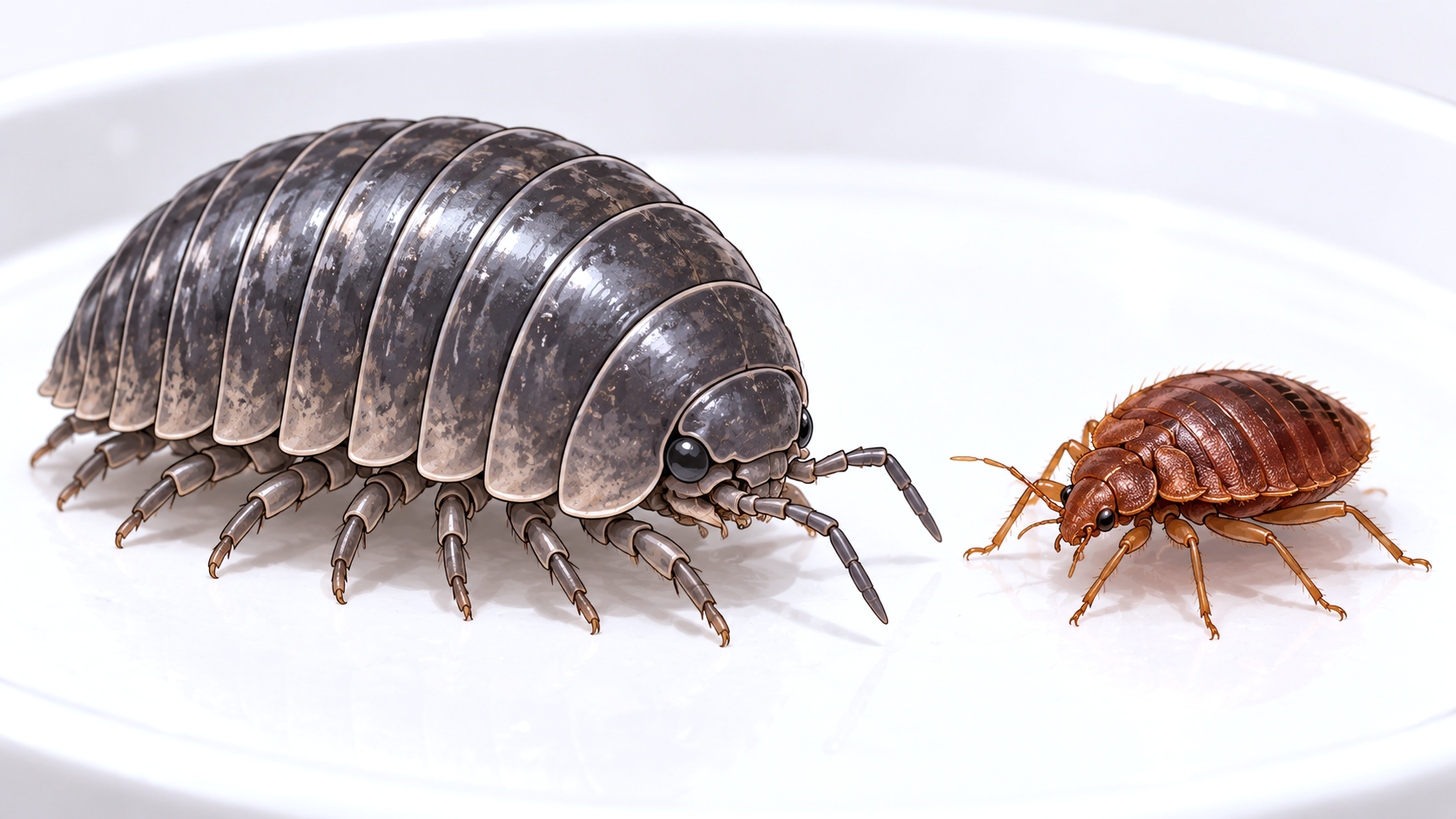
A roly-poly is rounded, heavily segmented and has 14 walking legs, while a bed bug is a flat, oval insect with six legs. Roly-polies favor damp areas near soil and may roll into a ball. Bed bugs hide close to resting hosts, feed on blood and leave characteristic infestation evidence around beds and furniture.
Color can cause momentary confusion because both may appear brownish or dark, but body construction, behavior and the place where the animal was found usually separate them quickly.
Count the Legs if the Animal Is Intact
Leg count provides one of the clearest physical checks. An adult roly-poly has seven pairs of walking legs, giving it 14 in total. Those legs run along much of the underside of its distinctly plated body. This arrangement comes from its terrestrial-isopod anatomy and reflects the fact that roly-polies are crustaceans rather than insects.
A bed bug has six legs. Adult bed bugs are typically about 5 to 7 millimeters long and have a flat, oval body when they have not recently fed. The abdomen is visibly segmented, but it does not have the succession of hard overlapping dorsal plates that gives a roly-poly its armored appearance. A recently fed bed bug becomes more elongated and swollen, with its color shifting toward reddish brown as blood fills the abdomen.
A roly-poly is generally more convex from the side. Its upper body forms a dome capable of closing around the underside. If you can see seven pairs of legs beneath a series of broad plates, you are not looking at a bed bug.
A Tight Ball Rules Out a Bed Bug
Disturb the animal gently and watch its response. Many familiar pillbugs in the genus Armadillidium can pull their appendages inward and close the body into a compact ball. Bed bugs cannot perform this behavior.
A bed bug remains visibly insect-shaped when disturbed. It may run toward a crack, seam or other cover, but it cannot enclose its legs inside an armored sphere. Bed bugs also cannot jump or fly, so an unidentified animal that leaps away is something else. Movement can be especially helpful when a dark photograph hides fine anatomical details. A pillbug may pause, curl or roll after contact. A bed bug typically crawls away while retaining its flattened profile.
Where You Found It Changes the Identification
A roly-poly discovered beside a basement wall, exterior doorway, plant pot or damp ground-level room fits the animal’s environmental requirements. Pillbugs normally occupy humid shelters beneath rocks, litter, wood and other debris, and individuals entering houses frequently die because indoor air is too dry for them. Canadian pest guidance likewise notes that pillbugs need moist conditions to survive.
A specimen tucked into a mattress seam deserves a different level of scrutiny. Bed bugs hide near places where people sleep, including mattress seams, box springs, headboards, bed frames and nearby cracks. Their flattened bodies allow them to occupy very narrow hiding places around sleeping areas. They can also occur in couches, chairs, luggage and other objects that provide shelter or transport. Location is evidence, not identification by itself. A roly-poly can wander farther into a building, and a bed bug can be found away from a mattress. Combine the location with body form and the surrounding signs before deciding what the animal is.
The Area Around a Bed Bug Usually Tells More of the Story
A lone dark arthropod on a sheet can be difficult to judge when it has been crushed or photographed poorly. Bed bug infestations produce physical evidence that roly-polies do not. Useful signs include live bed bugs, tiny pale eggs, shed nymphal skins, dark fecal spots and rusty or reddish stains where bugs have been crushed. These are among the physical signs used to confirm bed bug activity.
Roly-polies shed their exoskeleton too, but pillbug molting occurs in two major phases rather than producing the bed bug evidence associated with a blood-feeding infestation. They do not establish blood-feeding harborages in mattress seams, and they do not create the characteristic fecal spotting associated with bed bugs.
Several suspicious signs appearing together around a sleeping area deserve more weight than a skin mark alone. A confirmed insect specimen, fecal spotting, eggs or shed skins can provide direct evidence of an infestation.
A Skin Mark Cannot Identify Which Animal You Found
Roly-polies do not feed on blood and are not considered biting or stinging hazards to people. Bed bugs have piercing-sucking mouthparts and feed on human and animal blood, usually while a host is resting. Their bites can cause itchy inflammatory reactions, although some people develop little or no visible reaction.
A bite-like mark still cannot confirm bed bugs. Reactions vary substantially between people, and bed bug lesions can resemble those produced by mosquitoes, fleas and other biting arthropods. Clinical guidance therefore cautions that skin reactions alone are not diagnostic for bed bugs. Identification is stronger when an actual bed bug or other infestation evidence is recovered from the sleeping environment. Finding a roly-poly near someone who has unexplained skin marks does not connect the two events. Its presence is more consistent with outdoor pillbugs wandering into a house than with an organism feeding on the occupant.
Young Bed Bugs Can Be Much Paler Than Adults
An adult bed bug is usually brown to reddish brown, whereas unfed nymphs can be translucent or whitish yellow. Newly hatched nymphs are about 1.5 millimeters long and become progressively larger through five nymphal stages. Their general body plan resembles a smaller, paler adult.
Young roly-polies can also be pale, so color becomes particularly unreliable when comparing juveniles. Baby roly-polies begin life much smaller and lighter than typical adults, but their developing isopod body still differs from a six-legged bed bug nymph. Magnification can reveal the leg arrangement and segmentation when the animal is too small to examine easily with the naked eye. An unknown pale speck beside a bed therefore should not be classified from color alone. Capture the specimen intact if possible and examine its structure.
The Identification Changes What the Sighting Means
One roly-poly indoors usually represents an occasional invader associated with moisture and access from outside. Several may appear when outdoor populations are high or a basement remains damp, but indoor roly-poly removal focuses on the conditions allowing those animals to enter and survive.
A confirmed bed bug has a different significance because the insect can reproduce indoors and maintain a population close to human hosts. Bed bugs also spread between locations by hiding in luggage, furniture, bedding, clothing and other belongings. Public-health guidance identifies live insects, exoskeletons and stains around sleeping areas as evidence worth investigating.
Correct identification needs to come before any pest-control decision. Spraying a bedroom because a pillbug wandered across the floor wastes treatment and can create unnecessary pesticide exposure, while dismissing a genuine bed bug as an outdoor roly-poly can allow an infestation to continue.
Questions That Help With Difficult Roly-Poly and Bed Bug Identifications
Can a roly-poly be found on a bed?
Yes. An accidental wanderer can reach places that are not suitable habitat, including bedrooms. Its presence on a bed does not transform it into a bed-associated pest. Body structure and additional infestation evidence remain more informative than the surface where one specimen happened to stop.
What if the bug was crushed before I could count its legs?
Preserve whatever remains instead of relying on memory. Clear tape or a sealed transparent container can keep a specimen available for examination. Bed bug identification guidance recommends capturing examples for proper identification before taking further action.
Can a bed bug look round after feeding?
Yes. Feeding expands the abdomen and makes a bed bug more elongated and swollen than an unfed individual. It still does not acquire the hard overlapping plates or rolling ability of a pillbug.
Could both pests be present in the same home?
Yes. Finding one does not exclude the other because they enter or persist for entirely different reasons. Each suspected specimen needs to be identified from its own physical features and associated evidence.