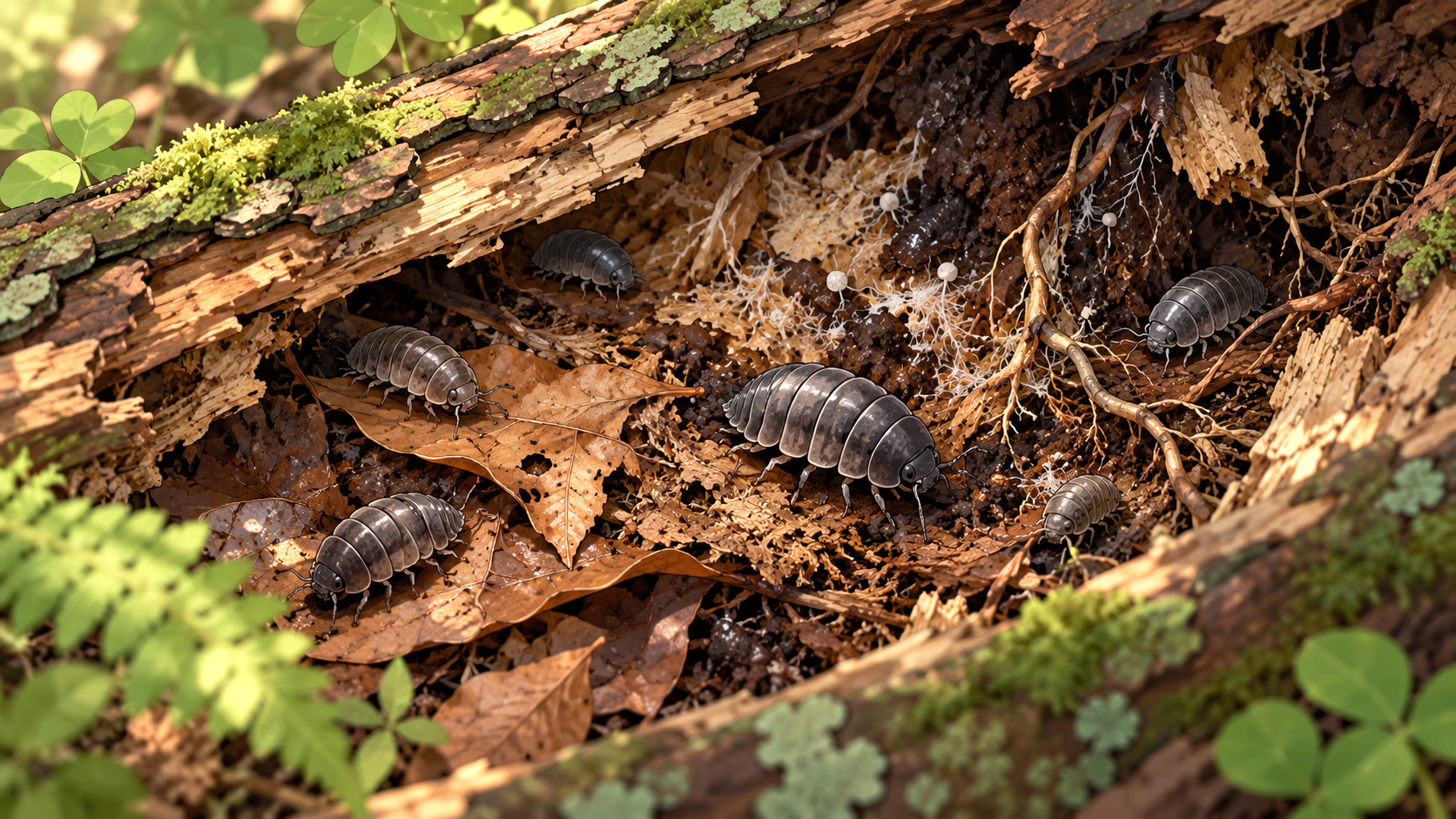
Roly-polies are decomposers that help process dead plant material, influence nutrient cycling and interact with soil microorganisms. By chewing litter into smaller particles and producing feces that microbes can colonize, they alter how organic matter is broken down. They also become food for other animals, connecting decomposing vegetation with higher levels of the food web. Their importance varies among habitats, species and litter types. Roly-polies do not perform decomposition alone, nor do they simply turn dead leaves directly into plant fertilizer. Their ecological role emerges from repeated interactions among litter, microbes, soil and other organisms.
A Fallen Leaf Passes Through More Than One Decomposer
Dead leaves can remain physically tough even after microorganisms begin colonizing them. Roly-polies enter this process as macrodetritivores. Their diet is dominated by dead and decaying organic material, and their chewing mouthparts break pieces of litter apart before and during ingestion. A major review of terrestrial-isopod nutrition describes this mechanical and chemical breakdown of plant litter as an important contribution to decomposition.
Fragmentation changes the material available to smaller decomposers. Breaking a leaf into smaller pieces increases the amount of exposed surface that microorganisms can colonize. Some material is ingested, digested and returned to the environment as feces, while other fragments remain available in the litter layer. Terrestrial isopods therefore function partly as litter processors rather than organisms responsible for every biochemical step of decay.
Experiments confirm that their influence can be measurable. Field microcosms containing terrestrial isopods showed greater litter decomposition than controls without them. The size of the effect varied with litter type and isopod treatment, so the result does not justify a fixed claim about how much faster every leaf decomposes when roly-polies are present.
Their Feces Become Part of the Decomposition System
Material leaving a roly-poly’s digestive tract is physically and chemically different from the leaf material it consumed. Isopod feces can contain relatively accessible carbon and nitrogen compounds and provide substrate for microorganisms. The same nutritional review that describes litter processing notes that isopod feces support dense microbial populations.
This creates an indirect route through which roly-polies influence decomposition. In laboratory soil incubations, feces produced by Armadillidium vulgare altered microbial biomass and extracellular enzyme activity, with effects depending on the quality of the material the animals had eaten. Feces produced from higher-quality litter could accelerate decomposition of more resistant litter.
Microbes remain major biochemical decomposers. Roly-polies modify the material those microbes encounter through chewing, digestion and defecation. Their own diverse associations with microorganisms may also influence how plant detritus is processed; terrestrial isopods host complex microbial communities relevant to decomposition and nutrient cycling.
Nutrients Move From Litter Toward the Soil
A leaf contains carbon, nitrogen, phosphorus, potassium and other elements that remain tied up in organic material after it falls. Decomposition gradually changes their chemical forms and distribution. Because roly-polies consume and transform litter, their activity can influence how those nutrients move through the surface layers of soil.
Field microcosm experiments found that isopod activity during litter decomposition increased several measured nutrients in surface soil, including organic carbon, total nitrogen and available forms of phosphorus, potassium and inorganic nitrogen. The strongest effects occurred near the surface where the animals and litter interacted. Those results support an ecological role in soil nutrient release during decomposition, not a claim that every garden gains a predictable quantity of nutrients from each pillbug.
Litter quality also changes the outcome. Armadillidium vulgare does not process every plant residue at the same rate, and experiments with vine leaves found that lignin, tannin and copper concentrations influenced consumption and assimilation. The ecological effect of a roly-poly population consequently depends partly on what organic material is available.
Their Activity Can Alter the Litter-Soil Boundary
Most common roly-polies live close to the ground in leaf litter and other humid shelters, placing much of their activity directly at the boundary between decomposing vegetation and soil. Feeding, movement and defecation redistribute small quantities of organic material within this surface environment.
Some terrestrial isopods influence soil structure more strongly than others. Reviews of isopods in agricultural systems describe litter movement, fecal production and, in burrowing species, bioturbation as processes capable of affecting the physical environment of soil. These activities contribute to soil formation and the movement of organic material.
The burrowing effects documented for specialized desert isopods should not be assigned wholesale to the common pillbugs beneath a garden pot. The broader ecological contribution shared by many terrestrial isopods is their processing of material at or near the soil surface. Species-specific behavior determines how much farther that influence extends.
Roly-Polies Connect the Detritus Food Web to Predators
Energy stored in fallen vegetation can follow a detrital pathway instead of being consumed while the plant is alive. Roly-polies occupy that pathway by feeding on dead organic matter and converting part of it into their own tissues. When another animal eats the isopod, some of that energy and material moves to a higher trophic level.
Spiders, ants, amphibians, birds and small mammals are among the animals documented taking terrestrial isopods, although the importance of pillbugs in each predator’s diet varies. Those feeding relationships between roly-polies and their predators make them prey as well as decomposers.
Death also returns their own tissues to the detrital system. A roly-poly therefore participates in more than one direction of nutrient and energy movement during its lifetime: it consumes decomposing material, releases processed waste and eventually becomes either prey or organic material available to other organisms.
Their Ecological Value Does Not Mean Every Garden Population Is Beneficial
An organism can perform useful ecosystem functions and still become undesirable in a particular setting. Roly-polies usually process dead material, but they sometimes feed on seedlings, roots and produce close to damp soil. Whether roly-polies are helpful or harmful in a garden therefore depends on what they are doing rather than on their ecological classification alone.
Removing every individual from a landscape is neither necessary nor a realistic ecological objective. A population working through leaf litter away from vulnerable plants is performing a different role from a dense aggregation feeding on newly emerged seedlings. Management is more selective when it responds to verified damage while leaving ordinary decomposition elsewhere undisturbed.
Questions About the Ecological Work of Roly-Polies
Are roly-polies primary decomposers?
The label can be misleading if it implies that they perform decomposition independently. Roly-polies are detritivores and litter fragmenters, while bacteria and fungi carry out much of the chemical decomposition of organic matter. Their activities interact rather than replace one another.
Would leaves stop decomposing without roly-polies?
No. Fungi, bacteria, other soil animals and environmental processes would continue breaking down litter. Removing terrestrial isopods can change the rate and pathway of decomposition, but they are one component of a larger decomposer community.
Do roly-polies make compost?
They can participate in decomposition inside compost because the moist organic material provides food and shelter. Their feeding fragments plant debris and contributes fecal material, but a compost pile depends on a much broader microbial and invertebrate community.
Do baby roly-polies contribute to decomposition too?
Yes. Juveniles begin feeding as they develop, although body size affects how much material an individual can process. Their contribution increases as young roly-polies grow through successive stages and consume more organic material.