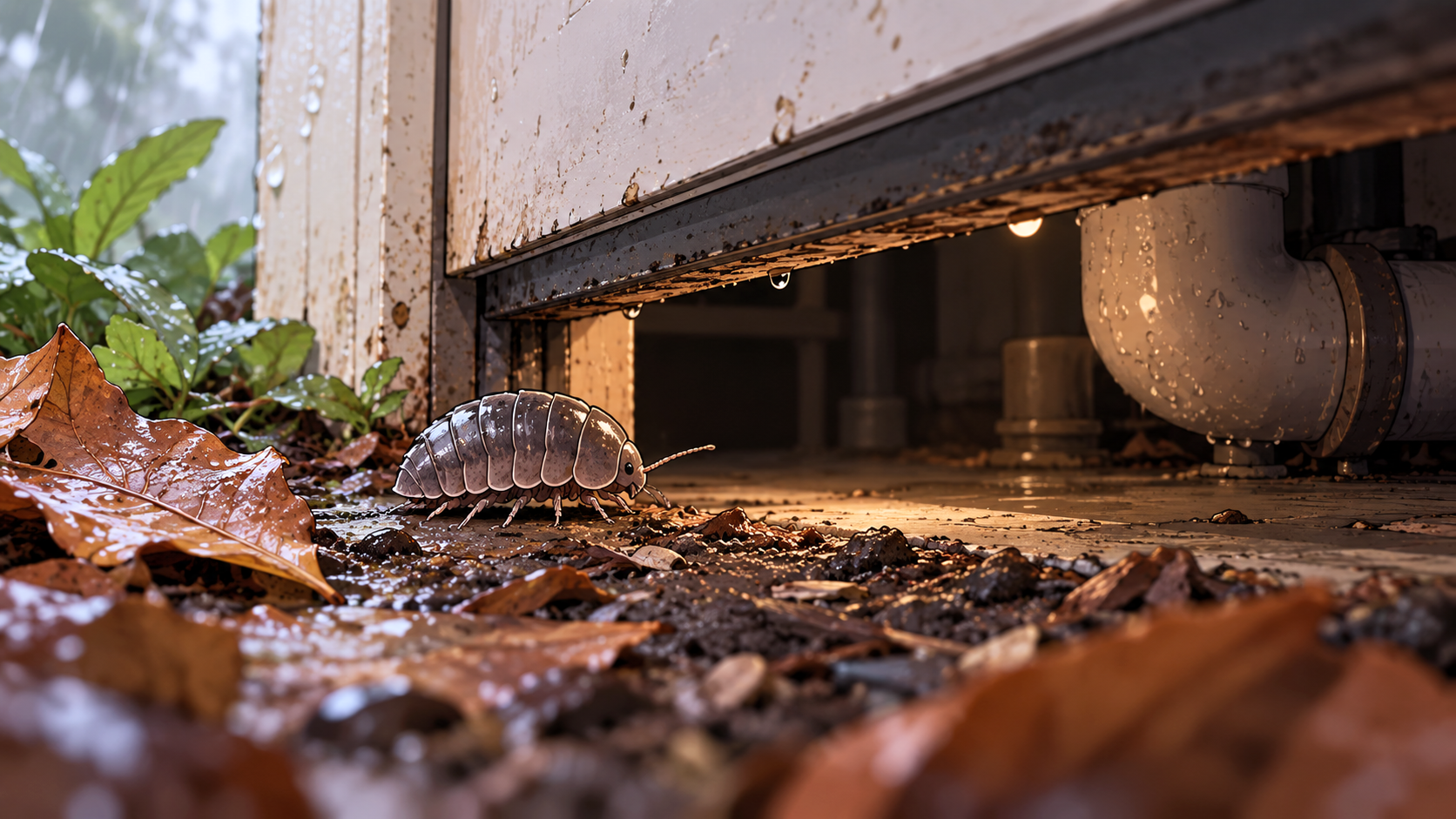
Roly-polies get into houses mainly because outdoor populations wander through ground-level openings and moisture strongly influences where they move and how long they survive. Gaps beneath doors, foundation cracks, basement windows and similar openings provide access. Damp basements and crawl spaces can support them longer, while dry rooms often leave them dead soon after entry. They are primarily outdoor animals rather than typical indoor pests. Repeated sightings usually begin with suitable habitat beside the building, a route through the exterior, or unusually damp conditions inside.
Most Roly-Polies Enter From Ground Level
A roly-poly does not need a large structural defect to get indoors. These small terrestrial crustaceans crawl across soil, patios, sidewalks and foundations during their normal movements, particularly when conditions favor surface activity. Openings along the lower part of a building can turn that movement into accidental indoor entry.
Documented access points include cracks and crevices in foundations and walls, poorly sealed doors and windows, and gaps beneath thresholds. Roly-polies and closely related sowbugs are consequently found most often on the first floor, in crawl spaces and in basements rather than appearing initially in elevated areas of a house. Ground-level doors are an especially common location for indoor sightings.
Their ability to negotiate uneven surfaces expands the places they can reach. Roly-polies can climb walls when the surface provides sufficient texture, so a foundation does not function as an impassable vertical barrier. Older construction, irregular masonry, gaps around basement windows and poorly fitted thresholds can provide both climbable surfaces and openings.
Outdoor habitat immediately beside the structure can increase the number available to wander inside. Roly-polies naturally occupy moist shelter beneath mulch, leaves, stones and wood, and structural-pest guidance identifies damp organic material around foundations as common habitat associated with indoor invasions. A house beside a large outdoor population therefore has more potential entrants than a house surrounded by comparatively dry, exposed ground.
Moisture Determines Whether an Indoor Roly-Poly Keeps Moving or Dries Out
Roly-polies are land-dwelling crustaceans, but their transition to terrestrial life did not eliminate their dependence on moisture. Their respiratory surfaces and water balance remain closely tied to humid conditions. Armadillidium vulgare can reduce water loss through behavior and body form, yet experiments still show substantial dehydration as relative humidity falls.
That dependence explains much of the difference between a roly-poly found alive in a basement and one discovered curled and motionless on an upstairs floor. Dry indoor air continually draws water from the animal. Household pest guidance therefore notes that pillbugs usually dry out quickly after entering buildings, while high indoor moisture can prolong their survival.
Humidity also affects their behavior before dehydration becomes fatal. Terrestrial isopods respond strongly to moisture conditions and use sheltered microhabitats to limit water loss. Rolling into a ball can reduce water loss in A. vulgare, but conglobation does not make the animal independent of atmospheric moisture. The much broader limits of roly-poly survival without adequate water depend heavily on humidity, temperature and species.
A Basement Can Be Very Different From the Rest of the House
Basements and crawl spaces are disproportionately associated with roly-poly sightings because they combine ground-level access with the possibility of elevated humidity. Roly-polies and sowbugs are specifically recorded invading damp basements and first floors, while Canadian pest guidance recommends drying damp basement areas when these animals appear indoors.
A basement does not have to contain standing water. Moist foundation materials, condensation, insufficient ventilation, plumbing leaks or generally high relative humidity can create a microclimate substantially different from the occupied rooms above. Health Canada specifically recommends using a dehumidifier or fan to dry damp basement areas when sowbugs or pillbugs are involved.
Location within the basement can provide additional clues. Repeated sightings concentrated beside an exterior door, foundation wall or window suggest a nearby route from outside. Animals scattered through a persistently humid crawl space may remain active longer after entering. A single roly-poly found far from a damp area provides much less information about indoor moisture than recurring live individuals in the same basement location.
Dead Roly-Polies Indoors Often Mean the Interior Was Too Dry for Them
Finding several dead roly-polies can look like evidence that they have established an indoor infestation. Often it indicates the opposite. They can enter successfully and then encounter conditions that cannot maintain their water balance. Structural-pest guidance describes pillbugs and sowbugs as occasional invaders that often die indoors when sufficient moisture and food are unavailable.
Dead individuals may therefore accumulate along basement edges, near exterior doors or elsewhere along the route taken after entry. Dry indoor conditions can kill them even when the exterior population remains large enough for replacements to continue wandering inside. Seeing new dead animals repeatedly does not mean the previous ones reproduced there.
Clusters of living animals deserve a different interpretation. Roly-polies normally spend daylight hours in moist protected locations and are more active during darker periods. If live individuals repeatedly persist in one indoor location, particularly a basement or crawl space, checking the moisture conditions in that area is reasonable. Without high moisture, long-term indoor survival is difficult.
Heavy Outdoor Populations Can Produce Repeated Indoor Sightings
A house can remain relatively dry and still receive roly-polies when many are living immediately outside. Large numbers indoors often correspond with substantial populations in surrounding soil and organic debris. Clemson’s household guidance notes that numerous indoor pillbugs or sowbugs commonly indicate a large population outdoors.
Weather can change how often those animals move. Prolonged wet conditions can favor large outdoor populations and surface activity, while environmental changes can push soil-dwelling arthropods away from established refuges. The resulting indoor appearance can be sudden even though the animals were already abundant around the property.
Their normal food helps explain why landscaped areas can support so many individuals. Roly-polies consume decaying leaves and other organic material, so moist mulch and accumulated plant debris provide resources as well as shelter. Their presence around a foundation is therefore not evidence that the house itself is attracting them as food.
Indoor Roly-Polies Usually Have Not Started a Household Colony
Unlike pests adapted to exploit stored food, fabrics or structural wood, roly-polies generally lack what they need to thrive throughout an ordinary dry house. They neither need nor normally seek household belongings as a breeding resource. Their appearance is better understood as movement by an outdoor species into a structure.
Exceptionally moist indoor environments can make persistence more plausible. Houseplants can also create small pockets containing damp growing media and decomposing organic material; pillbugs and sowbugs have been reported establishing populations in potted plants under suitable conditions. That situation differs from animals reproducing freely throughout bedrooms, kitchens or other dry living spaces.
Understanding how roly-polies reproduce also prevents a common misinterpretation of indoor sightings. Females carry developing offspring in a brood pouch rather than laying exposed egg clusters around a room. Finding several differently sized individuals near one entry route does not by itself demonstrate an indoor breeding population.
What Different Indoor Sightings Can Tell You
Why are roly-polies appearing beside my basement door?
Their location makes ground-level entry plausible. Small gaps around the threshold or frame can connect an outdoor population directly with the basement, particularly where damp soil, mulch or vegetation lies close to the entrance.
Why do I keep finding dead roly-polies in the same room?
Repeated deaths can occur when new animals continue entering but the room remains too dry for them to survive. The carcasses therefore do not necessarily represent one persistent indoor population.
Can roly-polies come through basement windows?
Yes. Gaps around ground-level windows and their frames are recognized entry routes for pillbugs and sowbugs. Window wells containing damp leaves or other organic debris can also place outdoor habitat immediately beside those openings.
Does one live roly-poly mean my basement has a moisture problem?
No. A single animal may simply have wandered through an opening. Repeated live sightings concentrated in a persistently damp area provide more reason to investigate moisture than one isolated visitor.
Can roly-polies enter attached garages?
Yes. Garage-door edges and other ground-level gaps can admit wandering terrestrial isopods, especially when suitable outdoor habitat reaches close to the structure. From an attached garage, an individual may occasionally wander farther into the building.
3 thoughts on “Why Do Roly-Polies Get Into Houses?”