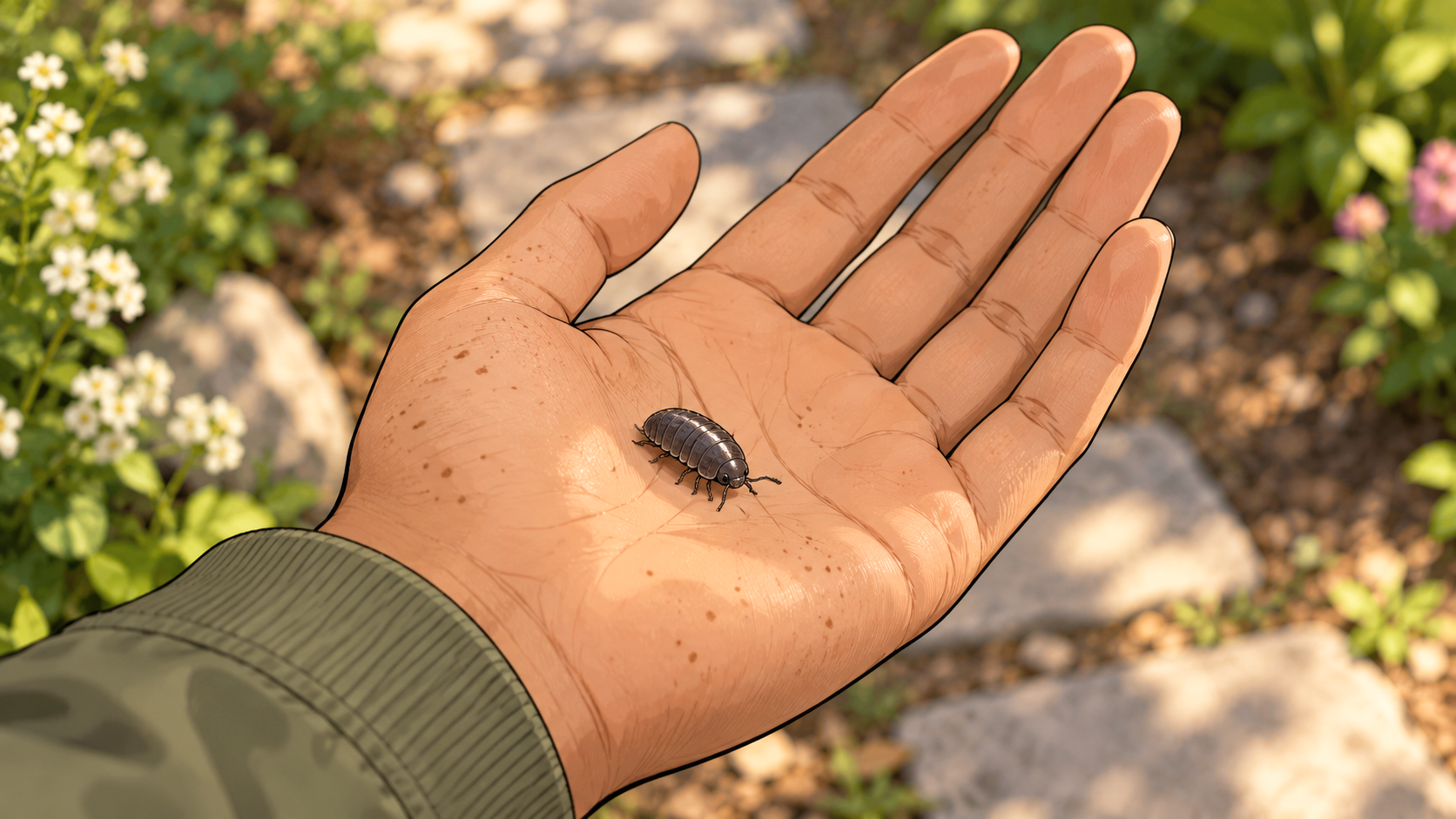
Roly-polies are not considered dangerous to humans. They do not bite or sting, are not venomous, and are not recognized as disease transmitters. Touching one normally poses little risk. Indoors, they are nuisance invaders rather than pests that attack people, contaminate food, damage clothing or consume structural wood. Their armored appearance and large number of legs can make them look more threatening than they are. Roly-polies are terrestrial crustaceans rather than insects, and the common pillbugs encountered around homes are defensive animals that typically curl up or seek shelter when disturbed.
Roly-Polies Do Not Bite or Sting People
Human skin is not a food source for roly-polies. Their mouthparts are adapted to feeding on organic material, particularly decomposing vegetation, rather than piercing human skin. Public-health guidance specifically states that pillbugs and sowbugs do not bite or sting, and other household-pest references classify them as harmless nuisance organisms rather than biting arthropods.
A roly-poly also lacks a stinger. Its most conspicuous defensive response is mechanical: many pillbugs roll their segmented bodies into a compact ball when disturbed. This behavior protects more vulnerable structures underneath the armored dorsal plates instead of delivering an offensive bite or sting.
Skin marks discovered after gardening should not be attributed to a nearby roly-poly simply because one was present. Gardens and damp outdoor spaces can contain mosquitoes, fleas, biting flies, mites, ants and other organisms capable of producing skin reactions. A roly-poly crawling across the skin does not provide a biological mechanism for the typical puncture or envenomation associated with an arthropod bite or sting.
They Are Not Venomous or Poisonous to Touch
Roly-polies have no venom apparatus for injecting toxins into people. Their body structure includes seven pairs of walking legs, antennae and specialized abdominal appendages, but no stinger or venom-delivery structure. Handling an ordinary pillbug therefore does not expose a person to venom.
There is also no evidence that common roly-polies poison people through normal skin contact. Some terrestrial isopods can accumulate metals from contaminated environments, a property that has made them useful in ecotoxicology. Recent reviews confirm that woodlice can bioaccumulate metals such as cadmium, copper, lead and zinc, with much of the sequestration occurring internally. That environmental-biology finding does not turn a roly-poly into a contact-poisoning hazard.
Ordinary hygiene is still sensible after handling soil animals. Roly-polies crawl through soil, decomposing vegetation, fecal material and other environmental substrates, so washing your hands afterward avoids transferring whatever dirt or microorganisms happened to be on the animal or your hands. This is a general hygiene precaution rather than evidence that pillbugs themselves are toxic.
Roly-Polies Are Not Recognized Disease Vectors
Roly-polies are not considered vectors of human disease. Canadian public-health guidance explicitly states that pillbugs and sowbugs do not transmit diseases, while state public-health guidance places them among moisture-dependent occasional invaders that cause no indoor damage.
That status differs from arthropods such as mosquitoes, ticks and fleas, in which pathogen transmission is an established part of the human-health risk. A roly-poly’s association with decaying material does not establish that it transmits disease to people. Its diet can include decomposing vegetation and other organic matter, but feeding on material containing microorganisms is not equivalent to functioning as a competent disease vector. No special disinfection of a room is required because a pillbug crossed the floor. Normal household cleaning is sufficient after removing an indoor visitor unless there is a separate sanitation issue unrelated to the animal.
Handling a Roly-Poly Is Generally Low Risk
Picking up a roly-poly with bare hands is generally safe for most people. It may walk across the hand or curl into a ball, and it does not have the biting, stinging or defensive capabilities that require specialized handling. Children observing roly-polies outdoors can be taught to handle them gently because the greater concern is usually injuring the small animal rather than being injured by it. Anyone with broken skin should avoid deliberately rubbing soil or outdoor debris into the wound, regardless of whether a roly-poly is present. Wash visibly dirty hands with soap and water after gardening or handling soil organisms, particularly before eating or touching the face. These precautions apply broadly to contact with outdoor environments.
A person who develops unexplained swelling, persistent pain, a spreading rash or another significant skin reaction should not diagnose it as a “roly-poly bite” based solely on finding pillbugs nearby. Since recognized pillbugs do not bite humans, another cause warrants consideration.
Roly-Polies Do Not Damage the House the Way Termites or Fabric Pests Do
Indoor roly-polies can be unpleasant to find in large numbers, but their presence does not mean they are consuming the building. They do not infest clothing, stored food or structural wood, according to Canadian household-pest guidance. State public-health guidance similarly describes isopods entering structures as organisms that cause no indoor damage.
Rotting wood deserves separate attention because damp, decomposing material can provide favorable conditions and food. Finding roly-polies around it does not mean they created the rot. Persistent live populations can instead accompany excessive moisture, which is why repeated roly-poly activity in basements and other indoor areas can be useful evidence that the area deserves a moisture inspection.
Their inability to damage ordinary household furnishings is also documented in household entomology guidance, which describes sowbugs and pillbugs as nuisance invaders that cannot damage furnishings. Indoor concern is therefore usually about the unwanted animals themselves or the damp conditions associated with their survival.
The Greater Safety Concern Can Be What Someone Uses Against Them
A harmless pillbug can create a less harmless situation if its presence prompts unnecessary pesticide use. Indoor roly-polies often die from dehydration without chemical treatment, and physical removal plus moisture correction is usually more relevant than spraying living spaces.
If a pesticide is used, its risks depend on the actual active ingredient, formulation, exposure route and label directions. Products should never be assumed safe around people simply because they are marketed for household or garden pests. Even substances perceived as lower risk can have precautions; for example, diatomaceous earth dust can irritate the respiratory tract if inhaled.
Finding roly-polies indoors also does not require emergency extermination. Professional assistance becomes more reasonable when persistent populations indicate a difficult moisture or entry problem rather than because the animals present an immediate danger to occupants.
Other Human-Safety Questions About Roly-Polies
Can a roly-poly crawl into your ear?
A small crawling animal could accidentally enter an ear canal, but this is not normal roly-poly behavior and they do not seek human ears as habitat. Any foreign object or animal lodged in an ear should be handled according to appropriate medical guidance rather than probed out with tools.
Can touching a blue roly-poly make you sick?
Blue or violet coloration can be associated with iridovirus infection in terrestrial isopods. The phenomenon concerns the animal’s health; blue coloration in roly-polies is not established as a human infection risk from ordinary contact.
Are roly-polies dangerous to babies or toddlers who touch them?
Normal skin contact is not considered dangerous. Young children should still be supervised around any small outdoor object or animal because they may put it in their mouth, and hands that have been in soil should be washed afterward.
Can roly-polies cause allergies?
Roly-polies are not recognized as a common household allergen comparable with cockroaches or dust mites. If symptoms repeatedly occur after a particular exposure, identifying the actual trigger is more useful than assuming the pillbug is responsible.
One thought on “Are Roly-Polies Dangerous or Harmful to Humans?”