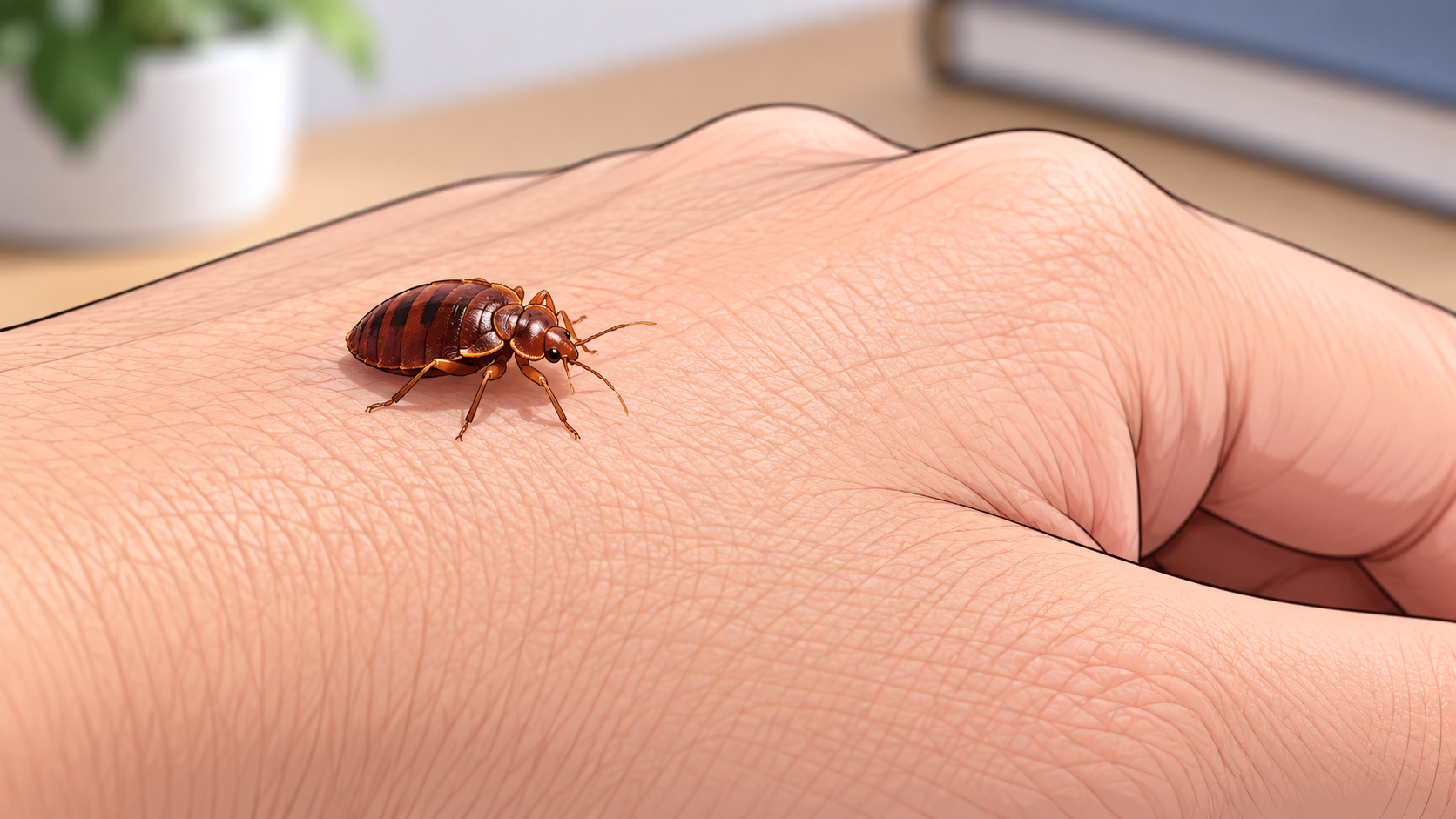
Bed bugs do not burrow under human skin, live beneath it or lay eggs inside it. They remain outside the body while feeding, using specialized piercing mouthparts to reach blood through the skin. Once a meal is complete, the entire insect leaves and normally returns to a protected hiding place nearby. A bump that remains after a bed bug bite is a skin reaction, not a bed bug trapped beneath the surface.
A Bed Bug Pierces Your Skin Without Putting Its Body Inside
The confusion often comes from the word “bite,” which does not describe bed bug feeding particularly well. Bed bugs have piercing-sucking mouthparts designed for blood feeding. During a meal, slender mouthparts penetrate the skin while the insect’s head, thorax, abdomen and legs remain outside. Blood travels through a food canal into the bed bug, while another channel carries saliva into the feeding site.
Those mouthparts can penetrate far enough to reach blood without creating a tunnel large enough for the insect to enter. A bed bug is a visible, flattened ectoparasite measuring roughly 1 to 7 millimeters depending on its age and feeding status. Its body cannot follow its feeding structures beneath intact skin. Scientific descriptions accordingly classify bed bugs as blood-feeding ectoparasites, meaning they feed externally on a host rather than inhabiting tissue within one.
Once engorged, the bed bug withdraws its mouthparts. Its normal next destination is an environmental harborage, not deeper tissue. Bed bugs commonly conceal themselves around mattresses, box springs, bed frames, furniture and cracks near resting hosts, which is why checking a mattress for physical bed bug evidence is more useful than examining a bite for a hidden insect.
The Lump After a Bite Is Made by Your Own Skin
A swollen spot can create the impression that something remains underneath it, especially when the area stays firm or itchy for days. The material inside that swelling is not a buried bed bug. Bite biopsies have shown edema and inflammatory cells within the skin, including lymphocytes and eosinophils around blood vessels and between collagen fibers. These inflammatory changes can occur in both superficial and deeper layers of the dermis.
Bed bug saliva helps the insect obtain its meal and can stimulate immune activity after exposure. Laboratory work has found that salivary material can induce several inflammatory mediators involved in cutaneous reactions following bed bug feeding. Individual immune responses vary considerably, so one person may develop almost nothing while another develops an obvious welt.
A particularly large bump therefore does not indicate deeper penetration. Bed bug bites can be raised, flat or swollen, and stronger inflammatory responses can occasionally produce blisters. Even bed bug bites that blister or heal slowly remain reactions in the skin rather than evidence of an insect underneath it.
Bed Bugs Do Not Leave Eggs Beneath the Skin Either
Some parasites use host tissue during part of their development, but bed bugs reproduce elsewhere. Females place small whitish eggs in sheltered environmental locations. Eggs can occur in mattress seams, furniture joints, cracks, crevices and other protected spaces associated with an infestation. Public-health observations describe bed bug eggs in dark cracks and crevices, not embedded in human tissue.
A newly hatched nymph emerges into that environment and later obtains blood from a host. Five nymphal stages occur before adulthood, with blood meals needed between molts. Nothing in the bed bug life cycle requires an egg, nymph or adult to develop inside a person.
Bed bugs also do not attach eggs to people in the manner associated with some other ectoparasites. Dermatology guidance specifically notes that bed bugs neither burrow into skin nor lay their eggs on people.
Scratching Can Make a Bite Look More Like a Skin Lesion
Persistent itching sometimes leads people to squeeze, pick or scratch a bump because they suspect an insect is underneath it. Doing so can transform a relatively uncomplicated bite reaction into an open lesion. Repeated scratching damages the skin barrier, can produce scabs and increases the opportunity for secondary bacterial infection.
Public-health information recognizes secondary skin infections as a possible consequence of bed bug bite reactions, particularly when irritated areas are repeatedly scratched. Reported complications include impetigo, ecthyma and lymphangitis. Digging into a suspected bite to “remove” a bed bug therefore creates injury without removing an insect, because there is no bed bug beneath the lesion.
An irritated area can also remain visible after the original feeding event is long over. The time needed for bed bug bite marks to resolve depends partly on the person’s reaction and whether the skin has been repeatedly disturbed.
A Crawling Feeling Under the Skin Does Not Establish Bed Bugs
Sensations described as crawling, tingling, prickling or movement can be disturbing, but they do not demonstrate that an insect is beneath the skin. Bed bugs cannot be identified from a sensation alone. Even actual bites are unreliable for diagnosis because skin responses vary and can resemble other conditions.
Attention can intensify ordinary skin sensations as well. Someone worried about an infestation may become unusually aware of hair movement, clothing, minor itching or other sensations that would normally pass unnoticed. Thinking about bed bugs can itself provoke genuine itching through attention and expectation without a new bite occurring.
Persistent sensations, unexplained lesions or symptoms that continue despite the absence of physical infestation evidence deserve medical evaluation rather than attempts to extract insects from the skin. Bed bugs are only one possible explanation for itching, and burrowing beneath the skin is not part of their biology.
The Evidence of Bed Bugs Will Be Outside Your Body
When bed bugs are responsible for bites, the insects spend their non-feeding time in the surrounding environment. Look for live bugs, eggs, shed skins and fecal spotting around likely harborages instead of squeezing skin lesions. Bed bugs commonly remain close to places where people sleep, although established infestations can spread farther through a room.
Physical evidence also helps avoid mistaking another skin condition or pest for bed bugs. Someone can be waking with bites without finding bed bugs, and bite appearance alone cannot settle the diagnosis. Conversely, some people have bed bugs without developing conspicuous skin reactions.
If an insect is actually found on the body, it is still behaving externally. Bed bugs can crawl onto human skin temporarily to feed, but the human body is not their normal living space.
Questions About Bed Bugs Under the Skin
Can a bed bug’s mouthparts break off inside your skin?
Bed bug mouthparts are inserted during feeding and normally withdrawn when the insect finishes. Retained bed bug mouthparts are not a recognized explanation for the ordinary bumps that follow bites. A persistent foreign-body-like lesion needs medical assessment rather than probing at home.
Can bed bugs enter an open cut?
An open wound does not turn human tissue into a normal bed bug habitat. Bed bugs are adapted to pierce skin and obtain blood with their mouthparts rather than crawl into wounds and establish themselves there.
What parasites actually can live beneath human skin?
Several organisms have life cycles or behaviors very different from bed bugs. Scabies mites, for example, create burrows within the superficial layer of skin. Certain fly larvae and other parasites can also infest human tissue under particular circumstances. A suspected skin parasite requires proper identification because treatments differ considerably.
Why can I still feel something after the bed bug bite disappears?
Residual itching or altered sensation can outlast the visible mark because skin inflammation and sensory irritation do not necessarily end at the same moment. Symptoms that persist, worsen or cannot be linked to confirmed bed bug exposure merit medical assessment for other causes.