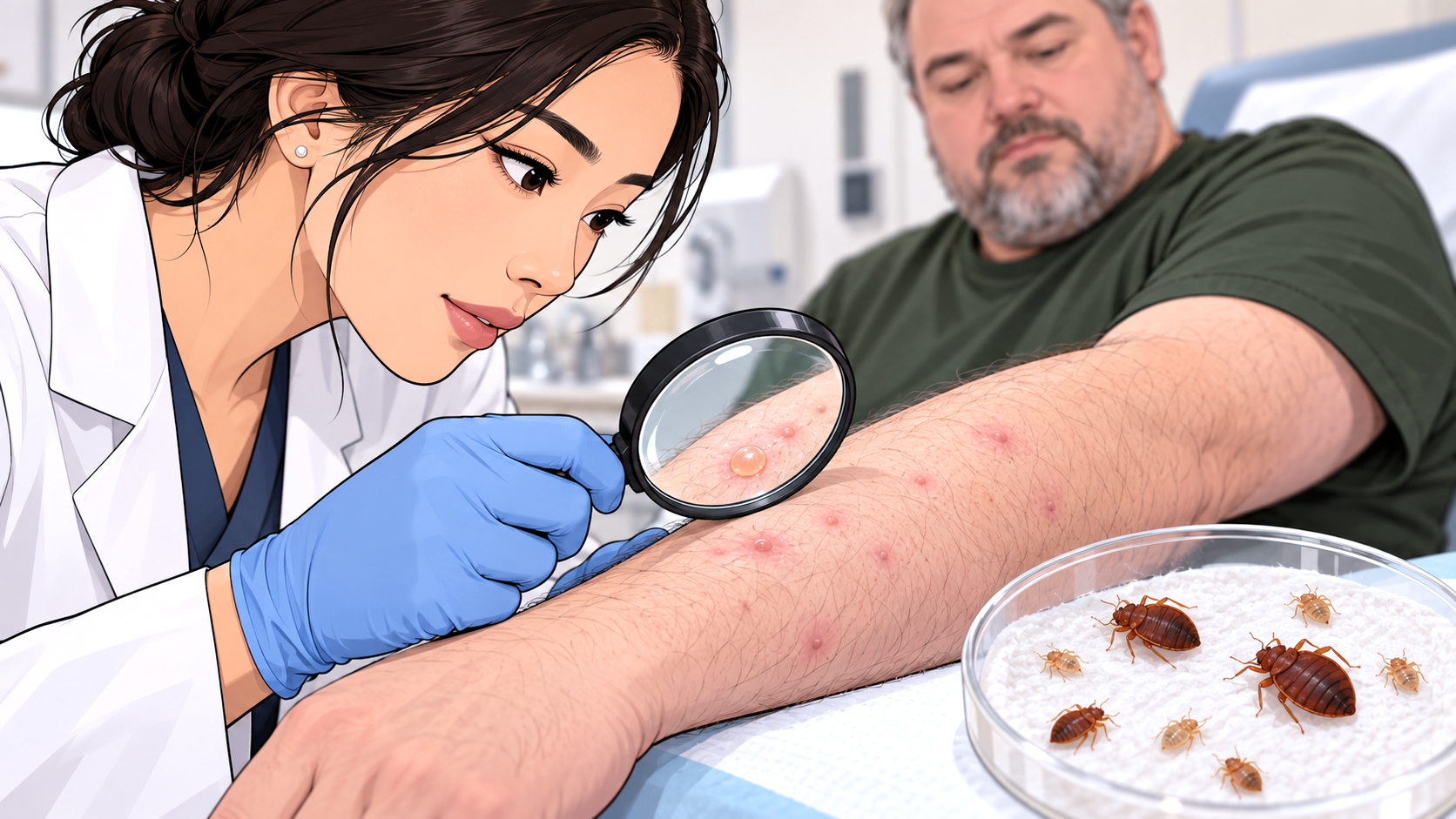
Some bed bug bites blister or heal slowly because the skin can mount a strong inflammatory or allergic response to substances in bed bug saliva. Scratching can then damage the skin further, and secondary infection may prolong healing. Bullous reactions can take weeks to resolve and are different from the more typical small, itchy bed bug lesions. A blister does not mean a bed bug injected venom or remained inside the skin. The fluid-filled lesion is produced by the body’s reaction after feeding has occurred.
A Blister Can Be an Immune Reaction to Bed Bug Saliva
Bed bugs need to keep blood flowing while they feed, so their saliva contains biologically active proteins involved in processes such as vasodilation and interference with clotting and platelet activity. Human immune responses to these salivary components vary widely. That variation helps account for the spectrum from no visible reaction to swollen or raised bed bug bites and, at the more pronounced end, vesicles and fluid-filled bullae.
A documented case of recurrent bullous reactions found specific IgE antibodies against a bed bug salivary protein called nitrophorin, with an immediate reaction followed by a pronounced late-phase blistering response. More recent clinical reviews likewise include vesicles and bullae among the possible manifestations of bed bug exposure. The reaction belongs to the person being bitten rather than indicating a special type of bed bug, which helps explain why people exposed in the same room can develop dramatically different skin findings.
Previous exposure may influence the response as sensitization develops. Some previously sensitized people can experience exaggerated local reactions that include wheals, vesicles, bullae or nodules. The immune response is also one reason some people appear far more affected by bed bug bites than others, even when visible marks do not accurately measure how many times each person was fed upon.
Bullous Reactions Can Cause More Tissue Inflammation Than an Ordinary Bite
A large bed bug blister is not simply a normal bite containing extra fluid. Detailed examination of experimentally induced bullous reactions found a progression from an early itchy, swollen lesion to a blister within about 24 hours. Skin biopsies showed substantial inflammation and features of cutaneous vasculitis, and the bullous lesions took weeks to heal.
That degree of tissue involvement provides a biological explanation for why a severe blister can remain visible much longer than a small papule. It also means a large or worsening blister deserves more caution than an uncomplicated itchy bump. Rare case reports have documented bullous eruptions accompanied by systemic symptoms such as fever and malaise, although bullous reactions with systemic illness are uncommon.
Blistering should not be used by itself to diagnose bed bugs. Other arthropod reactions, contact dermatitis, infections, autoimmune blistering disorders and additional skin conditions can produce fluid-filled lesions. Even ordinary bed bug marks are difficult to identify from skin appearance alone, and bed bug bites can resemble hives and other dermatological conditions.
Scratching Can Replace a Healing Bite With a New Skin Injury
Intense itching creates a second route to prolonged healing. Fingernails repeatedly rubbing or breaking a bite can remove the superficial skin, produce bleeding or scabbing, and keep the area inflamed. The resulting abrasion is now healing alongside the original bite reaction.
Broken skin also provides an entry point for bacteria. Arthropod bites that are repeatedly scratched can develop secondary bacterial infections, commonly involving Staphylococcus or Streptococcus species. Excoriated bite sites are susceptible to secondary infection, while reported complications following bed bug bites include cellulitis, impetigo and other bacterial skin infections.
Increasing warmth, tenderness, pus, spreading redness or worsening swelling warrants medical assessment rather than simply waiting longer for the mark to disappear. Most bites need only basic symptomatic care, but secondary infections may require antibiotic treatment. Avoiding scratching and keeping the affected skin clean reduce the chance that a relatively minor bite develops a longer-lasting complication.
A Bite Can Look Unhealed After the Active Inflammation Is Gone
Healing and disappearance are not always the same event. Inflammation can alter skin pigmentation after the swelling and itching have subsided, leaving a flat brown, purple or otherwise darker area where the bite occurred. More noticeable pigment changes may follow stronger inflammation or repeated scratching.
This residual discoloration can be mistaken for a bite that is still actively inflamed. Color also needs to be interpreted in the context of skin tone because bed bug bites can look different on dark or Black skin. A persistent flat mark without the earlier swelling, heat or itching may represent post-inflammatory change rather than continuing bite activity.
Bruise-like coloration deserves similar care in interpretation. Some lesions can develop darker or purpuric features, but purple or bruised-looking bed bug bites have different possible mechanisms from fluid-filled blistering. Neither color nor blister formation proves the insect responsible without supporting evidence of bed bugs.
Repeated Bites Can Create the Impression That One Reaction Never Ends
A person sleeping in an active infestation may receive additional bites while earlier lesions are healing. A new inflamed spot beside an older fading one can make the affected area appear continuously active, especially when several lesions overlap or occur close together. Because bed bug bites can appear in lines or clusters, separating older lesions from newly developing ones may be difficult by appearance alone.
The timing of the skin response adds uncertainty. A bed bug reaction can be delayed, so not every mark appearing on a particular morning necessarily resulted from feeding during the previous night. The broader healing timeline for ordinary bed bug bites therefore cannot be calculated accurately by counting days from when every mark was first noticed.
Continued new lesions also raise a different question from one old blister that is slowly resolving. Physical evidence around the sleeping area becomes more useful when determining whether exposure is ongoing, particularly because skin reactions alone cannot establish when the infestation has ended.
Blisters Need More Caution Than Ordinary Itchy Marks
Do not intentionally pop a bed bug blister. Opening it removes part of the skin’s protective barrier and creates another opportunity for contamination and infection. Keep the area clean and avoid scratching or picking at it.
Most uncomplicated bed bug bites need minimal symptomatic treatment. More extensive or severe reactions may sometimes be treated with topical corticosteroids and antihistamines under appropriate medical guidance, although clinical trials comparing treatments are limited. Current clinical guidance for bed bug bite reactions emphasizes symptom control, hygiene and treatment of secondary infection when present.
Medical care is appropriate for a large or worsening blister, substantial swelling, suspected infection, widespread hives, or a reaction that is not following a reasonable healing course. Breathing difficulty, swelling involving the mouth or throat, faintness or other signs of a severe allergic reaction require urgent medical attention. Rare severe allergic reactions have been documented, and Health Canada notes that some people can experience serious allergic responses to bed bug bites.
Questions About Blistering and Slow-Healing Bed Bug Bites
Can a bed bug blister contain blood?
A strong inflammatory reaction can occasionally have hemorrhagic features, so blister fluid is not necessarily completely clear. A bloody or unusually dark blister also has causes unrelated to bed bugs and warrants medical assessment when it is large, painful, worsening or unexplained.
Will a blister leave a scar?
A superficial lesion can heal without permanent scarring, but deeper inflammation, repeated scratching and infection increase the potential for lasting skin changes. Residual pigmentation is not the same as a scar and may remain visible after the surface has healed.
Can a bed bug bite become infected even without a blister?
Yes. Any itchy lesion can be scratched enough to damage the skin barrier. Blistering is therefore not required for a secondary bacterial infection to develop.
Does blistering mean the infestation is severe?
No. The size or intensity of an individual’s skin reaction does not measure the number of bed bugs present. A pronounced immune response can follow limited exposure, while another person can have bed bug exposure without obvious visible bites.
One thought on “Why Do Some Bed Bug Bites Blister or Take So Long to Heal?”