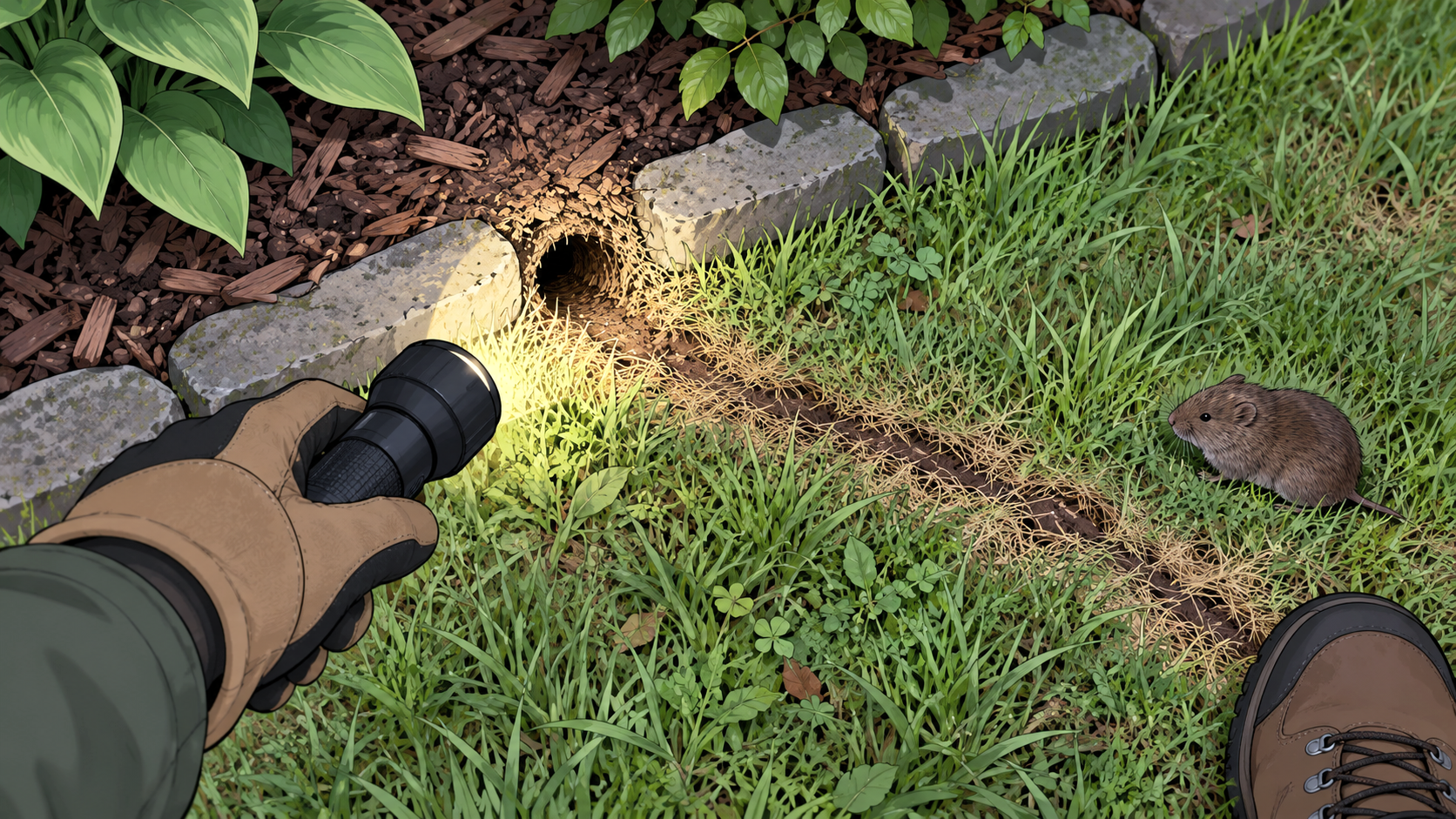
To get rid of voles, first confirm active vole damage, remove excessive vegetation that shelters them, and protect the plants being attacked. Concentrate on the affected area rather than treating the whole property. Habitat management and physical barriers are the best starting points for most outdoor problems. Persistent damage may justify additional control, but trapping and poisoning require separate safety and legal checks.
Finding a vole does not automatically mean treatment is necessary. A neglected strip of grass beside an orchard and a few old trails across an otherwise healthy lawn present different problems. The amount of fresh damage determines where we would spend time and money.
Confirm That the Vole Problem Is Active
Meadow voles often leave narrow, grass-free runways connecting feeding sites and burrow entrances. Fresh grass clippings, droppings, and recently gnawed vegetation along these routes indicate activity. Older trails containing new plant growth or debris may no longer be used. The surface pathways left by meadow voles are useful identification evidence, although woodland voles spend more time underground and may leave few visible runways.
Check the injury itself before selecting a treatment. Bark removed near the base of a young tree, repeatedly clipped garden seedlings, and trails through turf all deserve different responses. Fresh signs of voles in your yard help establish whether the animals are still causing problems.
Soil mounds require particular caution because vole holes and mole holes are not interchangeable. Moles construct distinctive tunnel systems and generally feed on soil invertebrates. Treating a mole problem as a vole infestation can leave the actual cause untouched.
Decide What Needs Protection First
Prioritize plants that cannot tolerate another feeding incident. Young fruit trees are especially vulnerable because vole girdling around the trunk can interrupt the movement of nutrients and eventually kill the tree. Loss of a recently planted tree is considerably more costly than temporary grass damage that can recover.
For a property with several affected areas, use the following order to determine where to begin.
| What you find | Initial priority |
|---|---|
| Fresh bark damage on young trees | Protect the trunks from further feeding |
| Newly clipped vegetable seedlings | Protect the affected planting area |
| Active runways through thick grass | Reduce shelter around the routes |
| Old lawn trails without new injury | Observe for renewed activity |
| Continuing damage across multiple locations | Assess whether localized measures are sufficient |
The appropriate response to voles damaging a garden depends on which plants are being lost and whether the injuries continue. A small number of voles feeding on established vegetation may warrant observation, while repeated losses of valuable plantings justify prompt protection.
Reduce Shelter Around the Affected Area
Voles benefit from dense grass, weeds, heavy ground cover, and accumulated vegetation. These materials provide food and concealment from predators. Removing unnecessary cover around vulnerable plantings can make the area less suitable for continued vole activity.
Begin with the vegetation immediately surrounding the damaged plants. Maintain grass, clear excessive weeds, and prevent thick mulch from accumulating against tree trunks. The reduction of protective ground cover is an established vole-management measure, particularly around cultivated landscapes and young trees.
There is no need to remove every shrub or ground-cover plant from the property. A strip of overgrown vegetation connecting a field to an orchard deserves more attention than a distant ornamental bed with no damage. Concentrating your work where shelter and feeding injury overlap avoids unnecessary disturbance elsewhere.
This approach has limits. Voles can remain in adjacent untreated areas, and clearing vegetation will not repair existing plant injuries. Preventing voles from returning requires keeping vulnerable areas less attractive rather than relying on a single cleanup.
Protect Plants Without Clearing the Entire Property
Physical exclusion is particularly useful when a relatively small area contains plants worth protecting. Suitable wire barriers can prevent voles from reaching vulnerable vegetation, provided they block both surface access and tunneling underneath.
For garden fencing, quarter-inch or smaller mesh is recommended, with the bottom buried to prevent digging beneath the barrier. Individual young trees can be protected with appropriately fitted trunk guards. These arrangements serve different purposes, so a barrier designed for one tree should not be assumed sufficient for an entire vegetable plot.
Where bark injury has already started, protecting trees from vole damage takes priority over attempts to eliminate animals across the surrounding property. Exclusion stops access to a particular plant; it does not require every nearby vole to disappear.
Know When Additional Control Is Justified
Trapping may be effective for a localized vole population, but it becomes labor-intensive over larger areas. The limitations of vole trapping make it less suitable as a blanket response to activity spread across extensive grounds.
Before using lethal traps, live traps, or relocation, verify the species and applicable wildlife regulations. Some vole species and subspecies receive legal protection, while jurisdictions impose different restrictions on trapping methods, permits, possession, and transportation. Whether voles can legally be killed or relocated cannot be determined from their status as garden pests alone. If authorization is uncertain, continue with nonlethal habitat changes and exclusion while checking with the relevant wildlife authority.
Any permitted trapping must also prevent access by children, pets, and non-target wildlife. Live capture raises additional welfare concerns because confinement and relocation can injure or kill small mammals.
Rodenticides should not be the default response. Products sold for mice or rats are not automatically approved for voles, and certain vole toxicants are restricted to licensed applicators or specific nonresidential uses. The legal and safe use of rodent baits requires following the product’s approved labeling and protecting non-target animals. Chemical treatment can also introduce hazards that were absent from the original plant-damage problem.
Check the Results Before Escalating
Use the original damage as your measure of progress. After reducing shelter or installing barriers, examine the affected plants for new feeding and check nearby routes for fresh activity. Monitoring vole activity through feeding signs provides a more useful assessment than counting brief sightings.
Where damage continues across the lawn or ornamental plantings, a yard-wide vole management approach can account for connected travel routes and surrounding habitat. Persistent losses in vegetable beds require a garden-specific control approach suited to the affected crops.
Professional assessment becomes worthwhile when valuable plants continue to deteriorate, several parts of the property are affected, or the responsible animal remains uncertain. The immediate objective is to stop fresh damage and identify where further intervention is actually necessary.