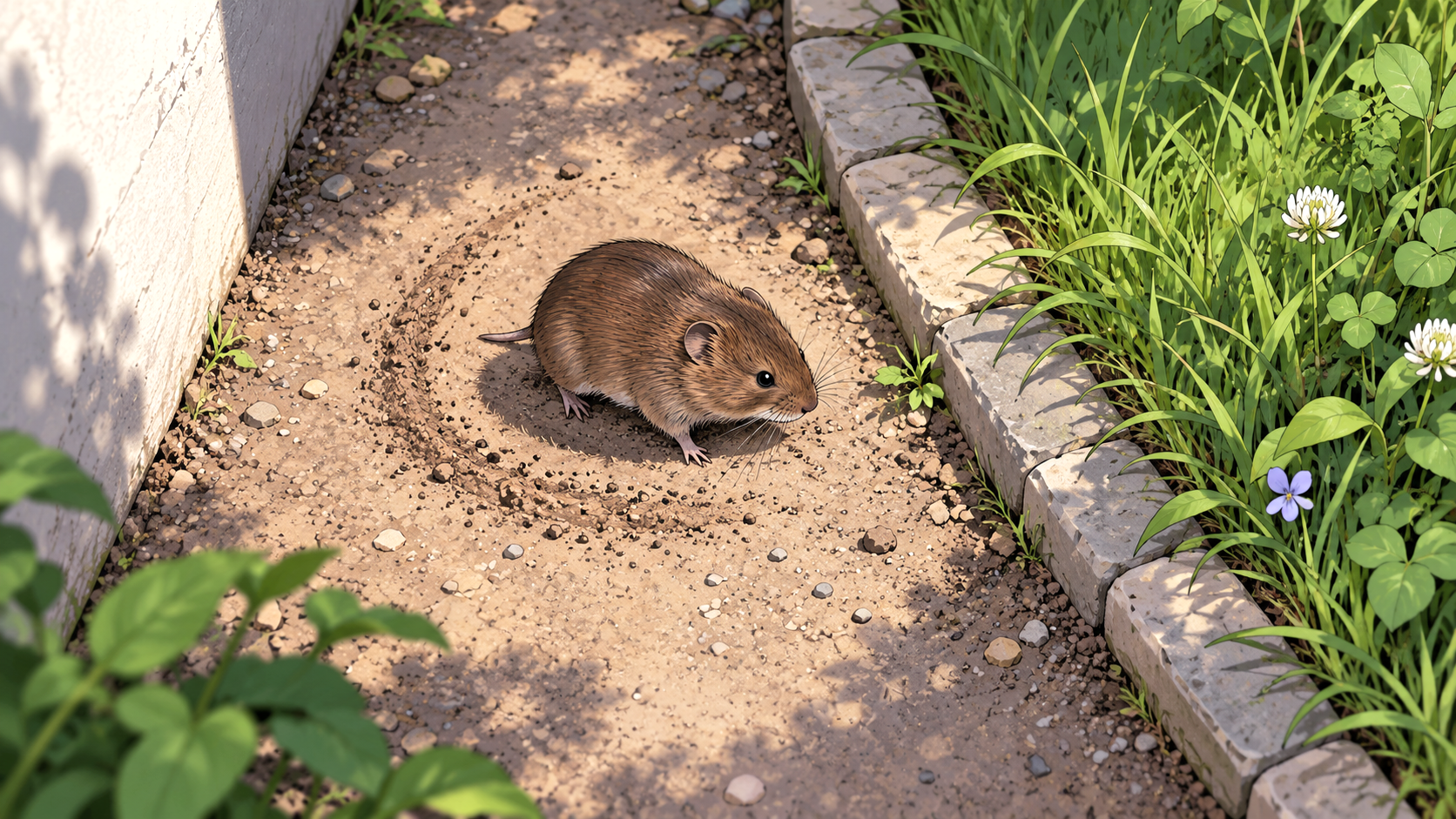
A vole making a quick turn in the grass is usually nothing unusual. A vole that repeatedly runs in tight circles, especially in the same direction without making progress, may be showing signs of disorientation or impaired coordination. Persistent circling can occur when an animal’s balance or nervous system is affected, but the behavior alone cannot identify the underlying cause.
The circumstances are important. A vole briefly doubling back toward cover is behaving differently from one that continues rotating on open ground, stumbles between turns, or seems unable to escape. The second situation deserves concern, particularly when the animal remains exposed and does not respond normally to its surroundings.
When Circular Movement Is Normal
Voles frequently change direction while moving through vegetation, investigating unfamiliar surroundings, or avoiding perceived threats. Their movements may look circular when they repeatedly follow the same curved path around grass clumps, obstacles, or sheltered openings.
Some species maintain narrow runways through grass, allowing them to travel between protected locations without repeatedly crossing exposed ground. An animal moving through a curved section of an established runway may appear to circle even though it is following a familiar route.
A vole startled in an open area might also turn sharply, hesitate, and move back toward the vegetation it just left. Such movements can appear erratic during a short observation, particularly when the animal disappears and reappears from different points beneath the grass.
The animal’s ability to stop, change direction, and continue purposeful movement provides useful context. Brief turning that ends when the vole reaches shelter is less concerning than repetitive circling accompanied by obvious difficulty moving normally.
Repeated One-Direction Circling Is More Concerning
An animal that persistently moves clockwise or counterclockwise through nearly identical circles may be experiencing something other than ordinary exploration.
Abnormal circling has been associated with disturbances involving the vestibular system, which contributes to balance, and neurological pathways involved in coordinating movement. Experimental work on rodents has demonstrated that vestibular disturbances can produce sustained directional circling.
These findings primarily involve laboratory rats and mice. They establish that disruptions to particular physiological systems can produce circling in rodents, but they do not prove that a wild vole displaying similar movements has the same underlying condition.
An important observation is whether the vole can interrupt its circular movement. An animal that briefly turns while investigating its surroundings may readily walk away, whereas one with impaired coordination may repeatedly return to the same turning pattern despite apparent attempts to move elsewhere.
Other concerning behaviors include falling over, rolling, keeping the head tilted, dragging a limb, or repeatedly colliding with nearby objects. Difficulty standing, abnormal coordination, and failure to respond normally are reasons to suspect that a wild animal may be injured or unwell.
None of these observations identifies a particular disease. They indicate that the animal’s condition may warrant professional assessment.
What Could Cause a Vole to Keep Circling?
Several possibilities deserve consideration, although evidence for the precise causes of persistent circling in wild voles is limited.
Disturbances involving balance or movement control are biologically plausible explanations. In other rodents, abnormal rotational behavior has been associated with both vestibular dysfunction and altered neural activity. The same outward behavior can arise through different mechanisms, so its appearance is not sufficient to locate an injury or identify the affected system.
Physical trauma is another possibility. A small animal may survive an encounter with a predator, collision, or fall but sustain injuries that affect movement. Head trauma can sometimes produce neurological abnormalities without an obvious external wound. A vole does not need visible bleeding to be seriously impaired.
Exposure to a toxic substance may also affect coordination. However, rodenticides differ substantially in their mechanisms and clinical effects, and circling is not a reliable diagnostic sign of rodenticide poisoning. The presence of pest-control products nearby does not establish that the animal encountered them.
Infectious or inflammatory conditions affecting the nervous system are additional possibilities. Some pathogens can produce neurological illness in mammals, although the ability of voles to carry infectious organisms does not demonstrate that a particular infection caused an observed movement abnormality.
Even carefully controlled studies of laboratory rodents show why a single explanation is inadequate. Persistent circling can occur without a clearly established inner-ear defect, indicating that superficially similar behavior does not always have the same physiological origin.
Can Stress or Fear Make a Vole Run in Circles?
A frightened vole may make abrupt turns, repeatedly retreat toward cover, or move along the perimeter of an enclosed space. These movements can superficially resemble circling when the animal is confined or unable to find an escape route.
Stress alone, however, should not be used to explain persistent, uncontrolled rotation. An animal that keeps turning after an immediate disturbance has passed, particularly while stumbling or losing balance, may have a more serious problem.
Confinement also complicates observation. A vole inside a bucket, trap, or unfamiliar enclosure may repeatedly follow the walls while searching for an exit. That behavior cannot automatically be interpreted in the same way as sustained circling on open ground.
Repeated handling or deliberately frightening the animal to see whether the behavior changes is inappropriate. Wild mammals can experience considerable stress from human contact and confinement, and provoking additional movement may worsen an existing injury.
If a vole is already displaying unusual movements, observe without interfering rather than attempting to test its balance or reactions.
Can You Identify the Cause From a Video?
A video can document the movement pattern, but it cannot establish whether a vole has an infection, neurological injury, toxic exposure, or another condition.
Useful footage shows whether the animal consistently turns in one direction, how it moves between circles, and whether it can stand and walk without losing balance. A continuous recording is more informative than several isolated clips because it preserves the sequence of movements.
The animal’s identity also deserves attention. Small mice, voles, and other rodents can resemble one another, particularly in poor-quality footage. The rounded body, short tail, and small ears characteristic of voles may help establish that the animal is a vole, but blurred photographs can prevent reliable identification.
A short clip may omit an obstacle, the presence of a predator, or other environmental conditions affecting the animal’s behavior. Conversely, even a clear recording of persistent circling cannot reveal the internal physiological changes responsible.
For wildlife professionals, accompanying information can be valuable: the location, approximate duration of the behavior, any visible injury, and whether the animal has had contact with a pet or a vehicle.
When Should You Contact a Wildlife Rehabilitator?
A vole that persistently circles, falls repeatedly, cannot maintain its balance, or appears unable to move away from danger should be treated as potentially injured or ill.
Walking in circles and other signs of neurological impairment are recognized reasons to seek qualified wildlife assistance. A prolonged episode is more concerning when the animal remains exposed, appears weak, or fails to respond to nearby movement.
Keep children and pets away, avoid touching the animal, and contact a licensed wildlife rehabilitator or appropriate local wildlife service for instructions. Do not attempt to force it to walk, administer medication, or offer food or water without professional guidance. The safe handling of distressed wildlife depends on the species, apparent injuries, and circumstances.
The appropriate response to a baby or injured vole also depends on whether the animal can move normally and whether intervention is necessary. An animal showing sustained abnormal movement should not simply be released at another location in the hope that the behavior will resolve.
If several animals in the same area exhibit unusual coordination problems or are found dead, contact the appropriate wildlife authority. Multiple affected animals may warrant investigation of a shared environmental or disease-related cause, although their presence does not establish what that cause is.
What If the Vole Stops Circling and Runs Away?
An animal that resumes coordinated movement and retreats into vegetation may have been making ordinary turns or reacting to a temporary disturbance. A brief episode without other abnormalities provides less evidence of serious impairment than sustained circling with loss of balance.
Recovery of apparently normal movement is encouraging but does not prove that the animal is healthy. Some neurological signs can occur intermittently, and an animal that disappears from view cannot be assumed to have recovered completely.
If repeated episodes are observed at the same location, record them from a safe distance and seek wildlife advice. The pattern over time may provide more useful information than a single moment when the animal briefly appears normal.