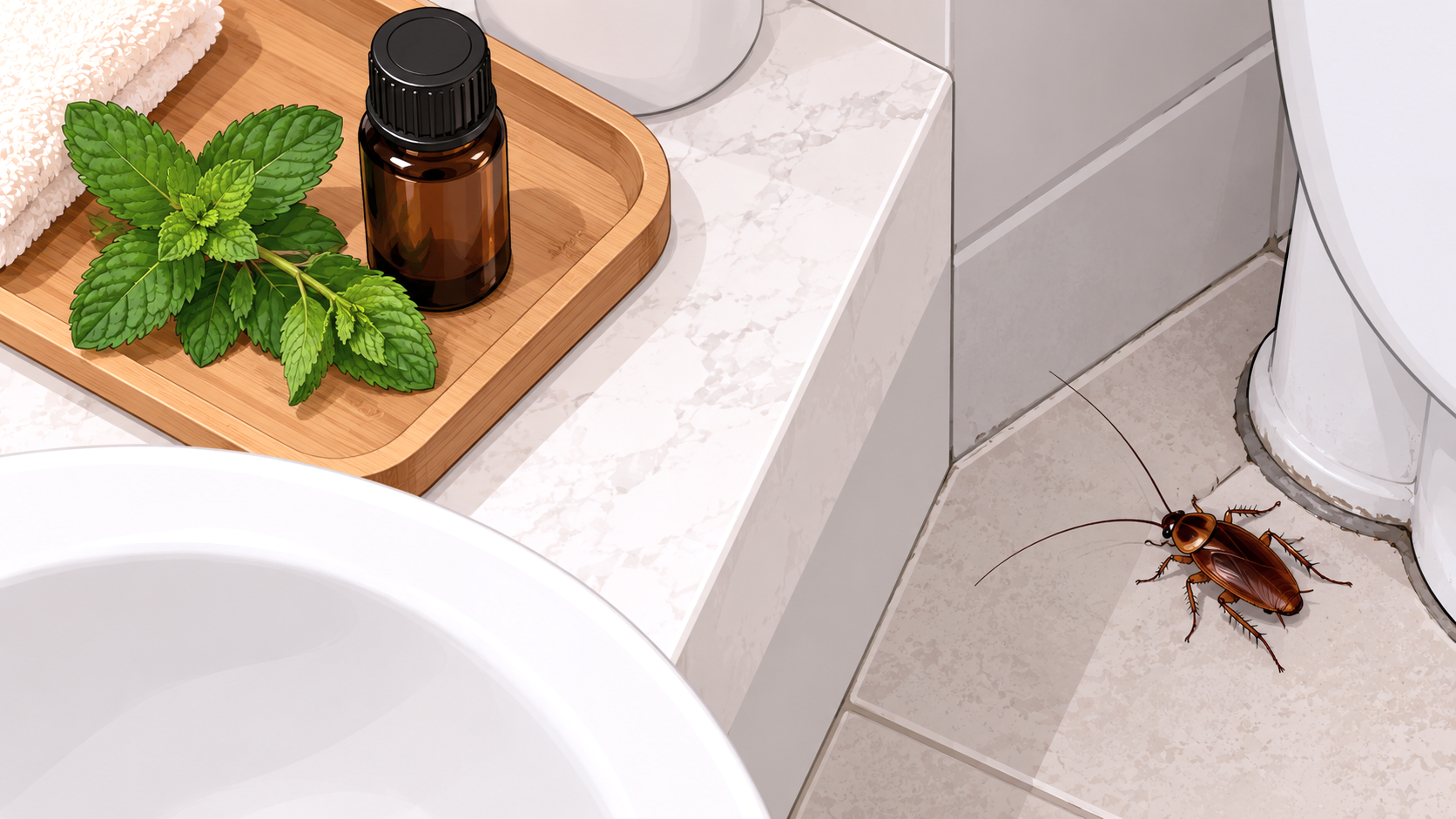
Peppermint oil can repel cockroaches under controlled conditions, but that finding needs a boundary around it. Laboratory research has found strong avoidance of mint-oil-treated areas by German and American cockroaches. It does not follow that drops of peppermint oil around a kitchen will reliably keep cockroaches out of a home or resolve an existing infestation.
The evidence is more interesting than the usual claim that cockroaches simply “hate the smell.” Cockroaches respond to chemical cues in their surroundings, and concentrated mint oil has produced measurable repellency in laboratory choice tests. Peppermint oil is also recognized as an ingredient that can appear in certain minimum-risk pesticide products. However, products qualifying for that federal exemption are not automatically evaluated for effectiveness simply because they contain an eligible ingredient. Repellency demonstrated under controlled exposure and dependable protection in an occupied home are two different standards.
What the Cockroach Experiments Actually Show
One frequently cited experiment tested corn mint oil, Mentha arvensis, against American and German cockroaches. Adult males were placed in choice boxes where they could occupy treated or untreated areas. Mint-oil deposits produced approximately 100% repellency in American cockroaches, while mean repellency among German cockroaches ranged from about 92% to 100% during the 14-day experiment. The oil also showed contact and fumigant toxicity at sufficient concentrations.
Those results provide legitimate evidence that mint oil can alter cockroach behavior. They do not reproduce what happens after someone mixes a few drops of retail peppermint essential oil with water and sprays baseboards. The experiment used a defined mint oil, controlled doses, confined test apparatus, laboratory cockroaches, and measured exposure conditions. Household applications vary in concentration, formulation, placement, surface type, ventilation, and how quickly volatile compounds dissipate. More recent research on essential oils against German cockroaches likewise demonstrates biological activity among several essential oils while emphasizing the difficulty of translating laboratory performance into practical pest-control efficacy.
Peppermint oil also should not be treated as synonymous with every substance described as “mint.” Peppermint oil, corn mint oil, individual mint-derived compounds, and finished pesticide formulations can differ chemically and in concentration. A study showing activity from one preparation cannot establish an identical result for every peppermint product on a store shelf.
Repelling a Cockroach Can Move It Without Solving the Infestation
A repellent changes where an insect is willing to travel. For a cockroach already living inside a structure, avoidance may simply redirect movement toward another untreated route or harborage. That makes peppermint oil fundamentally different from a strategy intended to reduce an established population.
Consider a cockroach living behind a refrigerator. Making one exposed section of baseboard unpleasant does not remove the food, water, cracks, appliance voids, or other protected spaces available nearby. The same limitation applies when cockroaches are established in cabinets or wall voids. Cockroach infestations leave several forms of evidence, and activity should be assessed across the affected area rather than judged by whether fewer insects cross one peppermint-treated spot.
There are situations where repellency can actually be inconvenient. A treatment that changes cockroach movement may complicate attempts to monitor established travel routes or draw cockroaches toward bait. Cockroach baits and gels depend on insects encountering and feeding on the bait, so we would not deliberately surround bait placements with strongly scented DIY repellents. Treatment components should work together rather than compete with one another.
Peppermint oil is therefore a particularly poor substitute for investigating why cockroaches are present. Food, water, shelter, entry routes, and accidental introductions can all contribute to cockroaches becoming established inside a house. Removing those opportunities has lasting value after an odor has disappeared.
Peppermint Oil Products Are Not All Equivalent
A bottle sold for aromatherapy and a pesticide formulated with peppermint oil are not interchangeable products. In the United States, peppermint oil is among the active ingredients permitted in qualifying minimum-risk pesticides, but an exempt product must satisfy specific ingredient, labeling, and regulatory conditions. States can impose additional requirements on these products as well.
The regulatory status can also be misunderstood as an effectiveness endorsement. Certain exempt repellents containing ingredients such as peppermint oil have not been evaluated for effectiveness by the EPA. A “natural,” “minimum risk,” or peppermint-based label therefore tells you something different from evidence that the particular product will control cockroaches in your circumstances.
We would judge a commercial peppermint-based cockroach product by its complete formulation, label directions, intended pest, and supporting evidence rather than by the presence of peppermint oil alone. Someone specifically trying to avoid conventional pesticides can take the same evidence-based approach when considering natural methods for getting rid of cockroaches. Plant-derived ingredients still need a useful delivery method and realistic expectations.
Concentrated Peppermint Oil Still Deserves Careful Handling
Essential oils are concentrated substances. “Natural” describes their origin, not an absence of hazards. Direct contact with concentrated essential oils can be especially concerning around animals. Cats and dogs exposed to concentrated oils through their skin, fur, ingestion, or other routes can develop health problems, so peppermint oil should not be casually spread where pets may walk through or lick it. The risk is particularly relevant when people apply oils repeatedly along floors and baseboards because those are also areas pets routinely contact.
Homes with animals deserve more restraint than a generic DIY recipe usually provides. Concentrated essential oils can pose hazards to pets, and products intended for pest control should be used according to their own directions rather than homemade concentration guesses. A household with pets that needs direct cockroach treatment is better served by selecting an approach specifically appropriate for that setting; cockroach-control choices around dogs and cats require attention to exposure as well as pest efficacy.
Human exposure deserves ordinary precautions too. Applying undiluted essential oil broadly to skin, food-contact surfaces, children’s play areas, or poorly ventilated spaces is unnecessary for cockroach management. Peppermint oil can be biologically active without being a sensible substance to distribute indiscriminately around a home.
Where Peppermint Oil Fits, If You Still Want to Use It
Peppermint oil makes the most sense as a limited supplementary repellent rather than the foundation of cockroach control. Someone experimenting with it should keep it away from food and vulnerable household members, avoid spraying it around cockroach bait, and watch actual cockroach activity instead of assuming a strong peppermint odor means the treatment is working.
Monitoring can show whether activity has shifted or persisted. Cockroach traps placed along likely travel routes can provide much better evidence of where insects remain active than smell can. Continued sightings elsewhere in the room are evidence that repelling cockroaches from one surface has not addressed the population.
For preventing an infestation, physical changes have a more durable role. Sealing gaps, reducing accessible food and water, inspecting items that can carry cockroaches indoors, and correcting conducive conditions help keep cockroaches out of a house without depending on a volatile scent remaining strong enough to affect their behavior.
Peppermint Oil Questions That Need Separate Answers
Will peppermint plants keep cockroaches away?
Evidence involving concentrated mint oils does not establish that a living peppermint plant releases enough relevant volatile compounds to protect a room from cockroaches. A potted herb and a measured deposit of concentrated essential oil create very different exposures.
Can peppermint oil be put on cotton balls instead of sprayed?
Cotton balls may localize the oil and reduce the amount spread across surfaces, but they do not overcome the central limitations of repellency. Placement also needs to prevent access by children and pets, and the odor will change as volatile compounds evaporate.
Does peppermint oil work equally well on every cockroach species?
No broad claim is justified. Controlled mint-oil research has included German and American cockroaches, but results from those species should not automatically be assigned to every cockroach. Species can differ in behavior and habitat, so identifying the cockroach you are dealing with can affect how an infestation is approached.
Is peppermint oil better than other smells claimed to repel cockroaches?
There is no reason to rank household odors solely by how strong they smell to people. Evidence, concentration, formulation, persistence, and the cockroach species all matter when assessing odors claimed to repel cockroaches. A strong human perception of an odor does not tell you how useful it will be as pest control.
One thought on “Does Peppermint Oil Repel Cockroaches?”