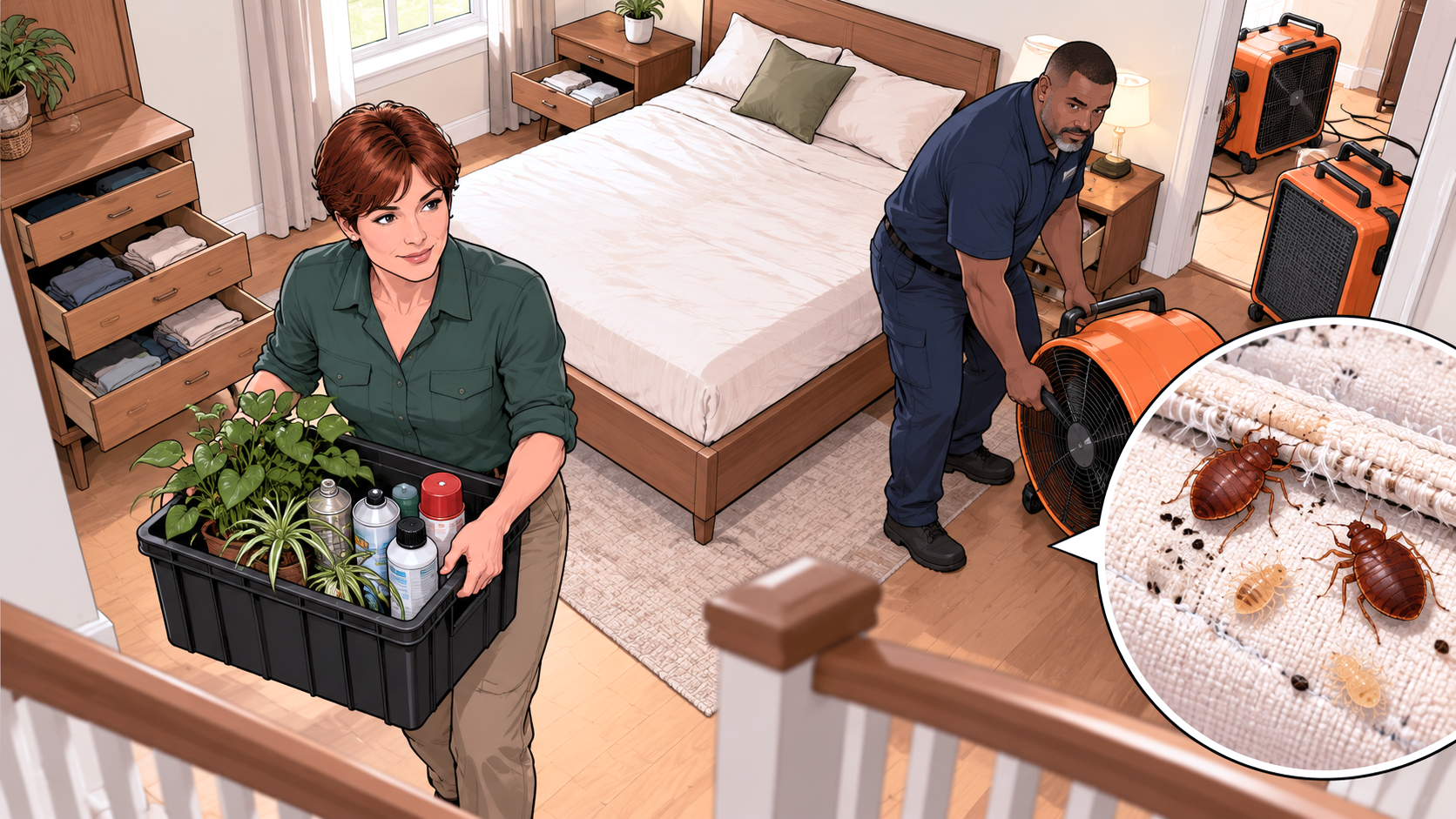
Before bed bug heat treatment, follow the pest-control company’s preparation sheet exactly, remove only the heat-sensitive or hazardous items they identify, and arrange the remaining belongings so heated air can circulate around them. Do not empty the home indiscriminately because untreated belongings removed from an infested area can carry bed bugs out and bring them back later. Preparation requirements vary with the equipment, target temperatures and building. Ask the provider about any item that is not specifically addressed in its instructions rather than guessing whether it can remain inside.
Do Not Pack Up the Infested Room and Move Everything Elsewhere
Ordinary moving instincts can work against bed bug control. Bed bugs hide in clothing, bags, furniture joints and other belongings, so carrying untreated possessions into another bedroom, garage, vehicle or friend’s home can spread the infestation. General bed bug preparation guidance specifically warns against moving belongings from an infested area into an uninfested one.
Whole-room heat is designed to treat many belongings while they remain within the treatment zone. Research under commercial heating conditions has shown why their placement matters: lethal exposure depends on the temperature actually reaching hidden insects and eggs, not merely on the room becoming hot. Bed bug eggs required greater thermal exposure than adults in controlled tests, with temperature and exposure time jointly determining mortality. Packing possessions tightly can create areas that heat more slowly, while removing potentially infested objects altogether excludes them from the treatment.
Reduce unnecessary clutter without transporting it through clean areas. Clothing on the floor, piles beneath beds and densely packed belongings can obstruct access and airflow. Items that remain should be arranged exactly as the provider requests. Since bed bugs hide in protected spaces throughout sleeping areas, preparation needs to expose those locations without accidentally relocating their occupants.
Heat-Sensitive and Hazardous Items Need Separate Handling
Professional heat reaches temperatures that can damage objects long before those temperatures become dangerous to bed bugs. Federal safety guidance specifically advises that heat-sensitive possessions require alternative handling during whole-residence treatment.
The company’s checklist determines exactly what leaves the treatment area. Depending on the provider and temperatures used, the removal list can include pressurized aerosol cans, combustible or flammable materials, certain medications, wax products, cosmetics, delicate artwork, musical instruments, heat-sensitive plastics and other objects that can melt, deform, leak or deteriorate. Never assume that every item in one of these categories must be removed under every protocol. Equipment and procedures differ.
Prescription and over-the-counter medications deserve particular attention because heat exposure may affect product stability. Ask the provider how medicines are to be handled, then store them according to their manufacturer or pharmacist instructions.
Any removed object that could harbor bed bugs needs to be handled without creating an escape route from the treatment. Bagging or otherwise containing items before carrying them through the property reduces opportunities for insects to fall off. Bed bugs can travel on clothing and other possessions even though they do not normally remain on the human body like lice.
Give Heated Air Access to Clothing and Other Dense Contents
A closed, tightly packed container can heat differently from the room surrounding it. The same applies to dense bedding, folded textiles and layered materials. Controlled research found that bed bugs covered by a blanket at 60°C required twice as long to reach complete mortality as directly exposed bugs because the temperature beneath the blanket took an additional hour to reach lethal conditions.
Do not decide independently that every dresser must be emptied or every closet stripped. Some providers instruct occupants to loosen packed clothing, open drawers, separate dense piles or leave closet contents arranged in a particular way so hot air can circulate. Others incorporate fans and furniture repositioning into their own setup. Follow the instructions for the actual system being used.
Clothing that the provider wants processed separately can be treated using an appropriate dryer when the fabric permits it. Federal preparation guidance states that 30 minutes on high dryer heat can kill bed bugs and eggs, while Health Canada advises storing cleaned and dried items in sealed plastic bags or secure plastic containers to prevent them from becoming infested again. Keep processed belongings separate from untreated belongings. A clean shirt returned to an infested pile before treatment can simply pick up another bug.
Furniture Needs Space for Airflow, Not a Trip to the Curb
Do not discard beds, couches or other furniture simply because heat treatment is scheduled. Many infested items can remain in place and be treated, provided the service can deliver sufficient heat through their harborages. The provider may ask for furniture to be moved away from walls or repositioned to improve circulation and equipment access. Dense furniture deserves particular attention because heat containment and circulation around treated objects strongly affect thermal performance. Fans used during professional remediation help move heated air through the treatment zone, but objects pressed tightly together can obstruct that movement.
Mattresses should not be wrapped in ordinary plastic in an attempt to make them hotter unless the provider specifically requires a particular setup. Experiments with black plastic showed how misleading surface temperature can be: the sun-facing side of wrapped mattresses reached 85°C while protected areas remained around 35°C or below, demonstrating that extreme surface heat does not guarantee lethal temperatures throughout a mattress. The same concern underlies failed bed bug heat treatments: thermal control succeeds only when lethal conditions penetrate the places occupied by bugs and eggs.
Clear the Areas the Technicians Need to Reach
Preparation is partly about heat distribution and partly about giving technicians physical access to the room. Floors, pathways, bed frames, furniture edges and other treatment areas need to be accessible enough for equipment, fans and temperature sensors to be positioned correctly. Remove ordinary trash and unnecessary cardboard without carrying loose infested material through the home. Seal discarded material before taking it outside. General bed bug preparation guidance recommends eliminating excess cardboard and floor clutter because both create additional hiding places and interfere with control.
Do not seal cracks, dismantle electrical fixtures or make last-minute structural changes unless instructed. Bugs occupying electrical outlets and surrounding wall spaces may be part of the treatment problem, and technicians need to understand the existing room layout before heat is applied.
The preparation requirements supplied for professional bed bug extermination may differ when pesticides, steam or several methods are being combined with heat, so the heat provider’s instructions take precedence over a generic checklist.
Pets and People Cannot Remain Inside During Treatment
Professional structural heat is not ordinary room warmth. Occupants need to leave for the period specified by the company and remain out until the provider confirms that re-entry is safe.
Pets also need to leave. Tell the technician about aquariums, terrariums, cages and any animals that might be overlooked during preparation. Fish tanks and other specialized habitats require provider-specific instructions because moving the animal may not resolve what to do with the equipment, water, plants or enclosure.
Do not attempt to stay inside to watch the process or return early to retrieve something. Heat-treatment crews use temperature monitoring and controlled equipment to manage conditions that are not intended for normal occupancy.
Tell the Provider About Sprinklers, Alarms and Unusual Heat-Sensitive Features
A building contains more than furniture and personal possessions. Fire sprinklers, heat detectors, alarm components and other temperature-sensitive systems may require professional protection or coordination before heating begins. Occupants should identify these features rather than attempting to disable safety equipment themselves.
The technician also needs to know about unusual materials or conditions that could affect heating. Rooms with extensive storage, large dense furniture, unusual electronics, valuable collections or areas that are difficult to access deserve discussion before treatment day. Controlled studies show that bed bug mortality changes markedly with temperature, duration and the conditions surrounding the insect, so inaccessible thermal refuges are more consequential than whether the room merely reaches a high peak temperature.
If you live in an apartment, tell the provider or building management about known bed bug activity outside your unit. Movement between adjoining apartments can undermine otherwise successful treatment when another unit remains infested.
Prepare for What Happens After the Home Cools
Heat kills through thermal exposure but does not leave a residual barrier that continues killing insects afterward. Federal safety guidance specifically notes that heat treatment has no residual effect, so untreated belongings removed before treatment need careful handling before they return.
Do not immediately unpack every sealed item or reorganize the entire room when you re-enter. Follow the provider’s instructions for returning removed possessions, laundering remaining items, cleaning and monitoring. Some programs combine heat with residual products, so premature washing or vacuuming of treated surfaces could interfere with another part of the control plan.
Monitoring also needs to remain intact where recommended. Properly positioned bed bug interceptor cups can reveal later activity without depending on bites or chance sightings. The specific steps required after bed bug treatment depend on whether heat was used alone or as one component of a broader program.
Questions Before Bed Bug Heat Treatment
Should you unplug electronics before heat treatment?
Follow the provider’s instructions for each type of electronic equipment. Some companies require certain devices to be unplugged or removed, while other electronics remain in the treatment zone. Do not assume that an unplugged device is automatically heat-safe.
Should you remove all your clothes from the house?
Usually not. Carrying untreated clothing out can transport bed bugs with it. Clothing that must leave should be contained and processed as directed, while items remaining for treatment need to be arranged according to the company’s airflow requirements.
Do you need to wash every piece of clothing first?
Not necessarily. Laundry requirements depend on the treatment protocol. When clothing is separately heat-processed in a dryer, keep the finished items sealed so they cannot be reinfested before the structural treatment.
Can you leave food in the home during heat treatment?
Provider instructions vary according to the food, packaging and treatment temperature. Perishable foods and products that can melt, spoil or be damaged by heat may need removal. Ask about anything not explicitly covered by the preparation sheet.
Can you stay in another room while one room is heated?
Only if the treatment company explicitly says the treatment design permits it. Professional heat can involve high temperatures, powerful heaters and air-moving equipment, and occupants should follow the exclusion area and re-entry instructions supplied for the service.