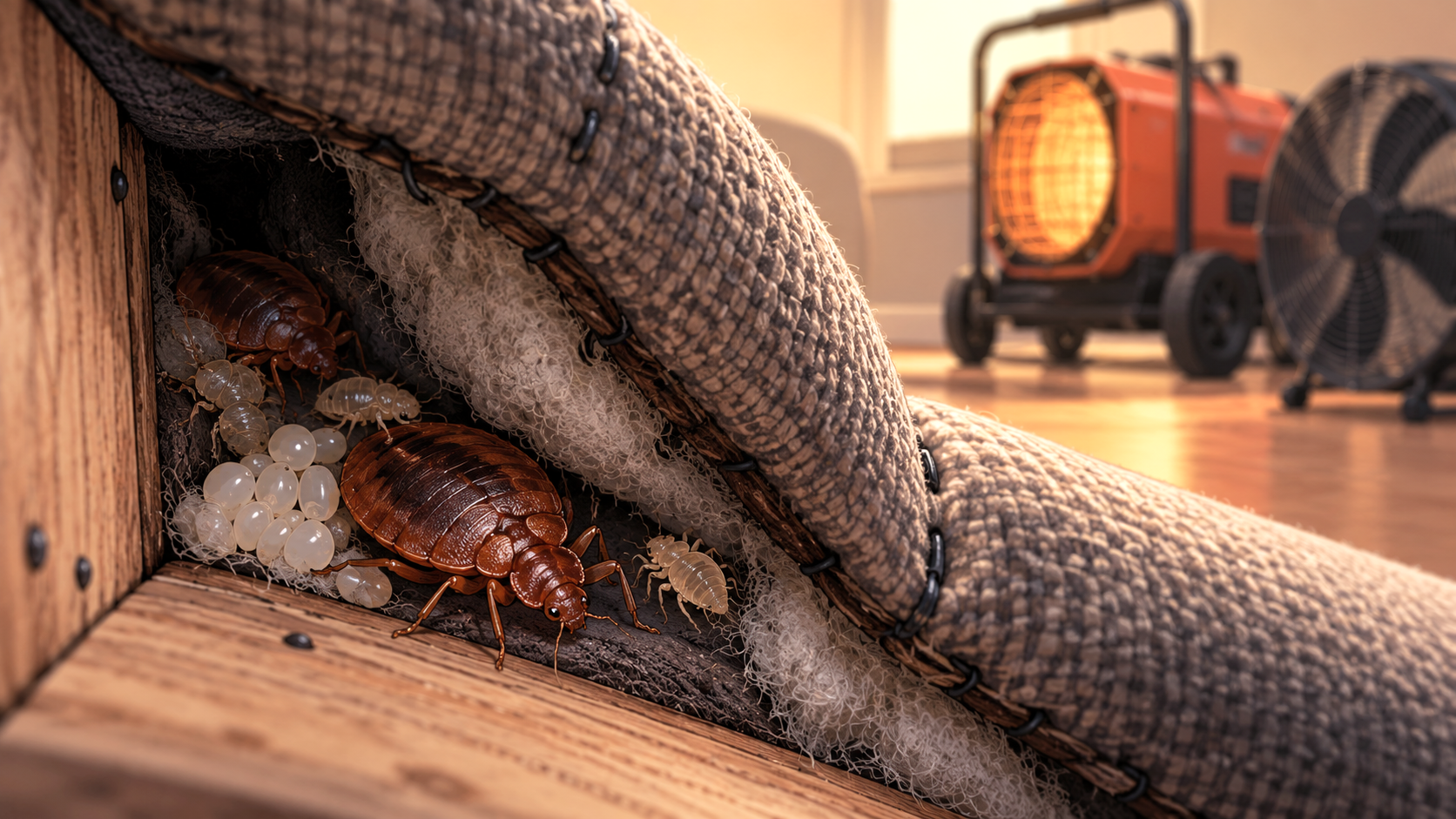
Bed bug heat treatment can fail when lethal temperatures do not reach every bug and egg for long enough. Mattresses, furniture, belongings, wall voids and other insulated spaces can remain cooler than the surrounding room. Bugs may also move toward cooler refuges as temperatures rise, while a later infestation can result from reintroduction rather than failure of the original heat treatment. Heat itself is highly effective against bed bugs. The challenge is delivering the required combination of temperature and exposure time throughout a real building.
A Hot Room Can Still Contain Cold Spots
Room temperature is not necessarily the temperature experienced by a bed bug hidden inside a mattress, beneath furniture or within a structural void. Heat must travel through different materials before reaching insects concealed within them, and those materials do not warm at identical rates.
Experiments simulating bed bug harborages demonstrate how large the delay can become. At a surrounding temperature of 60°C, uncovered bed bugs were killed after 60 minutes, while bugs beneath a blanket required 120 minutes. Researchers recorded a 60-minute delay before the interior of the blanket reached the lethal temperature, showing how covering materials can substantially slow heat penetration.
Furniture and mattresses create the same basic challenge on a larger scale. Dense objects, layered fabrics, piles of possessions and enclosed spaces can warm much more slowly than exposed room air. Earlier thermal-control experiments likewise found that containing and circulating heat around treated furniture was crucial, while even the type of flooring affected how efficiently heat was retained.
A professional whole-room bed bug heat treatment therefore depends on temperature distribution rather than simply making the property feel extremely hot.
Eggs Can Survive Temperatures That Kill Mobile Bed Bugs
Heat treatment becomes less forgiving when eggs are considered. Eggs can require either higher temperatures or longer exposure than adults, depending on the conditions.
Under commercial heat-treatment conditions, researchers calculated an acute lethal temperature for 99% mortality of about 48.3°C for adults but 54.8°C for eggs. At 45°C, adults had an estimated 99% lethal exposure time of 94.8 minutes, while eggs remained viable after as much as seven hours of exposure. At 48°C, eggs required an estimated 71.5 minutes for 99% mortality.
These figures are not a DIY recipe for heating a home. They demonstrate why the temperature measured beside a heater cannot establish whether eggs deep inside belongings received an adequate thermal dose. Bed bug control depends on both temperature and time, and the egg stage within the bed bug life cycle can become the limiting stage when heat distribution is uneven.
Bed Bugs Can Move Away From Rising Heat
A whole-room treatment does not instantly raise every part of a building to the same temperature. The gradual heating period creates temperature gradients, and mobile bed bugs can respond to them.
Research into recurring infestations in multi-unit housing identified this as one plausible route of survival. The treated apartments gradually warmed before reaching their target temperature, and researchers proposed that some bed bugs in furniture or walls could move into cooler harborages while the rooms were heating. Exterior walls, floors and ceilings were particularly relevant because the building’s construction could limit heat transfer.
The places bed bugs normally occupy make this behavior consequential. Their daytime harborages include narrow spaces in furniture and building components, and established infestations can extend into walls and ceiling spaces. A bug moving farther into an inadequately heated void may escape conditions that kill insects remaining in exposed furniture.
This risk is one reason heat-treatment equipment includes high-capacity heaters and fans. Air circulation helps distribute energy through the treatment area instead of allowing sharply different temperatures to persist.
Temperature Sensors Have to Represent the Hardest Places to Heat
A thermostat reading 55°C does not establish that a suitcase packed with clothes, the center of a mattress and a gap against an exterior wall are also at 55°C. Effective thermal remediation requires monitoring in locations expected to heat slowly.
Commercial heat research specifically emphasizes avoiding heat refugia, meaning locations where bed bugs remain below lethal temperature while surrounding areas become much hotter. Experimental work under commercial heating conditions concluded that appropriate temperature and exposure-time targets are needed to prevent these refuges from producing treatment failure.
Sensor placement consequently matters as much as the peak number displayed on a temperature monitor. If measurements come only from easily heated open spaces, they can overstate the thermal exposure received inside difficult harborages. A treatment can reach an impressive air temperature while still leaving biologically meaningful cool zones.
The same phenomenon explains why improvised heating methods are unreliable. In an experiment with mattresses wrapped in black plastic and placed in summer sun, exposed surfaces reached 85°C, yet the underside of a thick mattress never exceeded 35°C. Some portions of a thinner mattress also remained below 36.5°C. The enormous temperature difference showed why a hot exterior cannot verify lethal temperatures throughout an object.
Too Much Packed Material Can Make Heat Distribution Harder
Belongings are not automatically a problem during thermal remediation. Many items can remain inside precisely because heat treatment is intended to reach bed bugs hiding among household contents. Their arrangement, however, affects how readily hot air circulates and how quickly dense materials warm.
Closely packed clothing, overloaded storage areas, stacked boxes and densely arranged possessions can create insulated zones. Preparation instructions therefore vary according to the equipment and protocol used by the pest-control company. Removing everything from the property without instructions can also be counterproductive because an untreated item taken out before treatment may carry a bed bug with it and later return that insect to the home.
Follow the provider’s preparation instructions rather than improvising. The required preparation before professional bed bug extermination needs to reflect the actual treatment method, including which objects stay, which must be repositioned and which heat-sensitive materials require removal.
Bed Bugs Are Not Simply Becoming Heat-Proof
When bugs survive thermal remediation, it is tempting to assume they have developed the heat equivalent of pesticide resistance. Current evidence gives much more weight to inadequate thermal exposure.
Researchers experimentally selected bed bugs for increased heat tolerance over multiple generations and found only a limited ability to develop greater resistance. Comparisons among field populations also produced relatively little variation in heat tolerance. The authors concluded that development of meaningful physiological heat resistance appears unlikely to be a major limitation.
Bed bugs certainly tolerate temperatures that feel dangerously hot to humans. Recent research found substantial survival during prolonged exposures at 37°C to 40°C, reinforcing that ordinary hot indoor conditions are not equivalent to thermal extermination. At genuinely lethal temperatures, however, survival is governed strongly by the thermal dose the insect actually receives.
This differs from chemical control, where pesticide resistance can materially affect treatment performance. A failed heat service warrants investigation of temperatures, exposure duration, structural conditions and possible reintroduction before unusual heat tolerance is considered.
A Bed Bug After Heat Treatment Does Not Prove One Survived the Heat
Successful heat treatment has no lasting residual effect. Once the building cools, nothing about the previous high temperature prevents another bed bug from entering.
Luggage, bags, furniture and other belongings can introduce new bugs. Multi-unit housing adds movement from neighboring apartments. Genetic research in a repeatedly treated apartment building found evidence consistent with both persistence or local spread of existing populations and entirely new introductions, demonstrating how recurring bed bugs can have more than one origin.
The timing and distribution of later detections deserve attention. A bug found shortly after treatment near a previously active harborage raises different questions from one appearing after months without evidence following recent travel. Finding a bed bug months after treatment therefore requires renewed monitoring rather than automatically classifying the insect as a heat-treatment survivor.
Connected housing can make the source still harder to determine. Bed bugs are capable of moving between neighboring apartments, so treating one unit successfully may not prevent later entry from an unresolved infestation elsewhere in the building.
What to Ask When Heat Treatment Fails
If live bed bugs are confirmed after thermal remediation, ask the provider how temperatures were monitored throughout the property. Useful questions include where sensors were positioned, what minimum temperatures were reached at the slowest-heating locations, how long those locations remained at the required temperature and whether any structural areas could not be adequately heated.
The response should focus on measurements rather than how hot the room felt. Heat treatment is a controlled thermal process, and recorded temperatures can help determine whether survival through inadequate exposure is plausible.
Monitoring after retreatment also needs to continue. Properly positioned bed bug interceptor cups can detect mobile insects around beds and suitable upholstered furniture, while physical inspections can look for live bugs and other evidence. The broader question of whether a bed bug treatment has worked depends on sustained evidence after treatment rather than the apparent intensity of the heating event itself.
Questions About Failed Bed Bug Heat Treatments
Can one cold spot really allow an infestation to survive?
Yes. A sufficiently cool refuge can protect bugs or eggs from the thermal dose reached elsewhere. If survivors later feed and reproduce, a small remnant can rebuild the population.
Does a failed heat treatment mean the whole house needs to be heated again?
Not automatically. The provider needs to establish where activity remains and why the first treatment failed. The appropriate response can depend on the building, infestation distribution and whether the later bugs are survivors or a new introduction.
Can opening a window ruin a heat treatment?
Uncontrolled heat loss can interfere with the ability to reach and maintain target temperatures. Windows, doors, ventilation and other sources of heat loss need to be managed by the treatment provider rather than adjusted by occupants during service.
Is chemical treatment better if heat already failed once?
A failed heat service does not establish that heat is inherently unsuitable, nor does it guarantee that a chemical program will work better. Heat and chemical treatments operate differently, so the cause of the previous failure is more useful when choosing the next approach than the fact that heat was used.