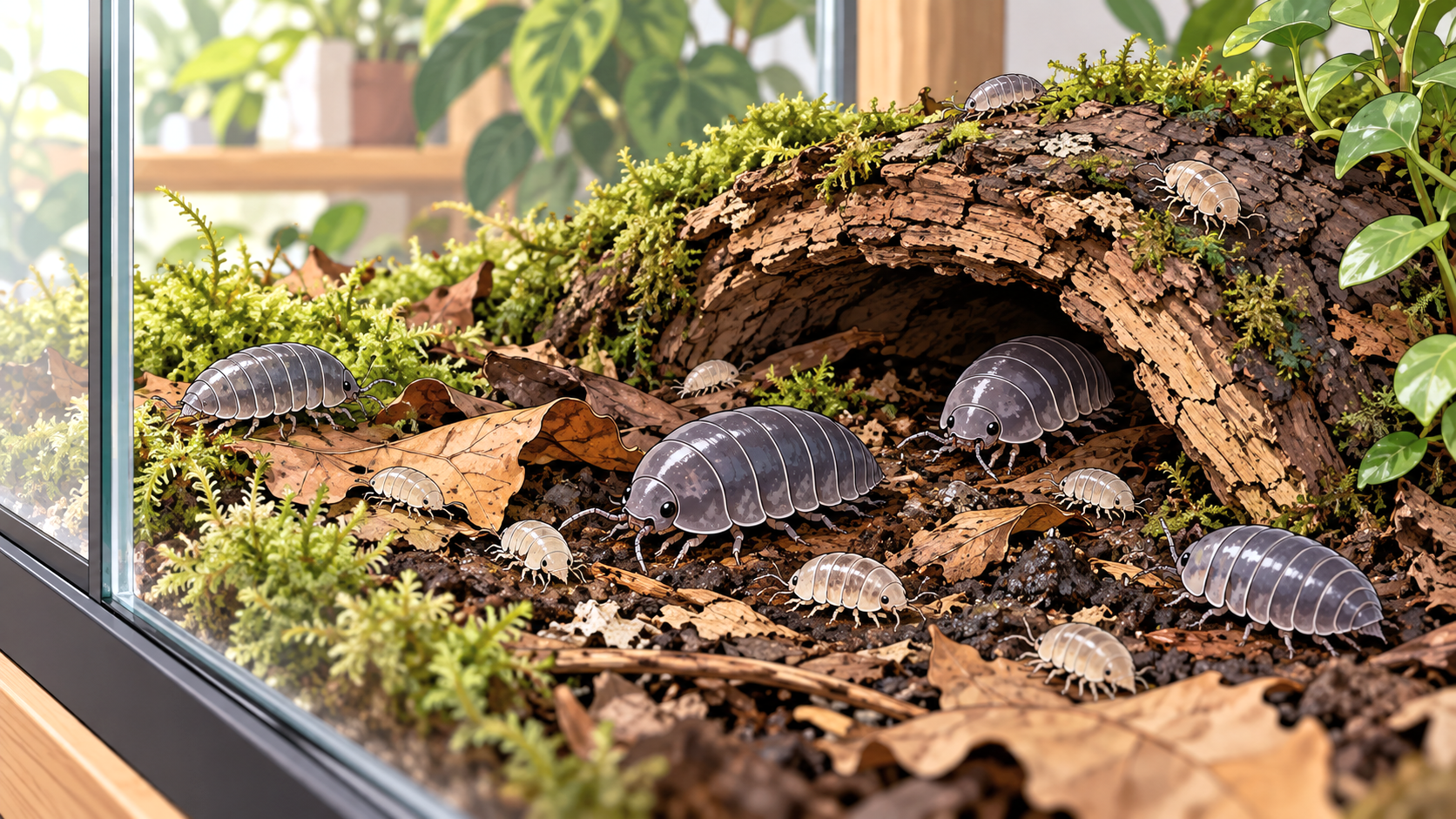
Roly-polies typically live about 1.5 to 2 years in the wild, although some survive considerably longer. The common pill bug, Armadillidium vulgare, has an estimated average wild lifespan of 18 months, while published species guides report that adults can live for two to five years under favorable conditions. Their longevity is strongly influenced by moisture, temperature, food availability, and the conditions of their habitat.
The Animal Diversity Web’s lifespan data gives an average of 1.5 years, whereas the University of Florida’s species account records potential adult longevity of two to five years. These figures describe different measures of survival. The longer lifespan represents what individuals can achieve, rather than the age most wild roly-polies reach.
Why Some Roly-Polies Live Longer Than Others
Dry conditions are particularly dangerous for roly-polies because their respiratory structures must remain moist to function. They lose water through their body surfaces and depend on humid shelters to avoid dehydration. An individual beneath damp leaf litter has access to more favorable conditions than one stranded on exposed concrete during hot weather.
Temperature also influences survival. Roly-polies become less active during cold periods and commonly shelter beneath logs, stones, and accumulated vegetation. In suitable locations, they survive winter rather than dying automatically when temperatures fall. The Missouri Department of Conservation’s terrestrial isopod profile describes their dependence on moisture and the adaptations that allow these crustaceans to occupy terrestrial habitats.
Food and shelter affect how long individuals remain healthy. Decomposing leaves, decaying wood, and other organic materials supply food while also providing protected, humid spaces. Research comparing Armadillidium vulgare populations in different Texas habitats found measurable differences in survival between populations occupying grassland and woodland environments. The study of habitat-related survival differences demonstrates that lifespan cannot be predicted from species identity alone.
How Long Does It Take a Roly-Poly to Become an Adult?
Roly-polies spend a substantial portion of their lives developing before reaching reproductive maturity. Newly emerged juveniles resemble miniature adults but must repeatedly shed their exoskeletons as they grow.
Young common pill bugs undergo frequent molts during their early development. Their exoskeletons cannot expand continuously, so growth depends on periodically replacing the rigid outer covering. The University of California’s pill bug life-cycle information describes molting every one to two weeks over several months before adulthood.
The University of Missouri’s reproductive and developmental account describes juvenile development extending to approximately one year in some pill bugs and sowbugs. Species, temperature, and environmental conditions affect the timing.
This has implications for estimating age. A fully grown roly-poly may have already spent many months developing, while a small individual is not necessarily newly hatched. Size provides a general indication of developmental stage but cannot establish an exact age.
Can Roly-Polies Live for Five Years?
Five years falls within the upper longevity reported for adult common pill bugs, but it should not be treated as their normal life expectancy. Survival to an unusually advanced age requires conditions that allow the animal to avoid prolonged dehydration and other sources of mortality.
Age-related changes also occur in these crustaceans. Research on Armadillidium vulgare found that older individuals exhibited changes in immune-cell characteristics and other physiological markers associated with aging. The 2020 study of senescence in common pill bugs demonstrates that their bodies undergo measurable biological deterioration with increasing age.
An unusually old roly-poly will not necessarily look dramatically different from a younger adult. Changes in activity or appearance alone are insufficient to determine whether an individual is approaching the end of its lifespan.
How Long Do Roly-Polies Survive Indoors?
Roly-polies usually survive only a few days inside an ordinary dry house. Their moisture requirements make most indoor living spaces unsuitable, particularly rooms with dry flooring, limited organic debris, and no access to damp shelter.
A basement with persistent moisture provides more favorable conditions than a heated bedroom or living room. However, finding roly-polies indoors does not establish that they have been living there for months. Individuals frequently wander inside from outdoor habitats through foundation gaps, door thresholds, and other openings.
The University of Maryland’s household guidance identifies excess moisture and outdoor hiding places near foundations as common contributors to indoor sightings. These animals do not damage furniture or establish typical household infestations.
An occasional indoor visitor can be moved outdoors to a sheltered location. When sightings become frequent, inspect for leaks, damp foundation walls, and accumulations of wet plant material beside the building. Correcting those conditions is more useful than attempting to determine the age of individual roly-polies.