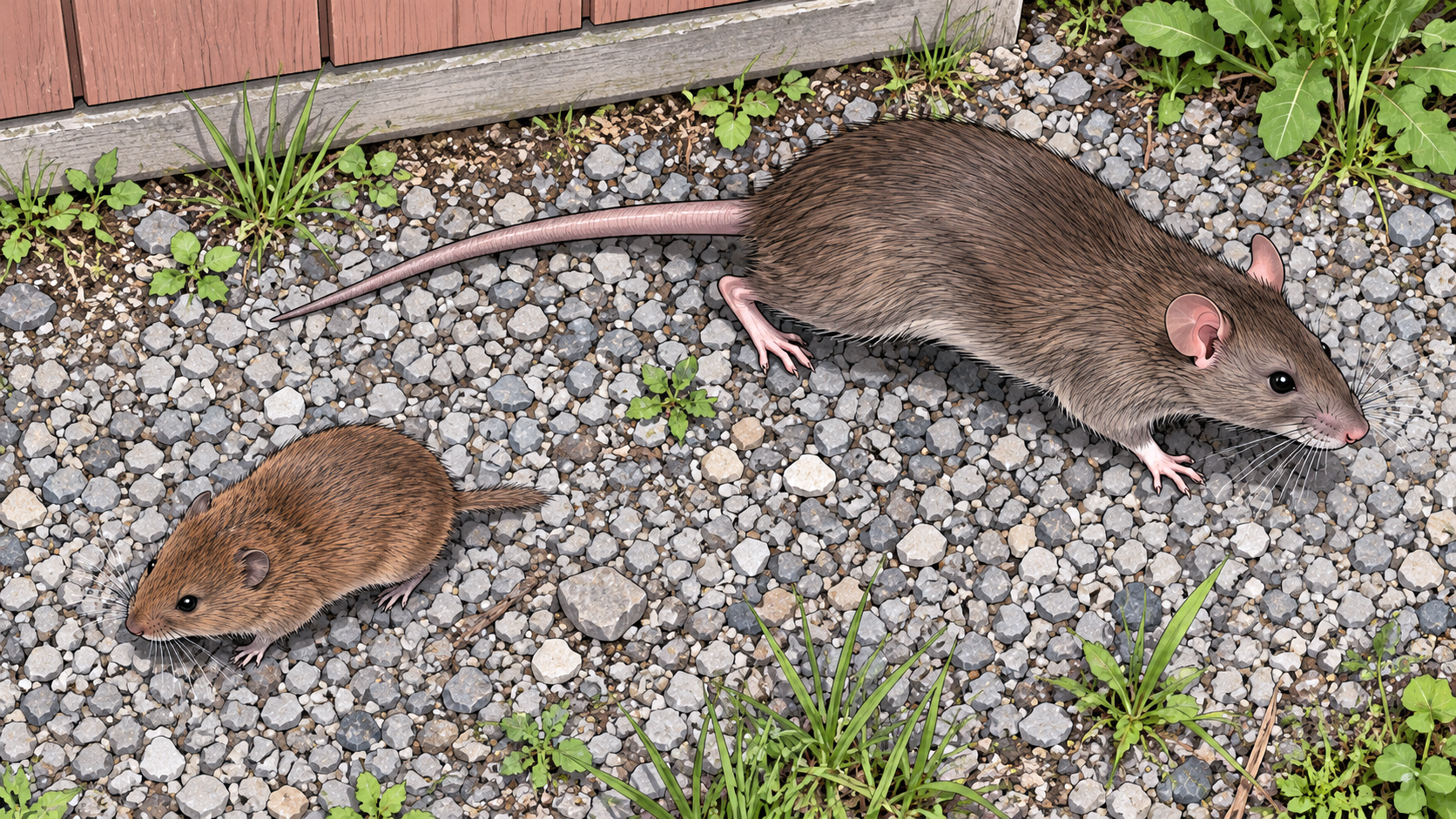
A vole is a small, compact rodent with a short, fur-covered tail and ears partly hidden by its coat, while a rat is generally larger, with a longer, mostly hairless, scaly tail and more prominent feet. Voles are commonly associated with grassy lawns and plant damage. Norway rats and roof rats are more closely associated with buildings, food waste, stored materials, and sheltered nesting sites. A young rat can resemble an adult vole in size, so the tail, feet, and surrounding evidence deserve closer attention than overall length.
The shape of the head is less reliable than many people assume. Norway rats have blunt noses and relatively small ears, while roof rats have pointed muzzles and larger ears. Comparing every rat to a pointed-nosed animal can therefore lead to a mistaken vole identification.
Vole vs. Rat: Physical Differences
| Feature | Vole | Norway rat | Roof rat |
|---|---|---|---|
| General build | Short, compact, rounded | Heavy, robust | Slender, elongated |
| Snout | Blunt and rounded | Blunt | Pointed |
| Ears | Small and partly concealed | Small but visible | Large and prominent |
| Tail | Short, covered with fine fur | Long, scaly, shorter than head and body combined | Long, scaly, longer than head and body combined |
| Feet | Small relative to body | Larger and more conspicuous | Slender, adapted for climbing |
| Adult weight | Commonly measured in tens of grams | Commonly several hundred grams | Commonly 140–280 grams |
| Common outdoor evidence | Grass runways and clipped vegetation | Burrows near foundations and sheltered ground-level areas | Activity around trees, fences, and elevated structures |
| Feeding habits | Primarily plant material | Wide variety of plant and animal foods | Fruits, nuts, seeds, and other available foods |
The Government of Alberta’s rat identification information documents the contrasting head shapes, ear sizes, and tail proportions of Norway and roof rats. These differences are worth recognizing because a Norway rat’s stocky body can superficially resemble a vole, particularly when the rat is young or partly concealed.
A Rat’s Tail Is Much More Conspicuous
A vole’s short tail usually extends only a modest distance beyond its hindquarters. Fine hair covers the tail, and the dense surrounding vegetation can conceal it during movement. In many familiar North American voles, the tail measures less than half the combined length of the head and body.
Rats have longer, cylindrical tails with visible scales and sparse hairs. A Norway rat’s tail is shorter than its head and body combined, but it remains considerably more prominent than the tail of a typical meadow vole. Roof rats have proportionally longer tails, extending beyond the combined length of the head and body. The Centers for Disease Control and Prevention’s rodent identification illustrations document these differences alongside the characteristic head and body shapes of both rat species.
Tail proportions become particularly useful when identifying an animal in a photograph. Suppose two rodents have equally rounded bodies, but one has a short, hairy tail and the other has a long, scaly extension trailing behind it. The former is more consistent with a vole, while the latter fits the typical rat profile.
A partly concealed tail should never be treated as a complete measurement. The tail lengths of different voles also vary by species, so the entire animal needs to be visible before using this characteristic confidently.
Young Rats Are More Difficult to Distinguish From Voles
An adult Norway rat is substantially heavier than a typical meadow vole. The University of California’s rat measurements place adult Norway rats between 7 and 18 ounces (198–510 grams), while familiar North American voles generally weigh much less.
Juvenile rats create the more difficult identification problem. A recently weaned rat can fall within the size range of an adult vole, so describing an animal as too small to be a rat is unreliable. Young rats also have proportionally large heads and feet, which can help distinguish them from smaller adult rodents.
The feet are particularly useful in a clear side photograph. A young rat often has conspicuous hind feet relative to its developing body. A vole’s short legs and smaller feet contribute to a lower, more compact profile. The general body proportions of voles provide supporting evidence when tail length is difficult to judge.
A dark coat offers little assistance. Both groups include brown and gray individuals, and some rat populations contain much darker animals. The color variations found among voles also prevent coat shade from serving as a dependable dividing line.
Their Feeding Damage Points Toward Different Animals
A cluster of damaged young plants at the edge of a lawn suggests a different feeding pattern from repeated chewing around garbage containers or stored animal feed.
Voles consume grasses, roots, bulbs, seeds, and other vegetation. Their feeding can leave neatly clipped grass, damaged underground plant parts, or bark injuries near the bases of trees. The Internet Center for Wildlife Damage Management’s vole information documents characteristic feeding injuries associated with these small rodents.
Norway rats are opportunistic feeders that consume grains, fruits, meat, food scraps, and numerous other available materials. Roof rats also exploit a broad diet, with fruit and nuts frequently attracting them in residential landscapes. Both species can damage garden crops, making chewed vegetables insufficient evidence for identifying a vole.
The location of the damaged material adds useful context. Repeated vole feeding on garden vegetables may occur alongside grass runways or sheltered vegetation. Rats commonly leave evidence near stored food, garbage, compost, and structures. The Environmental Protection Agency’s rodent identification guidance identifies chewed food packaging and nesting materials as characteristic signs of rats and mice occupying buildings.
Plant damage alone does not establish the animal responsible. Rats, voles, rabbits, and other wildlife can feed on overlapping plant species. A reliable identification combines the damage with physical evidence and the surrounding location.
Grass Runways and Rat Travel Routes Look Different
Voles, particularly meadow voles, repeatedly move through narrow pathways beneath dense vegetation. Their movements flatten or clip grass, eventually producing recognizable surface runways. These pathways commonly connect feeding areas with nearby cover.
The grass trails left by voles can become conspicuous after snow melts or vegetation is disturbed. They are generally associated with the ground-level cover that protects the animals during their movements.
Norway rats favor routes alongside walls, fences, foundations, and other sheltered edges. Repeated travel can produce worn paths, while contact between the animal’s fur and surrounding surfaces may leave dark rubbing marks. They also establish burrows around foundations, rubbish piles, and garden structures.
Roof rats often use elevated routes. Fences, branches, utility lines, and climbing vegetation can connect feeding and nesting sites. The University of California’s descriptions of rat activity identify both the ground-level habits of Norway rats and the climbing behavior associated with roof rats.
This means an animal repeatedly crossing the top of a fence warrants a different identification approach from one moving through flattened grass. However, rats can travel along the ground, and some voles use underground passages, so location remains supporting evidence rather than proof.
A Rat Is More Likely to Establish Itself Inside a Building
Rats frequently occupy human structures when food, water, and shelter are available. Norway rats commonly establish nests beneath floors, inside wall voids, and around ground-level storage areas. Roof rats favor elevated locations such as attics, ceiling spaces, and dense climbing vegetation.
Voles predominantly occupy outdoor habitats. They can occasionally enter buildings, particularly where openings connect sheltered outdoor areas with indoor spaces, but they are not typical indoor commensal rodents. An isolated vole entering a house therefore presents a different identification situation from persistent rat activity inside walls or storage areas.
Evidence concentrated around stored food, chewed wiring, concealed indoor nests, and regularly used building entry points deserves closer investigation for rats or mice. By contrast, visible feeding trails across a lawn and damage concentrated around living plants favor a vole.
Outdoor rat populations can also occupy gardens without establishing nests inside the house. The presence of an animal outdoors does not eliminate rats from consideration, particularly near compost piles, outdoor pet food, and accessible garbage.
How to Identify a Rodent You Saw Only Briefly
The most useful observation depends on what was visible. If you saw the entire animal, concentrate on the length and texture of its tail. If only the head appeared, look at the ears and muzzle, remembering that Norway rats also have blunt noses. When the animal was small, examine the size of the feet relative to its body rather than ruling out a juvenile rat.
Where no photograph is available, inspect the location without disturbing suspected nests or handling droppings. A combination of clipped grass, low vegetation cover, and surface runways supports a vole identification. Repeated gnawing around stored materials, rubbing marks along building edges, and activity in wall or roof spaces support a rat identification.
We would not choose a trap or poison from the animal’s estimated size alone. Rat-sized equipment, vole traps, and toxic baits have different practical and label-related requirements. Misidentification can expose pets and other wildlife to unnecessary risks without addressing the animal actually present.
A clear photograph that includes the entire tail, head, and feet is the best starting point. When that is unavailable, record the location and several independent signs of activity before making a treatment decision. The appearance of the animal and the evidence it leaves behind should support the same identification.