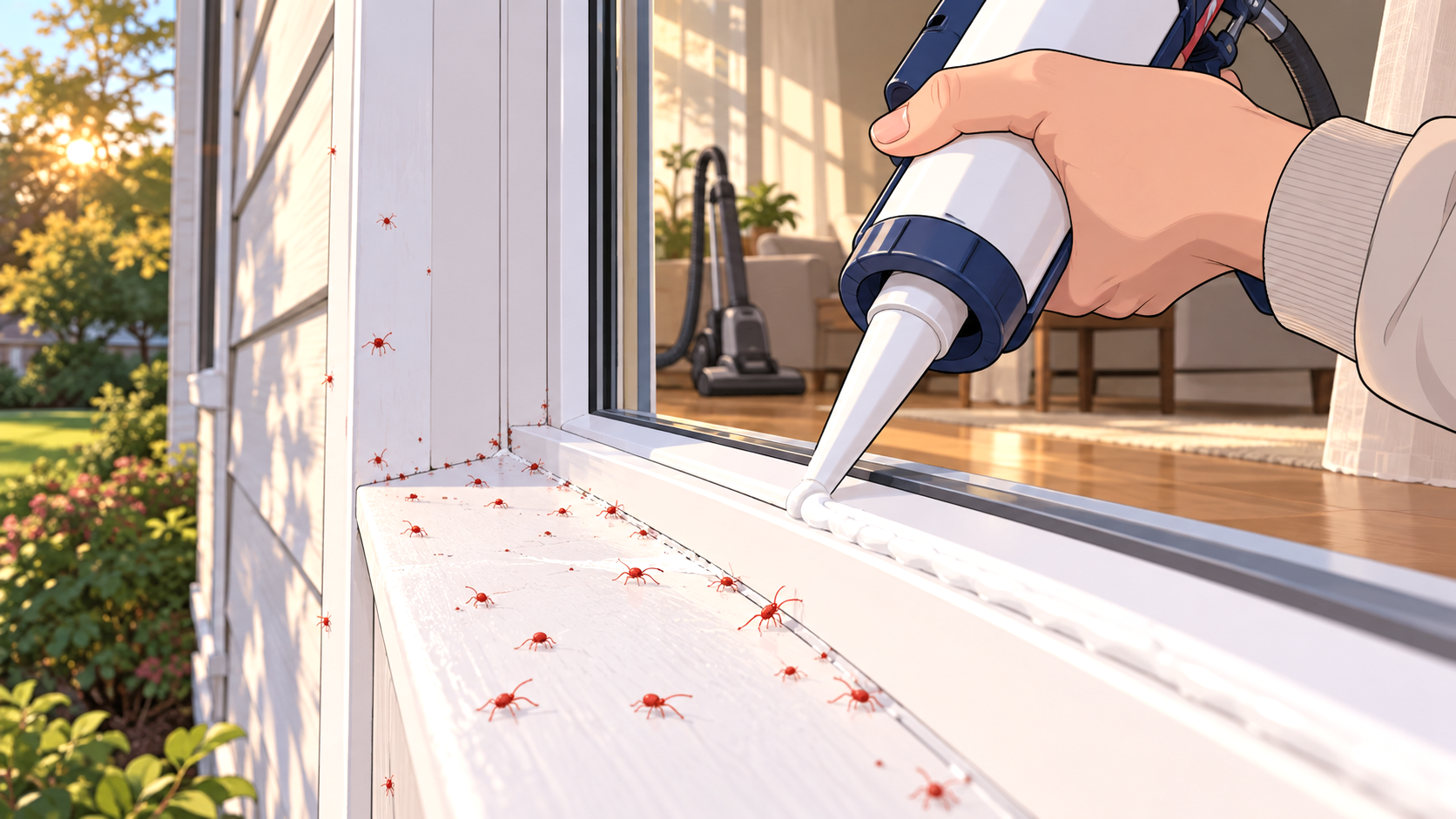
Spraying a household bug killer along the windowsills is often the first response to clover mites, but it rarely addresses the source of the problem. Clover mites found indoors usually originate from outdoor populations feeding on lawns, weeds, and other vegetation near buildings. Once inside, they typically perish within a few days without suitable plants to feed on. Getting rid of clover mites means vacuuming the ones already inside without crushing them, sealing the gaps they use, and reducing favorable vegetation beside the house. Outdoor treatment with insecticidal soap or an appropriately labeled pesticide may help during active migrations, but routine indoor spraying is generally unnecessary.
The Clover Mite Source Is Often Near Your Foundation
Many indoor clover mite invasions originate from lawns and other vegetation growing close to exterior walls, particularly on the south and west sides of buildings, where sunny surfaces can attract large numbers of migrating mites. They may feed on grass, weeds, or other suitable plants before climbing walls and entering through small openings. Separating that vegetation from the foundation can reduce future invasions, although the recommended width of the cleared strip varies. Some turf specialists find that a band of bare soil or stone 18 to 24 inches wide can help interrupt migration, while other guidance recommends an approximately three-foot vegetation-free border.
A wider cleared strip may be useful along sunny walls where recurring migrations are heaviest, provided the changes are suitable for the property’s landscaping and drainage. Gravel alone is not a dependable barrier because landscape rock does not reliably keep clover mites away, particularly if grasses and weeds continue growing through or beside it. Maintain the strip without suitable host vegetation and pair it with caulking and weatherstripping around windows and doors. Completing these improvements before seasonal migrations begin is more useful than trying to seal every opening during a large invasion. Adjustments to lawn edges, garden beds, and exterior surfaces can further support outdoor clover mite removal.
Clearing Clover Mites Already Inside
A vacuum or carefully used damp cloth handles indoor mites without requiring pesticide treatment. Crushing them leaves reddish marks on paint, trim, and fabric, sometimes creating clover mite stains that require careful removal. Move a vacuum nozzle close enough to collect the mites without dragging it across their bodies. After collecting a substantial number, empty the canister into a sealed waste bag or dispose of the vacuum bag outside the home, following the vacuum manufacturer’s instructions.
Routine indoor insecticide applications are generally not recommended because clover mites do not establish self-sustaining populations in occupied rooms. Renters may face additional challenges because clover mites entering apartments can originate from landscaping or structural openings controlled by the property manager. Document recurring entry points and request repairs where needed rather than repeatedly treating the same interior surfaces. Concentrations around windowsills, baseboards, and curtains can be handled through targeted indoor clover mite cleanup while the underlying entry routes are addressed.
Soap, Water, and Insecticide Outdoors
Outdoor treatment works best as a supplement to habitat changes and structural exclusion. A garden hose can dislodge mites from suitable exterior surfaces, while commercial insecticidal soap may control exposed mites through direct contact where its current directions permit application. Soap provides little lasting residual activity, so it must reach the mites to work. Other nonchemical and lower-impact clover mite methods can reduce the need for repeated pesticide applications.
Conventional insecticides have limitations as well. Colorado State University Extension reports that no chemical treatment provides consistently highly effective clover mite control, although formulations containing bifenthrin or lambda-cyhalothrin may help when applied to appropriate outdoor treatment sites. Unlike insecticidal soap, some pyrethroid products can leave residues that affect mites crossing treated surfaces later. Their effectiveness depends on the formulation, exposure, weather, and whether mites actually encounter the treatment. Killing visible migrants does not necessarily eliminate the outdoor population supplying them.
Treatment timing matters, but contact sprays and residual insecticides should not be treated as interchangeable. Insecticidal soap requires adequate contact with active mites, while a labeled residual treatment may remain effective for a period specified by its product directions. Choose an application based on the actual infestation and the authorized treatment site, not simply the presence of mites on a wall. A comparison of clover mite insecticides can help distinguish suitable active ingredients and formulations without assuming every product containing those ingredients has identical permitted uses.
When using a pesticide, follow the exact product’s instructions concerning children, pets, toys, application conditions, and reentry. Do not assume that a treated area becomes safe for unrestricted access simply because the spray has dried; some labels impose additional restrictions. Avoid applications during unsuitable wind or weather conditions and prevent pesticide drift or runoff into gardens, drains, or nearby water. Product-specific application and safety directions take priority over general recommendations. Pesticide registrations and permitted uses also differ between the United States, Canada, and other countries, so an EPA-registered product is not automatically authorized elsewhere.
Clover Mite Removal Questions That Surface Later
Will clover mites leave if I do nothing?
Eventually, visible activity often declines as seasonal conditions change. Spring invasions in Colorado typically end by late May, although timing varies with local climate and weather. Populations may become active again during favorable periods, especially when vegetation and entry points remain unchanged. This seasonal pattern is one reason clover mites keep returning to the same properties.
Does cutting back on lawn fertilizer help?
It can, particularly when a foundation is bordered by unusually lush grass. Clover mites can build large populations in vigorous, heavily fertilized turf, so avoiding excessive fertilization near affected walls may reduce favorable feeding conditions. This does not mean withholding necessary nutrients from the entire lawn; maintain appropriate turf care without encouraging dense growth directly against problem areas.
When is a professional worth paying for?
Heavy invasions that continue despite vegetation management, vacuuming, and structural exclusion can justify professional assessment. A qualified pest-control professional can confirm that the organisms are clover mites, identify outdoor sources, and determine whether a targeted pesticide application is appropriate. Professional assistance is particularly useful when treatment would involve difficult-to-access areas or complicated label restrictions. The main reasons for calling an exterminator for clover mites are repeated substantial invasions, difficult access, or failure to identify and correct the source.