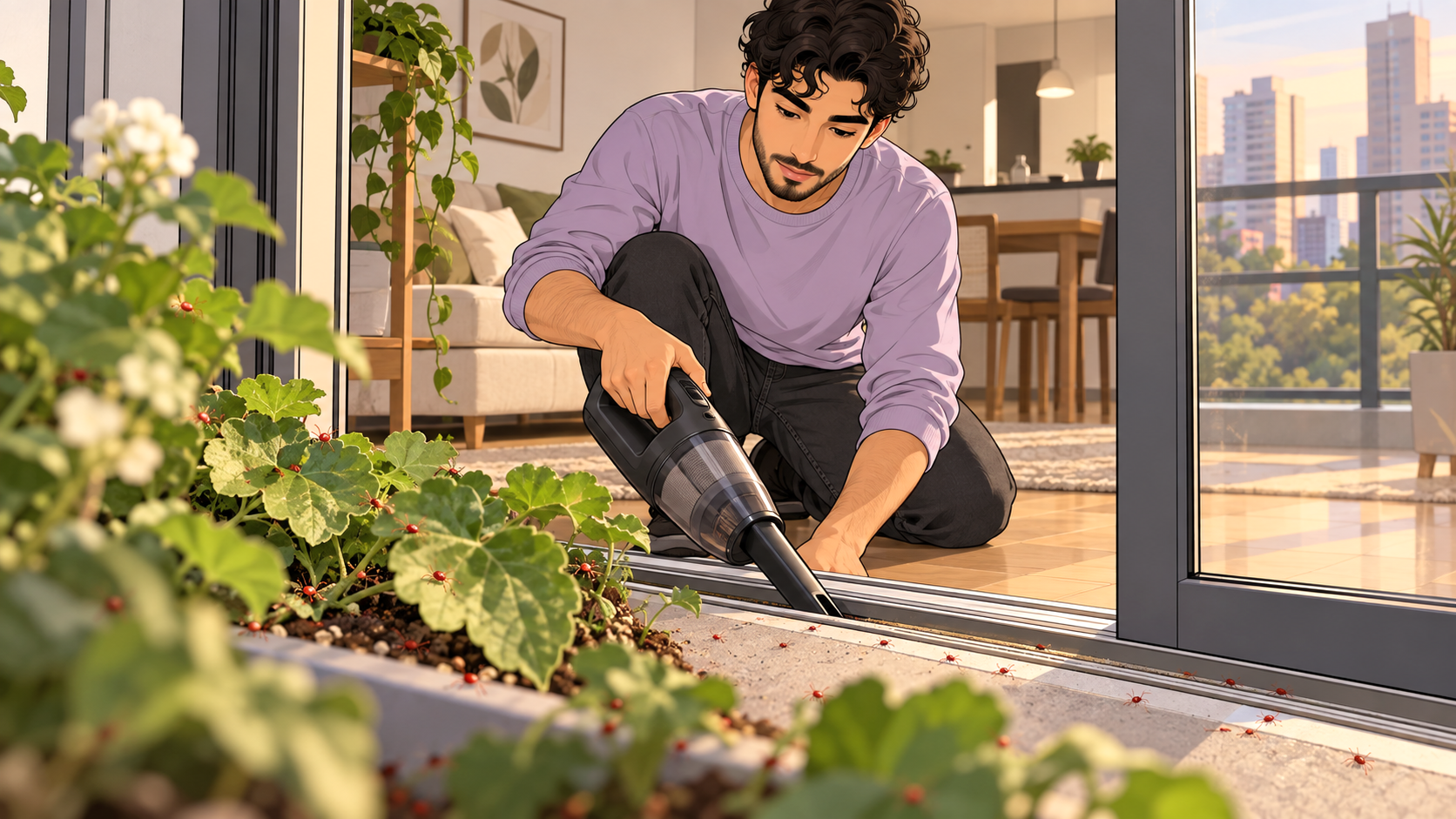
Getting rid of clover mites in an apartment requires a different approach from treating a detached house. You can remove mites from your unit and address small gaps you are permitted to alter, but the outdoor source, exterior walls, landscaping, and pesticide treatment may be controlled by the landlord or property manager.
That makes early reporting and building-level management especially important when large numbers keep appearing. Clover mites cannot maintain a reproducing population indoors, so the goal is to manage the migration affecting your unit rather than hunt for an indoor colony.
Remove Clover Mites Without Staining the Apartment
For mites already inside, vacuuming is usually the simplest option. Clover mites are soft-bodied and can leave reddish stains when crushed, so vacuuming is recommended for indoor removal instead of wiping or smashing large numbers against walls, curtains, or flooring.
Be particularly careful in a rental where stained paint, carpet, or furnishings could become a separate problem. Their red coloration does not come from blood, but the pigments can still mark surfaces when the mites are crushed.
Indoor pesticide treatment is rarely the priority. Clover mites that remain inside eventually die, and chemical treatment indoors is generally unnecessary. Removing visible mites as they appear is usually enough while the larger building problem is being addressed.
Report Repeated Migrations to the Landlord or Property Manager
A tenant often cannot address the most important parts of a clover mite problem independently. Exterior walls, foundation areas, shared landscaping, siding, and common spaces normally fall outside the individual apartment.
Document where and when the mites appear, then report repeated activity to whoever manages the property. Photos can help confirm that the pest is actually a clover mite, particularly because several tiny mites can look similar without magnification. Clover mites have a distinctive long first pair of legs that helps with identification.
Reporting also gives management a chance to inspect the exterior conditions associated with the affected units. Clover mites commonly originate in turf and other vegetation, and lush or heavily fertilized lawns can support large populations. In an apartment complex, changing those conditions may require the landscaping contractor or building owner rather than an individual tenant.
Do Not Apply Exterior Pesticides Without Permission
Perimeter treatments sometimes used around houses become more complicated at an apartment building. The exterior may be common property, and spraying from your unit can expose neighboring areas, landscaping, pets, or people.
If pesticide treatment is considered, building management or a pest professional should determine what can legally and safely be applied to the property. Any pesticide must be labeled for the pest and treatment site, and the product label must be followed.
This is also a situation where more pesticide is not automatically better. Physical and habitat measures are important for lasting management, while pesticide treatments can provide temporary suppression. An apartment resident who cannot modify the exterior is better served by getting the responsible property manager involved than repeatedly spraying accessible surfaces.
Ask Management to Address the Outdoor Source
Clover mites normally develop outdoors on plants. Their diet consists primarily of grasses and other vegetation, so a heavily affected apartment may be next to landscaping capable of supporting a substantial population.
One established preventive measure is creating a vegetation-free zone beside the building. Keeping an 18- to 24-inch band free of grass and leaves can discourage clover mite migrations. Other guidance recommends removing turf and suitable host plants immediately beside affected foundations.
As a tenant, do not remove communal plants or alter landscaping unless you have permission. Instead, point out concentrated mite activity to management and ask whether the landscaping beside the affected part of the building can be assessed. The broader conditions that encourage clover mites around a property may extend well beyond the boundaries of your apartment.
Shared Buildings May Need Coordinated Treatment
An apartment problem may involve more than one unit because several apartments can face the same exterior population. Treating only the unit where mites were first reported can miss activity elsewhere along the building.
This does not mean clover mites are breeding between apartments. They are temporary indoor invaders and do not reproduce inside buildings. Multiple affected units can simply be receiving mites from the same outdoor source or exterior section.
If neighbors are seeing them too, tell management. Coordinated inspection can identify whether the problem follows one exterior wall, landscaped area, or section of the property. This is particularly useful when clover mites keep returning after individual units have already removed the visible mites.
Make Only the Exclusion Changes Your Lease Allows
Small exclusion measures can help, but renters should distinguish between ordinary removable measures and alterations to the building. Weather stripping and sealing suitable gaps can reduce clover mite access, but permanent caulking, window modifications, or repairs may require approval.
For defects that belong to the building, such as damaged window seals or deteriorated exterior caulking, submit a maintenance request instead of making an unauthorized repair. Clover mites are extremely small, so even apparently minor defects can matter.
This is where apartment management differs most from treating your own house. You can control what happens inside your unit, but lasting improvement may depend on exterior work you are neither responsible for nor permitted to perform.
Other Questions About Clover Mites in Apartments
Should I call my own exterminator?
Check your lease or contact property management first. Exterior treatment or work involving common areas may require the landlord’s authorization, even if you are allowed to hire pest control for the interior.
Can clover mites spread from my apartment to my neighbor’s?
Finding them in neighboring apartments does not necessarily mean they spread from one unit to another. Several units can be affected by the same outdoor population.
Can I remove apartment landscaping that seems to be contributing to the problem?
Not without permission if the landscaping belongs to the property. Report the suspected source to management so it can be evaluated and modified appropriately.
Do I need to throw away furniture or belongings?
No. Clover mites do not infest furniture or household possessions. They are temporary plant-feeding invaders, not pests that establish themselves in belongings.
One thought on “How to Get Rid of Clover Mites in an Apartment”