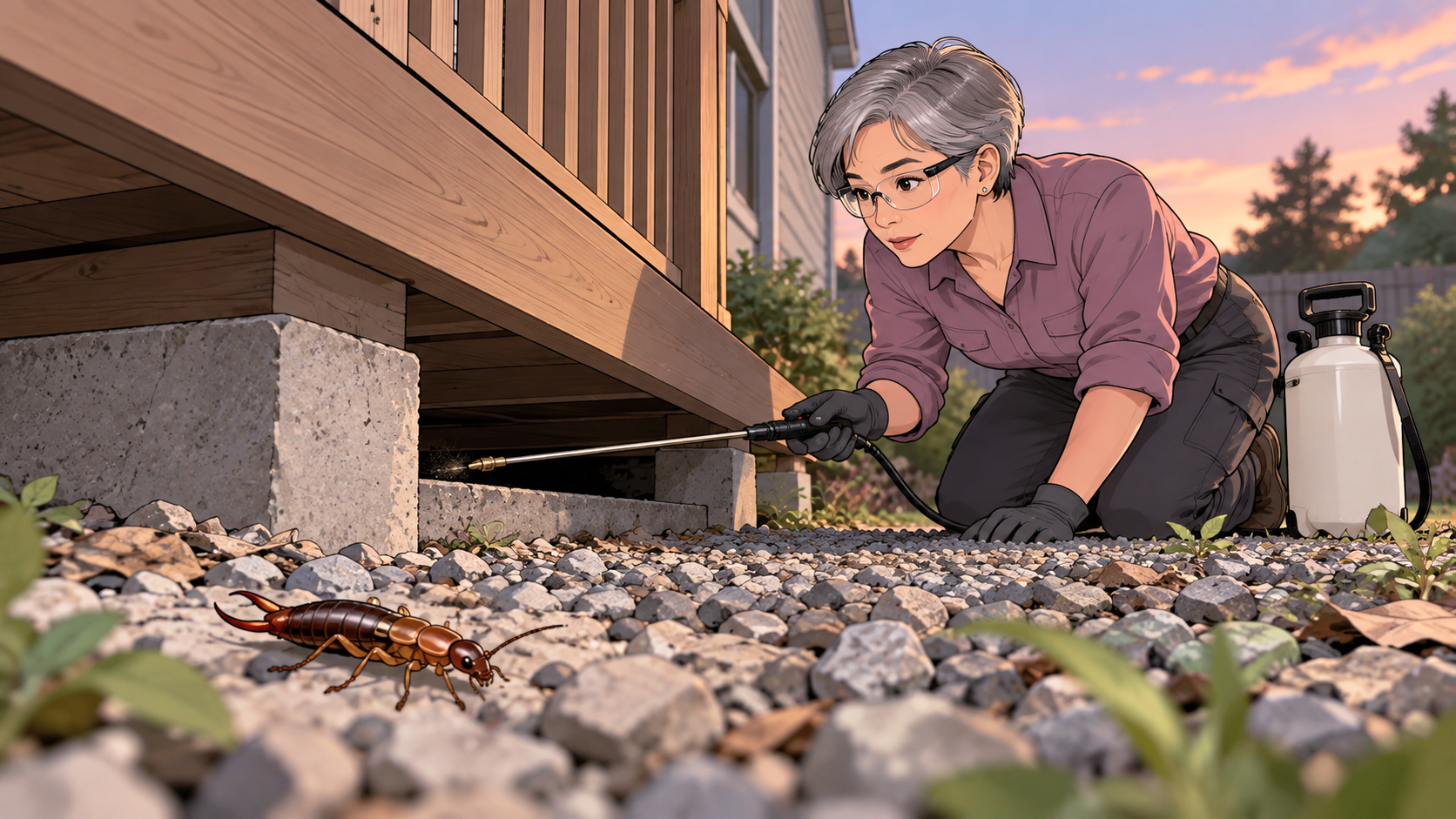
Bifenthrin kills earwigs. It is a synthetic pyrethroid insecticide that can kill susceptible earwigs through direct contact or exposure to treated surfaces. Products such as Talstar P Professional explicitly list earwigs among their target pests. However, a product containing bifenthrin is not automatically approved for every earwig problem, and successful control depends on its formulation, application location, and the insects’ exposure.
Bifenthrin is especially relevant to outdoor and perimeter treatments where earwigs repeatedly travel through identifiable areas. Its residual activity can continue affecting insects after an application dries, but it does not guarantee that all earwigs will encounter the treated surface or that new individuals will stop arriving.
What Happens When Bifenthrin Reaches an Earwig?
Bifenthrin interferes with the electrical signaling of insect nerve cells. It acts on voltage-gated sodium channels, disrupting their normal opening and closing. Sufficient exposure can produce abnormal movements, loss of coordination, paralysis, and death.
The insecticidal action of bifenthrin is classified under pyrethroids, specifically Insecticide Resistance Action Committee Group 3A. The compound is designed to work through contact or ingestion, although the importance of each exposure route varies with the formulation.
An earwig sprayed directly can receive a substantial dose. Another earwig may encounter a smaller amount while walking across a treated surface. Neither situation establishes a fixed killing time because exposure, formulation, and environmental conditions influence the outcome.
Visible knockdown also differs from confirmed mortality. An insect that becomes motionless shortly after treatment may have experienced nervous-system impairment, but apparent immobility alone does not demonstrate that it is dead.
Bifenthrin is broad-spectrum rather than selective for earwigs. It can affect numerous other arthropods, including beneficial insects, making unnecessary applications undesirable where earwig activity is minor.
Evidence That Bifenthrin Products Control Earwigs
Earwig control is an explicit labeled use of certain bifenthrin formulations.
One example is Talstar P Professional, a water-based concentrate containing 7.9% bifenthrin. Its registered labeling includes earwigs among the target insects for specified applications. The product is also approved for several other pest-control settings, subject to separate directions and restrictions.
Talstar P illustrates that bifenthrin can be used against earwigs without relying on claims about other insects. However, its efficacy under labeled conditions does not establish identical performance for every bifenthrin product sold to homeowners.
Concentrates, ready-to-use sprays, and granules differ in how they distribute the ingredient. Even two products containing the same percentage of bifenthrin may have different permitted sites, application rates, or directions because their complete formulations and registrations differ.
The registered product information for Talstar P Professional also illustrates why regional registration matters. A pesticide approved federally may have additional state restrictions, and products sold outside the United States operate under different regulatory systems.
For consumers comparing ingredient names, Ortho Home Defense formulations containing bifenthrin provide another example of how the same active ingredient can appear in products intended for different application methods. The correct treatment directions always come from the individual product label.
How Formulation Changes Earwig Exposure
Bifenthrin is available in several delivery forms, and the choice affects where the insecticide is deposited and how earwigs may encounter it.
| Formulation | Exposure route | Important consideration |
|---|---|---|
| Ready-to-use liquid spray | Direct contact or movement over treated surfaces | Convenient for small, labeled treatment areas |
| Dilutable liquid concentrate | Contact with spray or deposited residue after correct dilution | Mixing and application rates vary by product |
| Granular formulation | Exposure after granules distribute the insecticide at an approved site | Watering requirements and treated locations differ |
| Aerosol formulation | Direct spray or contact with an approved residual deposit | Indoor permissions and ventilation requirements must be checked |
A liquid concentrate is not automatically stronger in use than a ready-to-use spray. The percentage printed on a concentrate container describes the product before dilution. Its eventual application concentration depends on the instructions for the particular pest and location.
Granules require separate consideration. Some are designed to penetrate mulch or disperse across turf, while others have specific watering requirements. For example, Talstar PL granular insecticide contains bifenthrin and is formulated for outdoor applications, but its product-specific directions cannot be transferred to a liquid treatment.
Bifenthrin should not be selected solely because the formulation seems convenient. Earwigs occupying narrow crevices or protected spaces may avoid deposits on exposed surfaces. Their movement during nighttime activity can increase opportunities for contact, but the insecticide must still be present along a route they actually use.
How Long Does Bifenthrin Remain Effective Against Earwigs?
Bifenthrin can provide residual insecticidal activity, but its chemical persistence and its ability to kill earwigs are not the same measurement. A residue may remain detectable after environmental conditions have reduced its effectiveness against insects.
The ingredient binds strongly to soil and organic matter and has relatively low water solubility. Its environmental behavior and persistence help explain why it can remain in treated environments rather than disappearing immediately after application.
Residual performance varies with sunlight, rainfall, surface type, formulation, and disturbance. Outdoor deposits face different conditions from protected indoor surfaces. Cleaning or abrasion can also alter the amount of insecticide available for contact.
A manufacturer’s extended-control claim must therefore be interpreted according to the specific pests and application conditions named on the label. A product promising several months of activity against another insect does not necessarily provide the same duration of earwig control.
The time required for earwig activity to decline also depends on whether additional insects continue entering the treated area. Finding earwigs several days after application does not, by itself, establish that the bifenthrin residue has become ineffective.
Where Can Bifenthrin Be Used for Earwigs?
Depending on registration and formulation, bifenthrin products may permit applications to selected exterior building surfaces, lawns, ornamental landscapes, or specified indoor locations. Some professional products have extensive use-site lists, while consumer products may be more restricted.
The word bifenthrin on a container does not authorize treatment of every location where earwigs appear. A product labeled for outdoor perimeter applications should not be used on bedroom carpets or kitchen cabinets unless its directions specifically permit those locations.
Similarly, permission to treat ornamental plants does not establish that a product can be applied to vegetables or other edible crops. The crop, pest, application method, and any preharvest interval must all be covered by the applicable label.
For recurring earwigs near a building, an approved perimeter treatment may be appropriate when insects are moving through a defined location. It should not be confused with permission to spray an entire foundation indiscriminately. Some pyrethroid labels limit exterior applications to cracks, crevices, or specific structural areas, subject to exceptions and regional restrictions.
Persistent earwig activity around yards and lawns may involve several outdoor locations, but a pesticide should be directed only at areas where treatment is justified and permitted.
Environmental and Household Precautions
Bifenthrin is highly toxic to fish, aquatic invertebrates, and bees. Its tendency to bind to soil does not eliminate environmental risk because contaminated soil particles can be carried into surface waters.
The EPA’s pyrethroid runoff precautions address movement into drainage systems, streams, and other waterways. Avoiding application before heavy rainfall, preventing drift, and respecting restrictions near impervious surfaces are especially important.
Flowering plants create another exposure concern. Earwigs may be present around flowers alongside pollinators and other beneficial insects. Pollinator-protection restrictions can prohibit applications during bloom or require particular timing and other safeguards.
This is particularly relevant to milkweed. Although earwigs can prey on monarch eggs and small caterpillars, bifenthrin can also expose the insects gardeners are trying to protect. Its broad-spectrum activity makes it a poor choice for indiscriminate treatment of monarch habitat.
Household precautions depend on the specific formulation. Follow the required personal protective equipment, ventilation, and reentry instructions. Keep children and pets away from treated areas for the period required by the label, and prevent animals from contacting or ingesting pesticide deposits.
Do not apply bifenthrin directly to people, pets, food, utensils, or surfaces outside the product’s approved uses. Never increase the concentration or application frequency because insects remain visible.
When Is Bifenthrin Worth Using Against Earwigs?
Bifenthrin is a reasonable candidate when earwigs are causing a documented problem, a registered product explicitly covers them, and their activity is concentrated where treatment is permitted. Its contact and residual properties can make it useful against insects repeatedly crossing treated areas.
However, earwigs are not always undesirable outdoors. They consume other insects and decomposing material, and small populations may cause no meaningful damage. The integrated pest management approach favors intervention based on an identified problem rather than insect presence alone.
A useful way to evaluate treatment is to compare the affected location before and after application. If earwigs were repeatedly appearing along a particular exterior threshold, record fresh sightings at that point. If the concern involved plant injury, examine newly developing foliage for additional damage rather than expecting old holes to disappear.
Where activity remains unchanged, reassess the insects’ exposure and the suitability of the product’s application site before considering another treatment. New earwigs may be arriving from outside the treated area, especially when conditions attracting earwigs toward the house remain present.
For someone choosing an earwig pesticide, the decisive questions are whether the exact bifenthrin product lists earwigs, whether its label permits the intended location, and whether the insects are likely to encounter the application. Those considerations provide a sounder basis for treatment than the ingredient’s reputation for long-lasting pest control.