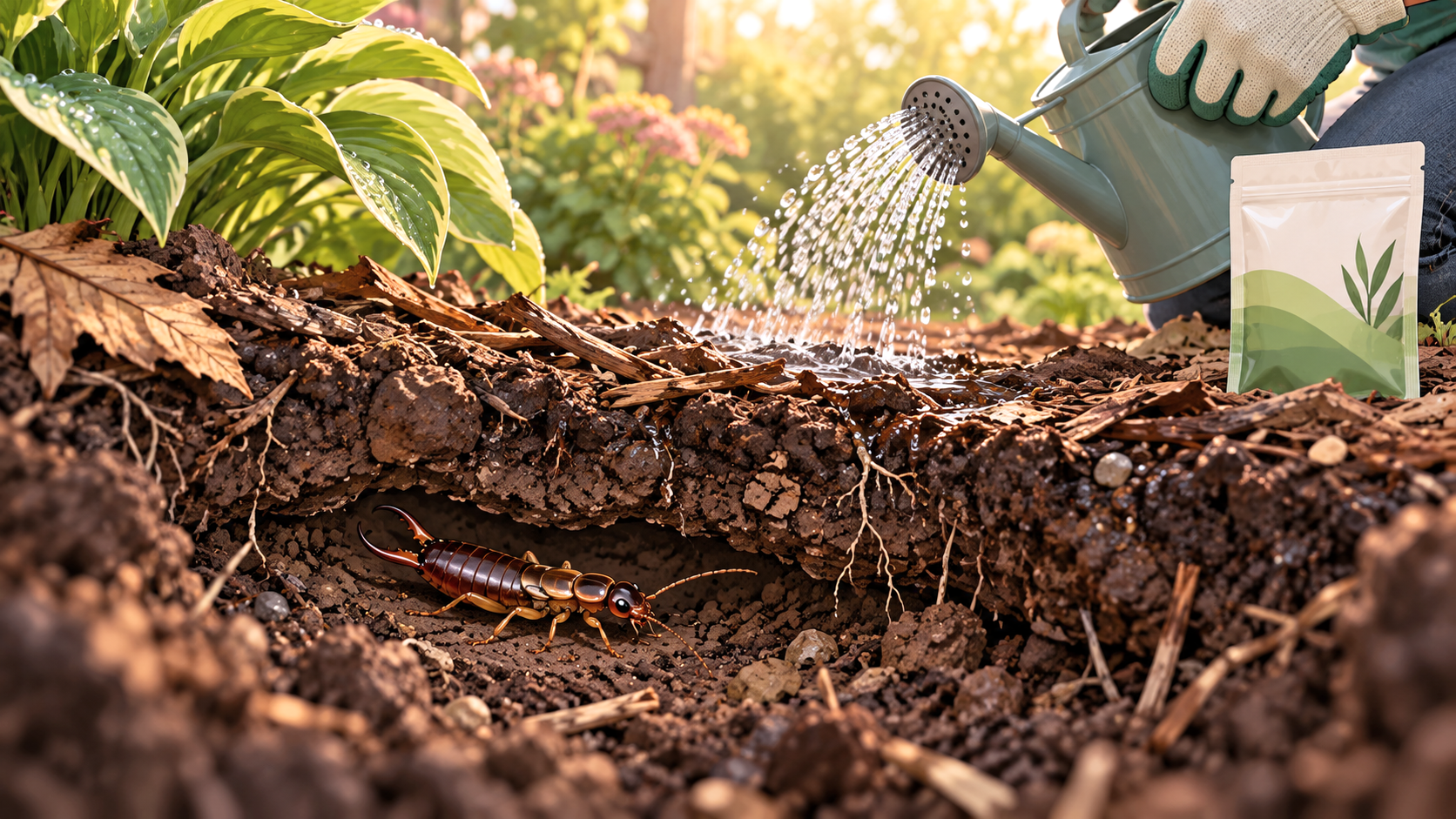
Certain beneficial nematodes can kill earwigs, but their effectiveness depends on the nematode species. Steinernema carpocapsae has demonstrated the ability to infect and kill European earwigs (Forficula auricularia) in laboratory research, with some supporting field evidence. Other commonly sold species, including Steinernema feltiae and Heterorhabditis bacteriophora, have not demonstrated the same effectiveness against European earwigs in comparative experiments.
This makes beneficial nematodes a possible but experimental option for earwig management rather than a dependable general treatment. Scientific evidence of infection does not establish that applying a commercially available nematode product will reliably eliminate earwigs from a garden.
Which Beneficial Nematodes Actually Kill Earwigs?
Beneficial nematodes are microscopic roundworms used in biological pest control. Several species are commercially available, but they differ in how they locate insects, which hosts they infect, and the environments where they perform best.
Research comparing entomopathogenic nematodes against European earwigs provides a useful distinction.
| Beneficial nematode | Evidence against European earwigs |
|---|---|
| Steinernema carpocapsae | Demonstrated infection and mortality in laboratory experiments, with supporting field observations |
| Steinernema feltiae | Did not cause earwig mortality in a published comparative laboratory study |
| Heterorhabditis bacteriophora | Did not cause earwig mortality in the same comparative study |
| Steinernema scapterisci | Earlier laboratory research found adult European earwigs resistant to infection |
A 2014 study in the Journal of Applied Entomology evaluated European earwig susceptibility to three entomopathogenic nematode species. Of the species tested, S. carpocapsae was the only one capable of killing European earwigs under the experimental conditions.
An earlier investigation of Steinernema scapterisci infectivity also found that adult European earwigs resisted infection. These results demonstrate why claims that all beneficial nematodes kill earwigs are inaccurate.
The species name matters when buying a product. Packaging that simply advertises beneficial nematodes may contain an organism intended for fungus gnats, root weevils, or lawn grubs rather than the species with demonstrated activity against earwigs.
What the Research Found About Steinernema carpocapsae
A 2011 study published in the Journal of Invertebrate Pathology established that European earwigs could serve as hosts for S. carpocapsae. Researchers exposed earwigs to different concentrations of infective juvenile nematodes and examined mortality, infection, reproduction, and host-recognition behavior.
The laboratory experiments involving European earwigs and S. carpocapsae produced an estimated LC50 of approximately 226 infective juvenile nematodes per earwig. LC50 refers to the exposure estimated to kill half the tested insects under the specified experimental conditions.
That number is not a recommended garden application rate. Laboratory exposure conditions differ from treating soil, and the concentration required to affect an individual insect cannot be translated directly into a quantity to spread across a flowerbed.
Researchers also found that larger earwigs experienced significantly higher mortality than smaller individuals. The nematodes recognized chemical cues associated with earwig cuticles, and exposed insects increased their grooming behavior. These observations suggest that earwigs can detect or respond to the parasites rather than remaining passive hosts.
The study included supporting field evidence from California pistachio orchards, where earwig catches were lower in nematode-treated areas than in controls. However, those observations did not establish a reliable homeowner treatment program or demonstrate complete population elimination.
The 2014 comparison added another important finding: European earwigs could detect S. carpocapsae and avoid shelters containing the nematodes. That avoidance behavior may reduce exposure under natural conditions.
How Nematodes Infect and Kill Earwigs
Entomopathogenic nematodes infect susceptible insects while searching for hosts in suitable environments. Infective juveniles enter through natural body openings or other accessible routes and release associated bacteria that contribute to the host’s death.
The biology of insect-parasitic nematodes explains why these organisms are used against certain soil-dwelling insects. They depend on living hosts and environmental conditions that allow them to survive long enough to initiate infection.
Steinernema carpocapsae is generally described as an ambush forager. Instead of actively searching through large volumes of soil, it tends to remain near a location and infect susceptible insects that move within reach.
This behavior is relevant to earwigs because the insects regularly travel across soil surfaces. An earwig moving through a suitable treated location might encounter infective juveniles, although contact does not guarantee successful infection.
The process is not instantaneous. Nematodes must survive in the environment, encounter a susceptible host, penetrate it, and establish an infection. The general progression of nematode infection can result in insect death several days after exposure, depending on the host and conditions.
Earwig-specific laboratory findings should not be confused with the performance of nematodes against their more established commercial targets, such as cutworms or certain beetle larvae.
Why Garden Conditions Can Limit Nematode Effectiveness
Beneficial nematodes are living organisms that require suitable environmental conditions. Their survival is affected by temperature, moisture, ultraviolet radiation, and storage quality.
Soil moisture
Nematodes need moisture to move and survive. Extremely dry soil can cause them to die before they encounter an insect, while waterlogged conditions can reduce oxygen availability and interfere with movement.
The environmental requirements for beneficial nematodes include moist soil, appropriate temperatures, and protection from direct sunlight. These requirements apply to maintaining viable nematodes, not to guaranteeing control of earwigs.
An important practical conflict arises when earwigs are concentrated in damp locations. Nematodes also require moisture, so deliberately keeping an unwanted earwig shelter wet to support nematode treatment may preserve conditions favorable to the insects.
Sunlight and temperature
Direct sunlight, particularly ultraviolet radiation, can rapidly reduce nematode survival. Applications are generally more successful when made in the evening or under conditions that limit exposure.
Temperature requirements vary by species and formulation. The application guidance for insect-killing nematodes emphasizes avoiding excessive heat, sunlight, and drying.
A nematode product stored improperly before purchase may already have lost viability. Leaving a package in a hot vehicle or allowing the organisms to dry out can affect performance before treatment even begins.
Exposure to the wrong location
Applying nematodes to soil does not mean they will reach earwigs concealed inside dry structural gaps, elevated vegetation, or inaccessible objects.
The behavior of entomopathogenic nematodes under field conditions makes protected soil habitats more suitable for treatment than exposed surfaces where desiccation and ultraviolet radiation are severe.
An earwig population moving mainly through untreated shelters may therefore avoid the application entirely. Successful infection in a laboratory container cannot eliminate this field-exposure problem.
Can You Buy Beneficial Nematodes Specifically for Earwigs?
Commercial products containing Steinernema carpocapsae are available, but that does not mean every product is marketed, tested, or authorized specifically for earwig control.
Many suppliers primarily recommend this species for insects such as cutworms, armyworms, and certain boring larvae. The established commercial uses of S. carpocapsae involve pests whose susceptibility and treatment conditions are better characterized.
Before purchasing nematodes for earwigs, examine the manufacturer’s target-pest list. A seller may use broad phrases such as controls soil insects without providing earwig-specific evidence.
If the product does not identify earwigs as a target, the laboratory findings discussed above should not be treated as proof that the retail product will control them. The nematode strain, number of viable infective juveniles, formulation, and application conditions may differ from those used in published experiments.
Some products contain mixtures of several nematode species. The presence of S. feltiae or H. bacteriophora alongside S. carpocapsae does not establish improved earwig control. No reliable universal advantage has been demonstrated for such mixtures against European earwigs.
The most useful question for a supplier is whether the exact product has supporting earwig efficacy data under practical outdoor conditions, rather than whether its ingredients have killed earwigs in any laboratory study.
Could Beneficial Nematodes Affect Earwigs That Help Your Garden?
European earwigs are not uniformly harmful. They consume aphids and other small arthropods, and their predatory activity can contribute to biological control in orchards and gardens.
Research into nematode compatibility with earwigs was partly motivated by this beneficial role. In pome-fruit production, earwigs can help suppress pest insects, so nematodes used against another pest may inadvertently affect useful predators.
The 2014 investigation of nematodes and European earwigs considered these interactions directly. Its findings suggest that earwig avoidance of certain nematodes may help reduce conflict between biological-control agents.
Treating an entire garden with nematodes solely to remove earwigs may therefore be counterproductive where the insects are causing little damage. Earwigs can be beneficial predators in gardens, and occasional sightings do not establish that intervention is necessary.
If the concern involves irregular holes in leaves or damaged blossoms, first determine whether earwigs are actually feeding on the plants. A nearby earwig may be hunting another insect rather than causing the observed injury.
Are Nematodes Worth Using Against Earwigs?
The available evidence supports a narrow conclusion: Steinernema carpocapsae can infect and kill European earwigs, but reliable garden-scale control has not been established sufficiently to recommend it as a dependable first-choice treatment.
The species is biologically capable of killing earwigs, yet its effectiveness may be restricted by host avoidance, variable susceptibility, and the difficulty of maintaining suitable exposure conditions. Other commercially common nematode species have performed poorly against European earwigs in comparative laboratory research.
Nematodes are also unlikely to address earwigs appearing inside a house. Applying soil-dwelling organisms to interior floors, cabinets, or structural gaps is not a practical substitute for removing individual insects or resolving unwanted entry. Recurring earwigs in houses can result from continued introductions that an outdoor biological treatment may not prevent.
For garden problems, the management of earwigs in yards and lawns should be proportionate to the actual nuisance or plant damage. Beneficial nematodes are worth considering only when a suitable species and product are available, the treatment area can support their survival, and the expected benefit justifies the expense.
Do not apply an arbitrary number of nematodes based on laboratory LC50 figures. Follow the supplier’s handling directions and any applicable product restrictions, and avoid combining living nematodes with pesticides or other materials unless compatibility has been established.
For most homeowners, purchasing nematodes specifically to kill earwigs offers uncertain value. Where S. carpocapsae is already being applied for another established target pest, a reduction in earwigs is possible, but it should be regarded as a potential secondary effect rather than a guaranteed result.