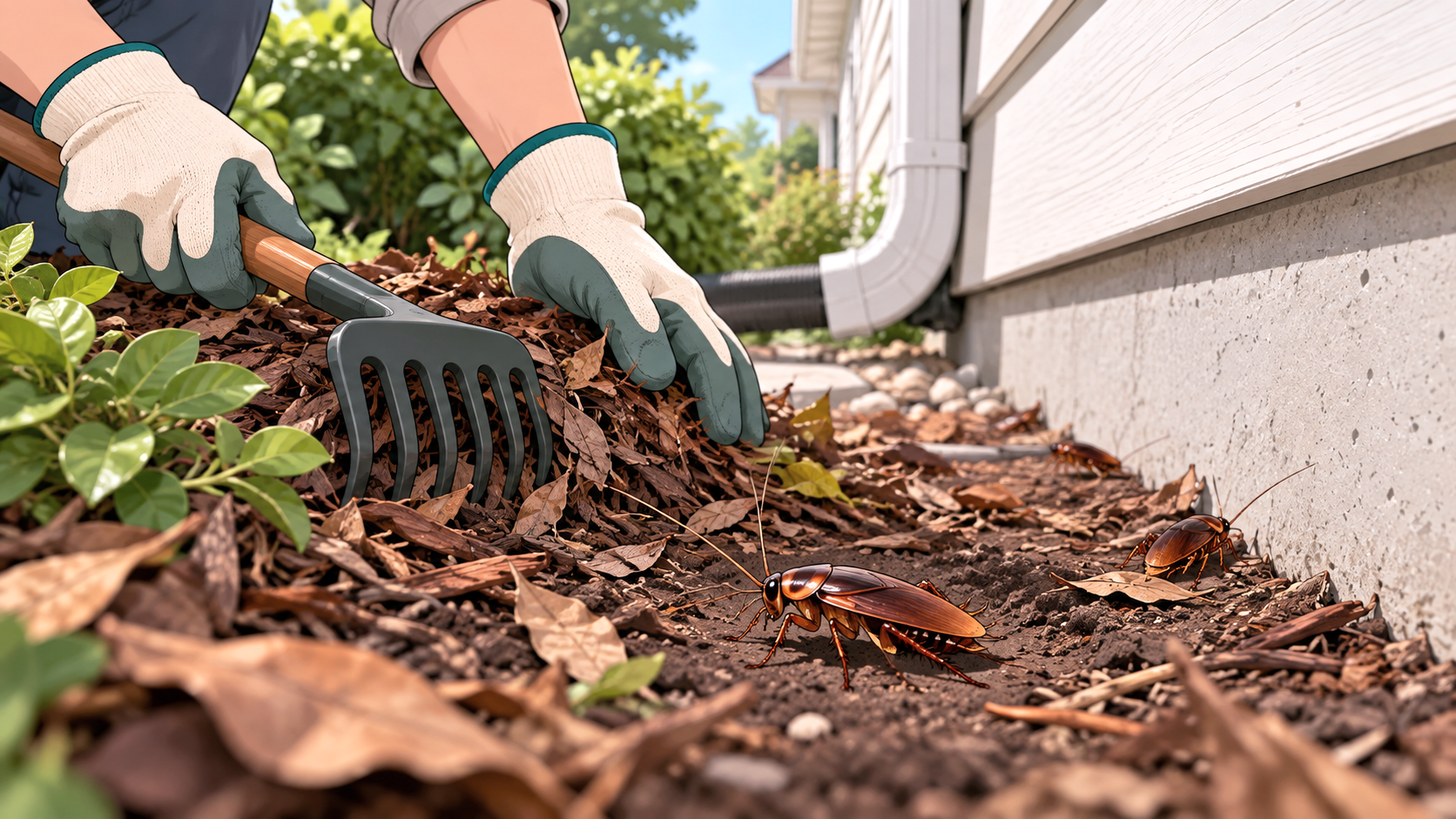
Cockroaches living around a property’s exterior may be established beneath mulch, inside utility enclosures, among leaf litter, or within gaps in paving. Some remain outdoors throughout their lives, while others occasionally enter the house through poorly sealed openings. Spraying the foundation without locating their outdoor shelters may kill exposed insects but leave the surrounding population largely unaffected.
To get rid of cockroaches outside your house, identify the species, locate concentrated activity, remove sheltered debris, correct moisture problems, and seal accessible entry points. Outdoor cockroach baits can help when a substantial population persists, but treating every insect found in the garden is unnecessary. Many native cockroach species are ordinary members of outdoor ecosystems rather than household pests.
Identify Whether the Cockroaches Are Outdoor Residents
The species present determines whether outdoor treatment is appropriate. American, Oriental, Turkestan, and smokybrown cockroaches can establish populations around buildings, although their preferred environments differ. German cockroaches, by contrast, are predominantly associated with indoor infestations.
The University of California’s cockroach management guidance distinguishes outdoor-associated species from those that commonly reproduce inside buildings. It also recommends identification before selecting treatment because measures effective against one species may be unnecessary or poorly suited to another.
| Cockroach | Outdoor locations commonly associated with it |
|---|---|
| American cockroach | Warm, humid utility spaces, drainage infrastructure, protected debris |
| Oriental cockroach | Damp ground-level areas, masonry gaps, vegetation, water-meter boxes |
| Turkestan cockroach | Irrigation boxes, pavement cracks, leaf litter, landscape debris |
| Smokybrown cockroach | Tree holes, mulch, roof-adjacent vegetation, wooded surroundings |
| German cockroach | Primarily indoor environments; outdoor sightings warrant investigating the source |
The Texas A&M cockroach management guidance identifies American, Oriental, and smokybrown cockroaches as outdoor-associated species that become particularly troublesome when they enter buildings.
A cockroach beneath a garden log does not automatically require extermination. Repeated sightings near doorways, outdoor kitchens, refuse storage, or building foundations provide a stronger reason to investigate.
The differences between cockroach species also help prevent harmless outdoor residents from being mistaken for established indoor pests.
Find the Outdoor Hiding Places That Support the Population
The most useful inspection takes place around the locations where cockroaches are repeatedly observed, not across every square foot of the garden.
Examine accessible gaps beneath paving stones, spaces between retaining-wall blocks, utility enclosures, stacked timber, dense groundcover, and debris accumulated beside the foundation. Look for live insects, egg cases, and concentrations of activity.
Outdoor cockroaches often occupy sheltered locations where the temperature and moisture conditions remain more stable than those of exposed soil. The University of California’s research on outdoor cockroach harborages describes Oriental and Turkestan cockroaches breeding within moist pavement joints, underground utility spaces, and cracks between landscaped areas and hard surfaces.
Inspecting after dark with a flashlight may reveal concentrated movement near these shelters. However, a single nighttime observation does not establish where the insects reproduce.
Avoid opening electrical utility boxes, entering drainage infrastructure, or removing heavy structures without appropriate authorization and safety precautions. If insects appear concentrated inside a locked utility enclosure or public installation, the responsible utility provider or property manager may need to investigate.
Reduce Mulch, Leaf Litter, and Dense Vegetation Near the Foundation
A thick layer of damp organic material can provide the shelter and resources that outdoor cockroaches need. Mulch, fallen leaves, old timber, and dense groundcover become particularly favorable when they remain against shaded foundation walls.
Rake accumulated leaves away from exterior walls, remove unnecessary timber piles, and thin vegetation that prevents the soil immediately beside the building from drying. Firewood should be stored in an orderly location away from the house rather than stacked against exterior siding.
The University of California’s Turkestan cockroach recommendations advise reducing excessive groundcover and leaf litter near structures, with gravel or bare soil potentially replacing mulch immediately beside affected foundations.
There is no need to remove every plant or replace an entire garden with gravel. Concentrate on locations where vegetation conceals repeated cockroach activity or provides a continuous sheltered corridor toward the building.
The objective is to make the immediate perimeter less suitable for persistent pest populations while retaining ordinary garden habitat elsewhere. Cockroaches have ecological functions in outdoor environments, so eliminating unrelated wild populations provides little household benefit.
Repair Irrigation Leaks and Eliminate Persistent Damp Areas
An irrigation box that remains wet throughout the day may support cockroaches even when the surrounding garden appears dry. Leaking hose connections, dripping outdoor faucets, clogged gutters, and poorly graded soil can create similar conditions.
Follow visible damp patches to their source. Repair plumbing leaks, adjust sprinklers that repeatedly soak the foundation, and correct drainage defects that allow water to collect against the building.
The EPA’s integrated pest management principles emphasize modifying environmental conditions that support pest populations before relying on pesticides.
Pay attention to outdoor pet feeding areas and refuse storage as well. Keep bins closed, clean spilled waste from the surrounding ground, and remove uneaten pet food rather than leaving it accessible overnight. A persistent combination of moisture and food residue can support cockroaches despite otherwise well-maintained landscaping.
The survival of cockroaches without drinking water varies among species, so reducing moisture can make a location less favorable without guaranteeing immediate mortality.
Block Cockroaches From Entering the House
Outdoor population management and building exclusion serve different purposes. Even when cockroaches remain established beyond the property, effective exclusion can reduce how frequently they enter living spaces.
Inspect exterior door sweeps, window screens, weather stripping, and gaps around plumbing or cable penetrations. Close suitable structural openings with materials compatible with the building, ensuring that repairs do not obstruct ventilation or drainage.
The EPA’s pest-prevention recommendations emphasize sealing cracks and closing entry points before turning to chemical controls.
Where cockroaches appear near a seldom-used floor drain, the plumbing should also be examined. A dry or defective trap can compromise the intended water seal, although insects around a drain do not necessarily originate inside the pipe.
If cockroaches are repeatedly found in an attached garage, inspect the door threshold and the opening connecting the garage to the house. Garage-specific cockroach activity can sometimes be reduced substantially by correcting those openings without treating indoor living areas.
Sealing the house does not eradicate the surrounding insects, but it prevents an outdoor problem from unnecessarily becoming an indoor one.
When Is Outdoor Cockroach Bait Worth Using?
Bait treatment is most defensible when monitoring identifies a substantial nuisance population in specific outdoor shelters, particularly when cockroaches repeatedly approach or enter the building.
Choose a cockroach bait expressly labeled for outdoor application. Depending on its instructions, a product may be suitable for protected bait stations near irrigation enclosures, hardscape crevices, or other confirmed harborages. Do not place pesticides inside public water-meter boxes, storm drains, or sewer structures without authorization, and never use products contrary to their labels.
Research conducted through the University of California’s outdoor cockroach baiting program demonstrated that targeted baits could successfully reduce Turkestan cockroach populations around buildings. This provides a more specific basis for treatment than scattering insecticides across an entire yard.
Baits generally need time to work. Repeatedly disturbing placements or spraying repellent products over them can interfere with cockroach feeding.
Outdoor applications also require attention to pets, wildlife, rainfall, and irrigation. Bait placed where water regularly flows may deteriorate or move away from the intended location. Follow product instructions concerning weather, application sites, and access restrictions.
Why Spraying the Entire Yard Is Usually a Poor Solution
Broad insecticide applications can expose beneficial organisms and contaminate areas that have little involvement in the cockroach problem. They may also leave the actual harborages untouched.
The National Pesticide Information Center’s guidance on protecting water resources explains how pesticide runoff and movement through soil can introduce chemicals into waterways. Applications near drains, irrigation channels, and impervious paving require particular caution.
The University of California’s Turkestan cockroach guidance specifically discourages pesticide treatment of public storm drains and sewers because of environmental contamination risks. Cockroaches emerging from municipal infrastructure should be reported to the responsible authority rather than treated through unauthorized chemical applications.
Spraying every shrub or applying a continuous pesticide barrier is not automatically necessary even when cockroaches are abundant. Focus first on known shelters, moisture conditions, and documented entry points. The hazards associated with cockroach spray exposure remain relevant outdoors, particularly around children, pets, and areas used for recreation.
Measure Whether the Outdoor Population Is Actually Declining
After correcting habitat conditions or applying targeted bait, compare activity at the original problem locations. Inspect the same accessible shelters on comparable evenings and use sticky cockroach monitors inside entrance areas to track attempted indoor movement.
The University of California’s monitoring recommendations support placing traps near exterior doors to identify invading outdoor species. Outdoor trapping devices should be used only where their design and labeling permit, with protection from weather and unintended animal contact.
Fewer cockroaches appearing around a doorway may indicate that exclusion is working even when insects remain in distant garden habitats. Conversely, persistent concentrations near the foundation suggest that a sheltered source has not been adequately addressed.
If large numbers continue emerging from inaccessible utility structures, extensive retaining walls, or drainage systems, a licensed pest-management professional can assess the situation. Species identification and source location should guide any additional treatment.
A yard does not need to become completely free of cockroaches to protect the house. Successful outdoor management means reducing nuisance populations near occupied structures, limiting conditions that support them, and preventing avoidable entry into the building.
One thought on “How to Get Rid of Cockroaches Outside the House”