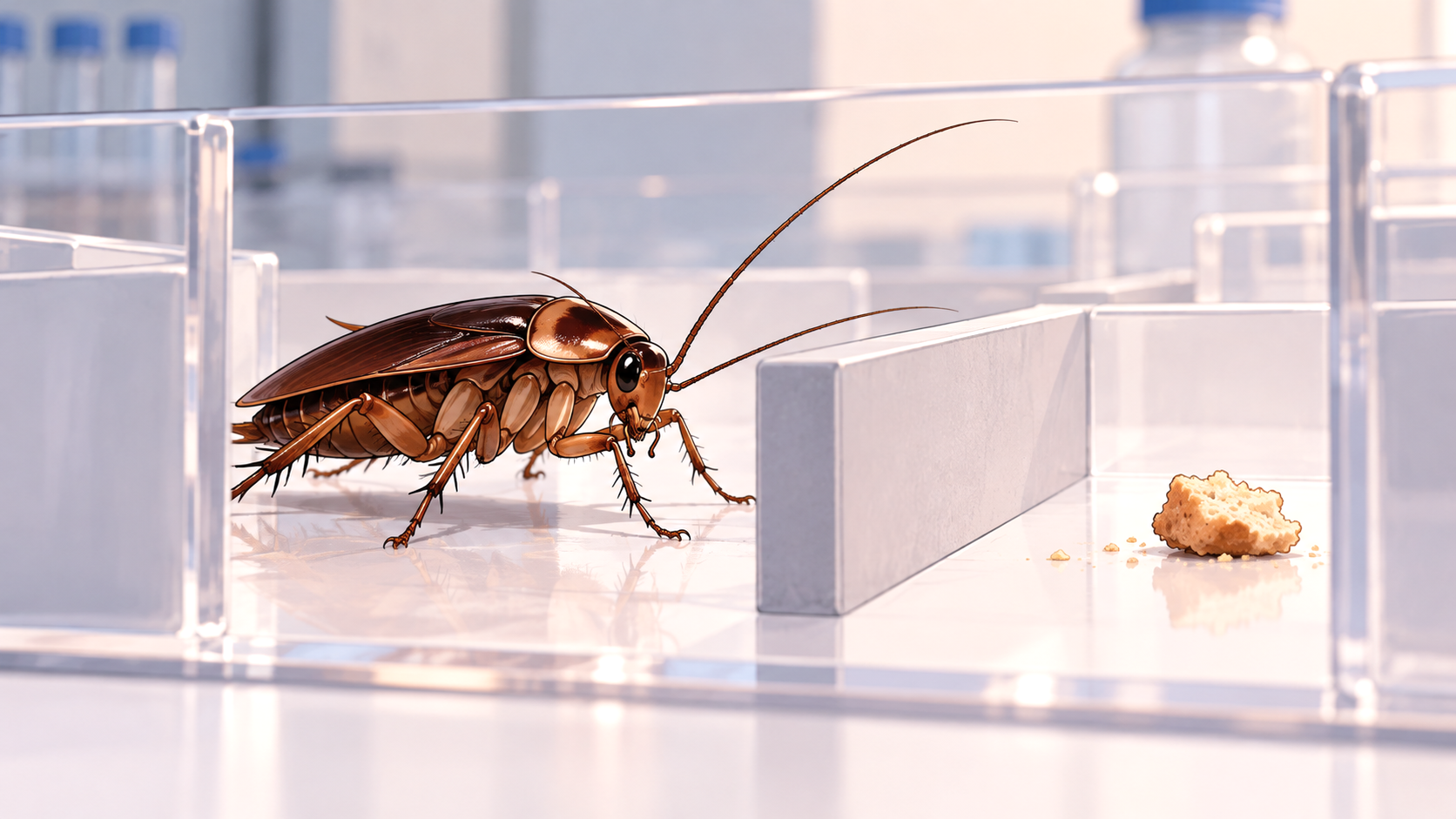
Cockroaches are smarter than their reputation suggests. They can learn from experience, remember associations, recognize spatial relationships, and change their behavior based on previous outcomes. Laboratory experiments have shown that some cockroaches retain learned information for several days, while others can remember the location of a hidden target or avoid a previously unfavorable choice.
Their intelligence is not comparable to human reasoning. Cockroaches do not need abstract thought or deliberate planning to accomplish these tasks. Their nervous systems are specialized for processing sensory information, learning useful associations, and responding efficiently to their surroundings.
Cockroaches Can Learn From a Single Experience
One of the clearest demonstrations of cockroach learning came from experiments involving American cockroaches (Periplaneta americana).
Researchers trained individual cockroaches to associate two odors with different outcomes. Vanilla and menthol served as signals, while sugar solution provided a reward and salt solution provided an unfavorable experience. Before training, the insects naturally preferred vanilla. After training, their preferences changed according to which odor predicted sugar.
Remarkably, one training trial was sufficient to reverse the original preference, and the learned response remained detectable seven days later.
The 1980 study published in the Journal of Insect Physiology also demonstrated that cockroaches could reverse an established preference through additional training.
This represents associative learning: the insect connects a sensory cue with a consequence and subsequently behaves differently when encountering that cue. It is more sophisticated than an automatic response to the immediate presence of food because the odor itself becomes meaningful through experience.
However, the experiment does not establish that cockroaches consciously evaluate their options. A change in learned preference demonstrates memory and behavioral flexibility without revealing a humanlike thought process.
How Long Can Cockroaches Remember Things?
Cockroach memories can persist for hours or days, depending on the species, what is learned, and how the experiment is conducted.
Several studies provide useful examples:
| Experiment | What the cockroach learned | Demonstrated retention |
|---|---|---|
| American cockroach odor discrimination | Which scent predicted sugar rather than salt | At least 7 days |
| American cockroach visual-odor association | A green light predicted a nearby odor | Up to 72 hours |
| American cockroach classical odor conditioning | An odor associated with a reward | At least 4 days |
| American cockroach maze conditioning | Which route was associated with an unpleasant stimulus | Up to 24 hours |
| Madeira cockroach odor conditioning | Which odor predicted a reward | At least 48 hours under favorable training conditions |
In the visual-odor experiment, researchers trained American cockroaches to extend their antennae toward a green light that had previously accompanied an odor. The study published in the Journal of Experimental Biology found that the learned response persisted for up to 72 hours.
A separate investigation of classical odor conditioning in American cockroaches demonstrated retention for at least four days following repeated training.
These durations are experimentally demonstrated intervals, not absolute memory limits. An animal retaining information for seven days might remember it longer, but the experiment does not establish how long that memory ultimately lasts.
Nor does every learned behavior persist equally well. Memory strength can decline, and new experiences may modify previously learned associations.
Can Cockroaches Remember Where Things Are?
Cockroaches can learn spatial information rather than relying exclusively on odor.
In a particularly revealing experiment, American cockroaches were trained to locate a hidden target using visual landmarks. Their performance improved as they gained experience, indicating that they remembered the target’s position relative to environmental cues.
Researchers then examined the involvement of specialized brain structures called mushroom bodies. When selected regions of both mushroom bodies were damaged, the cockroaches lost their ability to locate the hidden target using landmarks, although they could still locate a visible target.
The 1998 study in the Journal of Comparative Neurology established an important connection between these brain structures and place memory.
Later research revealed that American cockroaches can remember spatial relationships in more than one form. A 2018 study published in Frontiers in Psychology found evidence for both body-centered spatial memories and memories involving the relative positions of visual landmarks.
In one experiment, cockroaches learned the angular relationship between two lights. Their subsequent responses depended on that relationship rather than simply on the presence of the individual lights.
Such findings suggest that cockroaches can retain useful information about the arrangement of their surroundings. They do not demonstrate that the insects construct detailed mental maps comparable to those used by humans.
The distances cockroaches travel through buildings can involve several connected spaces, but observing movement between locations does not itself prove that an insect has memorized a route.
Cockroaches Can Learn Which Choices to Avoid
Learning is not restricted to finding something rewarding. Cockroaches can also modify their decisions after experiencing an unfavorable consequence.
A 2020 investigation used a T-shaped maze to test American cockroaches. During training, choosing a particular branch resulted in exposure to bright light. Researchers subsequently measured whether the insects learned to avoid that branch.
The study published in Frontiers in Physiology found that cockroaches could learn the association and retain it for up to 24 hours. It also revealed substantial differences between individuals.
Some insects learned the task more successfully than others, and performance in one learning experiment did not necessarily predict success in another.
This individual variation challenges the assumption that every cockroach of the same species responds identically to experience. It also demonstrates why intelligence cannot be reduced to a single score based on one laboratory task.
A cockroach changing its route after repeated unfavorable experiences may be showing learned avoidance. However, an insect that suddenly runs toward a person during an escape is not necessarily making a learned decision. Many rapid defensive movements arise from sensory circuits that operate without prior training.
The Time of Day Can Affect How Well Cockroaches Learn
An unusual finding in cockroach research is that learning performance can depend on internal biological rhythms.
Scientists studying the Madeira cockroach, Rhyparobia maderae, formerly known as Leucophaea maderae, trained insects to associate different odors with rewarding and unfavorable solutions.
Cockroaches trained during the early part of their subjective night learned the association successfully and retained it for at least two days. Those trained at other phases performed substantially worse, even though their untrained odor preferences remained intact.
The 2007 study published in Proceedings of the National Academy of Sciences found that performance depended primarily on the biological time of training rather than the time at which memory was tested.
Further experiments identified the optic lobes as important components of the circadian system regulating learning and memory. The 2016 study in the Journal of Biological Rhythms demonstrated that disrupting this regulation could remove some of the time-dependent limitations on memory formation and retrieval.
These findings do not mean cockroaches are incapable of learning during daylight. The results concern particular species, conditioning methods, and biological conditions. They show that even a relatively small insect brain integrates learning with internal physiological timing.
Do Cockroaches Have Individual Personalities?
Researchers have documented consistent individual differences in some cockroach behaviors, including responses to unfamiliar environments and learning tasks.
The 2020 conditioning study found variation in learning and memory performance among American cockroaches. Certain individuals responded strongly to training, while others showed weaker or less consistent changes.
Scientists use the term behavioral individuality when animals differ consistently in measurable tendencies. However, this should not automatically be interpreted as personality in the everyday human sense.
For example, a cockroach that explores a maze more readily may differ in motivation, stress response, sensory sensitivity, or previous experience. Without additional experiments, its behavior cannot be attributed to curiosity or confidence.
An individual repeatedly choosing one route may have developed a preference through learning, but the observation alone does not reveal whether the choice results from memory, environmental cues, or an inherent behavioral tendency.
Do Cockroaches Recognize People?
There is no convincing experimental evidence that common household cockroaches recognize individual humans in the way people recognize familiar faces.
Cockroaches detect movement, air disturbances, contact, odors, and visual information. Some of these cues may become associated with previous experiences, but recognizing a repeated stimulus is different from identifying a particular person.
A cockroach that repeatedly escapes when someone approaches may be responding to predictable sensory signals rather than remembering the individual’s identity.
Similarly, the rapid escape movements of cockroaches demonstrate effective sensory processing and motor control, not necessarily conscious recognition of a human threat.
The laboratory evidence supports learning about odors, visual cues, spatial arrangements, and consequences. Claims that household cockroaches remember specific people, recognize their owners, or deliberately outsmart humans go beyond what those experiments establish.
Does a Cockroach’s Small Brain Limit Its Intelligence?
Cockroach brains are much smaller than mammalian brains, but size alone is not a reliable measure of what an animal can learn.
Insects possess highly organized neural circuits capable of processing sensory information and storing memories. The mushroom bodies are especially important for associative learning and spatial memory.
Research on neuronal activity within cockroach mushroom bodies found cells involved in distinguishing sensory stimulation caused by the insect’s own movements from external signals. Other neurons were associated with locomotion and changes in turning direction.
These findings suggest that cockroach nervous systems integrate information about both the environment and the animal’s behavior.
Nevertheless, demonstrating efficient learning does not establish abstract reasoning, self-awareness, or humanlike intelligence. Scientists evaluate particular cognitive abilities through controlled behavioral experiments rather than assuming that success at one task implies competence in unrelated tasks.
For cockroaches, the strongest evidence concerns associative learning, memory retention, and spatial orientation. Their performance in these areas is sufficiently developed to influence how they interact with familiar environments, even without the cognitive abilities associated with humans or other large-brained animals.