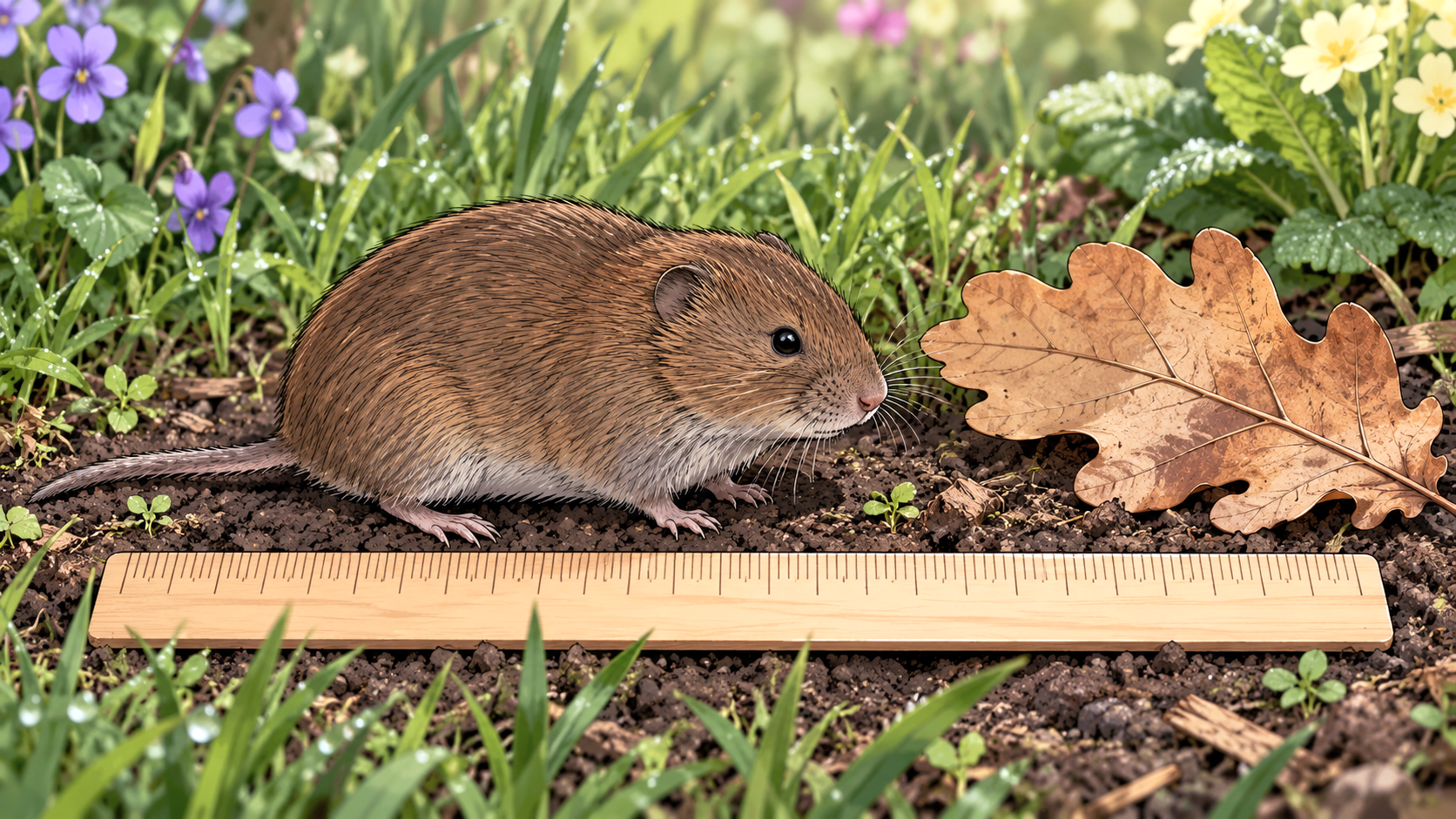
Most common North American voles grow to approximately 5–9 inches (12.5–22.5 cm) long, including their tails, and weigh between 1 and 3 ounces (28–85 g). Their exact size depends on the species, age, and individual animal. Some woodland voles are considerably smaller, while the Eurasian water vole can weigh more than 10 ounces (300 g).
A vole’s published length can also be misleading unless the measurement specifies whether the tail is included. Mammal reference guides commonly record total length from the nose to the tail tip, but others provide separate head-and-body measurements. Those figures cannot be compared directly without accounting for the tail.
Vole Sizes Compared by Species
Several voles commonly found in North America differ substantially in their adult dimensions. A meadow vole and a woodland vole may both be called voles, yet their recorded weights and body lengths are not interchangeable.
| Vole species | Length | Adult weight |
|---|---|---|
| Meadow vole (Microtus pennsylvanicus) | 5.5–7.7 in (14–19.5 cm) | 1.2–1.9 oz (34–54 g) |
| Prairie vole (Microtus ochrogaster) | 4.9–7.1 in (12.5–18 cm) | 1.1–2.5 oz (30–70 g) |
| Woodland vole (Microtus pinetorum) | 3.3–4.7 in (8.3–12 cm), excluding tail | 0.5–1.3 oz (14–37 g) |
| Montane vole (Microtus montanus) | 5.5–8.7 in (14–22 cm) | 1.3–3.0 oz (37–85 g) |
| Townsend’s vole (Microtus townsendii) | 6.5–8.9 in (16.5–22.5 cm) | 1.7–2.9 oz (47–83 g) |
<text color=”secondary” size=”xs”>The ranges reflect published species accounts and include rounding in imperial conversions. Length includes the tail except where indicated. Meadow vole weights reflect the reported adult male and female ranges.</text>
The meadow vole’s recorded measurements place it among the familiar medium-sized voles. The prairie vole overlaps considerably with it, while the woodland vole has a smaller body and lower recorded weight. The upper end of the montane vole’s size range is higher than that of either the prairie or woodland vole. The differences become more apparent when comparing weights than when comparing total lengths.
These ranges also explain why identifying a vole by size alone is unreliable. Several species can have the same total length despite having different typical adult weights. Other features, including the overall appearance of a vole, provide useful supporting information.
How Long Are Vole Tails?
Tail length accounts for a noticeable part of a vole’s total measurement, even though the tail is shorter than the combined head and body in the species discussed here.
For prairie voles, recorded tails measure 1.0–1.8 inches (2.5–4.5 cm). Meadow voles have tails measuring 1.3–2.5 inches (3.3–6.4 cm). Woodland vole tails range from approximately 0.6–1.6 inches (1.5–4 cm). The Texas Tech University prairie vole measurements provide a useful example, with average recorded dimensions of 146 mm in total length and 34 mm for the tail.
Using those average measurements, the prairie vole’s tail accounts for approximately 23% of its total length. Removing the tail from the reported average leaves a head-and-body length of 112 mm, or approximately 4.4 inches. This calculation shows how a vole described as nearly 6 inches long can have a substantially shorter body.
The relationship between tail and body length also varies among species. Consequently, a photograph showing only the torso cannot establish total length, and a missing or concealed tail makes visual size estimates less dependable.
How Heavy Can a Vole Get?
A vole’s weight varies considerably even within a single species. The published adult prairie vole range extends from 30 to 70 grams, meaning an individual near the upper end can weigh more than twice as much as one near the lower end. These figures represent recorded size variation rather than a standard weight that every adult eventually reaches.
The Townsend’s vole provides another example of a relatively large North American species, with adults recorded between 47 and 83 grams. Its documented average adult weight is 65 grams. In contrast, woodland voles are recorded at 14–37 grams, making even the upper end of that range lighter than the average Townsend’s vole.
Recorded weight also depends on age and biological differences within populations. A smaller specimen is not necessarily underweight, particularly when its species has not been identified. Body mass should be interpreted against an appropriate species reference rather than a single universal vole weight.
Are Male Voles Bigger Than Female Voles?
Sex differences are not consistent across all vole species. Prairie voles show no significant sexual size dimorphism in their published species account, and woodland voles likewise have little difference between male and female body size.
Montane voles show a somewhat different pattern. Males are generally slightly larger than females, although recorded sizes overlap. Townsend’s voles have also been documented with females marginally larger than males in one population study.
These differences are generally too small and variable to identify an individual vole’s sex through length or apparent weight. A large animal cannot automatically be classified as male, and a smaller adult is not necessarily female. The relationship must be assessed within the species rather than assumed for all voles.
How Quickly Do Voles Reach Adult Size?
Young voles develop quickly, but the point at which they reach adult dimensions depends on the species. Prairie voles are reported to reach adult size within approximately two months of birth. Their initial body weight is only a small fraction of their mature mass, so measurements change substantially during early development.
Young animals should therefore not be compared directly against adult size ranges. A vole smaller than the minimum listed for adults may simply be immature, while an unusually small individual could belong to a naturally smaller species. The development of baby voles also involves physical changes that go beyond increasing body length and weight.
An individual that has reached reproductive maturity has not necessarily reached the largest dimensions recorded for its species. Adult measurements describe observed animals rather than a precise growth milestone that every vole reaches at the same age.
Which Voles Grow the Biggest?
The Eurasian water vole (Arvicola amphibius) is considerably heavier than the North American grassland and woodland species listed above. The Wildlife Trusts records a head-and-body length of 5.5–8.7 inches (14–22 cm), a separate tail length of 3.7–5.5 inches (9.5–14 cm), and a weight of 5.3–10.6 ounces (150–300 g).
Those measurements place a large water vole in a different weight category from a prairie or meadow vole. At 300 grams, it weighs approximately four times as much as a 70-gram prairie vole and more than eight times as much as a 37-gram woodland vole. The comparison uses the upper published weights for each species, so it illustrates their size differences rather than the weight of an average animal.
The People’s Trust for Endangered Species also identifies the water vole as Britain’s largest vole species. Its larger dimensions make it a poor reference for estimating the size of an ordinary North American garden vole. The different types of voles do not share one adult size range, and geographic context matters when deciding which measurements are relevant.
Measuring a Vole Accurately
A measurement is most useful when it records the head-and-body length, tail length, and total length separately. For a photographed animal, a ruler or another object of known dimensions must be positioned on the same plane as the vole. An object closer to the camera will appear larger and distort the comparison.
We would also avoid estimating an animal’s weight from its apparent length. The published woodland and prairie vole ranges demonstrate that body mass and total length do not follow one universal relationship. An accurate weight requires a scale, while a photograph can support only an estimate of visible dimensions.
Where size is needed for identification, record the location and compare measurements with species known to occur there. If the animal is alive, avoid handling it simply to obtain a measurement. A clear photograph beside a stationary reference object provides useful scale without unnecessary contact.
2 thoughts on “How Big Do Voles Get?”