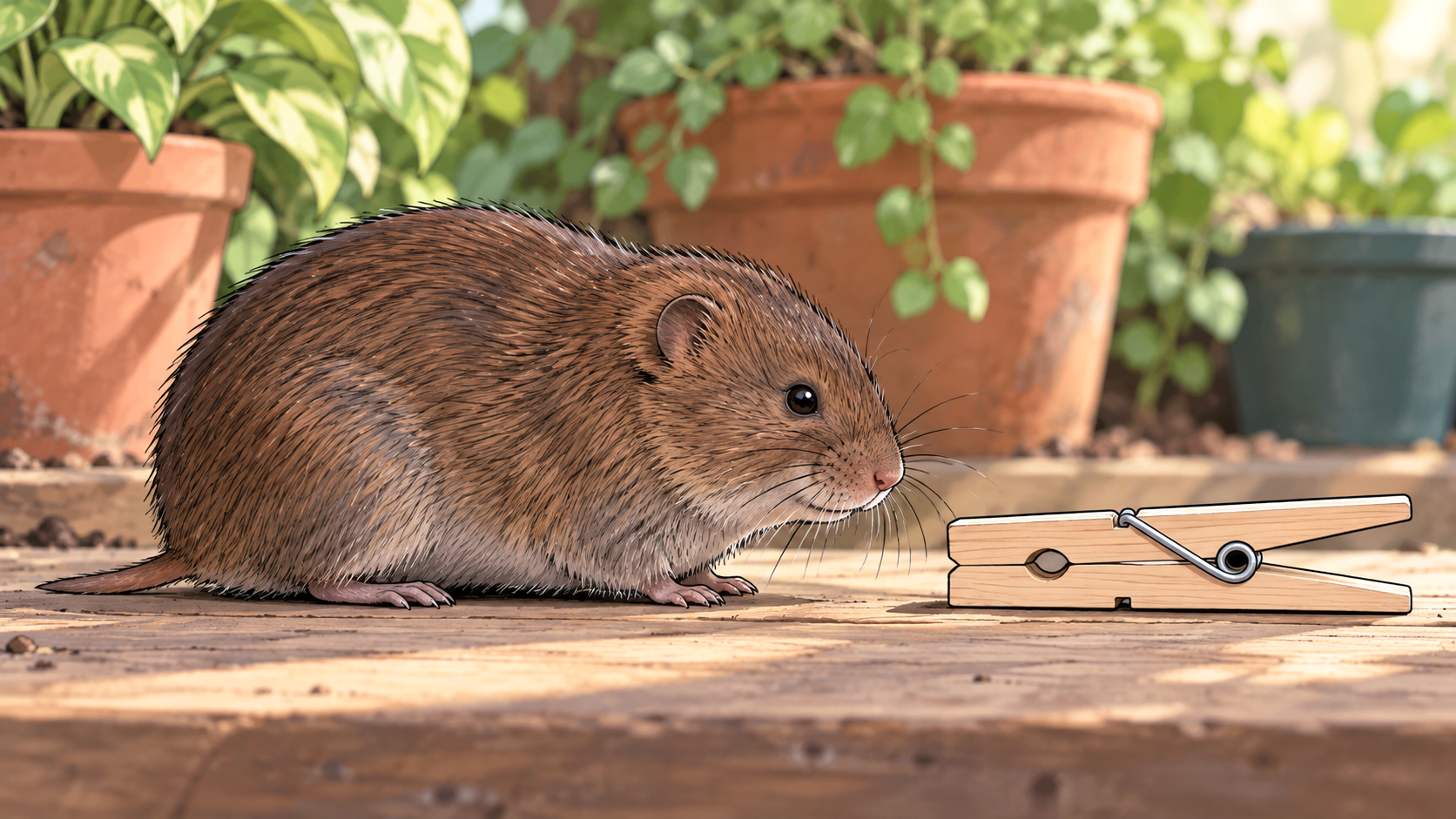
Most common North American voles reach 5–9 inches (12.5–22.5 cm) in total length, including their tails, and weigh approximately 1–3 ounces (28–85 g). Smaller species, such as woodland voles, can weigh less than half an ounce, while the much larger Eurasian water vole can exceed 10 ounces. Adult size varies by species, sex, geographic population, and age.
Published measurements require some care because total length and body length are different figures. Total length includes the tail, while head-and-body length excludes it. A woodland vole listed as 4 inches long without its tail cannot be directly compared with a meadow vole recorded at 6 inches from nose to tail tip.
How Big Are Different Vole Species?
The size differences among North American voles are substantial enough that one general measurement cannot describe every species. Meadow and prairie voles occupy overlapping ranges, while woodland voles are noticeably smaller. Townsend’s voles, found along the Pacific coast, rank among the larger members of the genus Microtus.
| Vole species | Length | Adult weight |
|---|---|---|
| Meadow vole (Microtus pennsylvanicus) | 5.5–7.7 inches | 1.2–1.9 ounces |
| Prairie vole (Microtus ochrogaster) | 4.9–7.1 inches | 1.1–2.5 ounces |
| Woodland vole (Microtus pinetorum) | 3.3–4.7 inches, excluding tail | 0.5–1.3 ounces |
| Montane vole (Microtus montanus) | 5.5–8.7 inches | 1.3–3.0 ounces |
| Townsend’s vole (Microtus townsendii) | 6.5–8.9 inches | 1.7–2.9 ounces |
Lengths include the tail unless otherwise indicated. Measurements represent published ranges and are rounded to one decimal place. The meadow vole weight range combines reported adult male and female measurements.
The meadow vole’s recorded dimensions show an average total length of 6.6 inches (167.5 mm) and an average adult weight of approximately 1.6 ounces (44 g). The prairie vole is similar in length but has a wider recorded weight range, extending from 30 to 70 grams. The woodland vole provides the clearest contrast because its head-and-body length is only 3.3–4.7 inches before the tail is included.
The remaining species demonstrate how much geographical and biological variation exists within this group. Montane voles have recorded body masses reaching 85 grams, while Townsend’s voles average approximately 65 grams as adults. These figures reflect different species rather than a predictable progression from smaller to larger voles with age.
How Much of a Vole’s Length Is Its Tail?
Tail length can change the reported size of a vole by several inches. Meadow voles have tails measuring 1.3–2.5 inches (33–64 mm), while prairie vole tails measure 1.0–1.8 inches (25–45 mm). Woodland voles have shorter tails, measuring 0.6–1.6 inches (15–40 mm).
Consider a prairie vole with a total length of 5.9 inches (150 mm) and a tail measuring 1.4 inches (35 mm). Its head-and-body length would be 4.5 inches (115 mm). The tail would account for approximately 23% of its total length. This is an illustrative calculation using measurements within the species’ documented range, rather than an average for all prairie voles.
The proportion varies among species, making tail-inclusive measurements particularly important when distinguishing voles from mice. A length reported without identifying the measurement method can exaggerate or conceal differences between animals. Ideally, both dimensions should be recorded independently.
How Heavy Is a Fully Grown Vole?
Body mass varies more dramatically than length might suggest. An adult prairie vole weighing 70 grams is more than twice as heavy as one weighing 30 grams, even though both fall within the species’ documented adult range. The difference reflects natural variation rather than proof that the heavier animal belongs to a different species.
Meadow voles have comparatively narrow average adult weights. Published figures place males at an average of 44.2 grams and females at 44.0 grams. Woodland voles, by comparison, range from 14 to 37 grams. Even the heaviest woodland vole in that reported range weighs less than the average adult meadow vole.
The difference between species also makes visual weight estimates unreliable. Two voles with similar total lengths can have different body masses, and an individual’s weight cannot be calculated accurately from length alone. A small animal does not automatically indicate an immature vole, especially where naturally smaller species occur. The different types of voles have their own characteristic measurements, so identifying the species provides the proper context for evaluating weight.
Do Male and Female Voles Grow to Different Sizes?
Sexual size differences depend on the species. Prairie voles show no significant sexual size dimorphism in published measurements, and woodland voles have almost no recorded difference between males and females. Meadow voles also have nearly identical reported average adult weights, although their individual weight ranges overlap considerably.
Montane voles show a different pattern, with males generally growing slightly larger than females. Townsend’s voles have been documented with females marginally larger than males in one population study. Neither pattern can be applied to all voles.
Sex therefore cannot be established reliably from overall size. A particularly large individual may reflect its species, geographic population, age, or natural variation rather than being male or female.
When Do Young Voles Reach Adult Size?
Growth can be rapid. Prairie voles reach adult dimensions within approximately two months of birth, although developmental timing differs among species. Newly born prairie voles average approximately 3 grams, compared with adult weights of 30–70 grams.
A prairie vole growing from 3 grams to 30 grams increases its body mass tenfold. Reaching 70 grams would represent more than twenty times its birth weight. These comparisons illustrate the magnitude of early growth; they do not describe a fixed growth trajectory that every individual follows.
Age also influences the interpretation of measurements. Montane voles continue growing throughout their lives, and recorded size differences reflect age alongside sex, subspecies, and geographic location. An animal may reach reproductive maturity before reaching the larger adult dimensions recorded for its population.
The appearance of baby voles changes during early development, so a specimen’s small size should be interpreted alongside other age-related characteristics rather than treated as a standalone identification method.
What Is the Largest Vole?
The Eurasian water vole (Arvicola amphibius) is much larger than the familiar North American meadow, prairie, and woodland voles. The Wildlife Trusts’ measurements give a head-and-body length of 5.5–8.7 inches (14–22 cm), a tail length of 3.7–5.5 inches (9.5–14 cm), and a weight of 5.3–10.6 ounces (150–300 g).
Combining the reported head-and-body and tail ranges gives a possible overall measurement span of 9.3–14.2 inches (23.5–36 cm). Those endpoints are calculated from separate published ranges and do not establish that the longest body and longest tail occurred on the same animal.
At 300 grams, a large Eurasian water vole weighs nearly seven times as much as an average 44-gram meadow vole. Even an individual at the lower end of the water vole’s reported weight range is substantially heavier than the largest prairie voles in the measurements above.
The Eurasian water vole should not be confused with North America’s smaller grassland voles or with the North American water vole (Microtus richardsoni). Despite sharing a common-name component, these animals represent different species with different physical dimensions and geographical distributions.
Can You Estimate a Vole’s Size From a Photograph?
A photograph can provide a useful length estimate when an object of known size appears beside the animal. Both must be at approximately the same distance from the camera. Perspective distortion makes objects closer to the lens look larger, so a ruler several inches in front of a vole will produce a misleading comparison.
For example, suppose a clearly visible vole occupies 600 pixels in an image, while a 6-inch ruler on the same plane occupies 750 pixels. Dividing 600 by 750 and multiplying by 6 gives an estimated visible length of 4.8 inches. This calculation assumes that neither object is significantly angled toward the camera and that the animal’s full measured length is visible.
A photograph showing only the torso cannot reliably establish total length, particularly when the tail is concealed. The general body proportions and visible features of a vole can help assess the animal’s identity, but a photograph without a scale does not provide a dependable measurement.
For an animal encountered outdoors, record its location and obtain a clear side photograph with an appropriately positioned reference object if possible. There is no need to capture or handle a live vole simply to measure it. An accurate size estimate, combined with the species known to inhabit the area, provides a more useful identification starting point than comparing the animal with a single generic vole measurement.