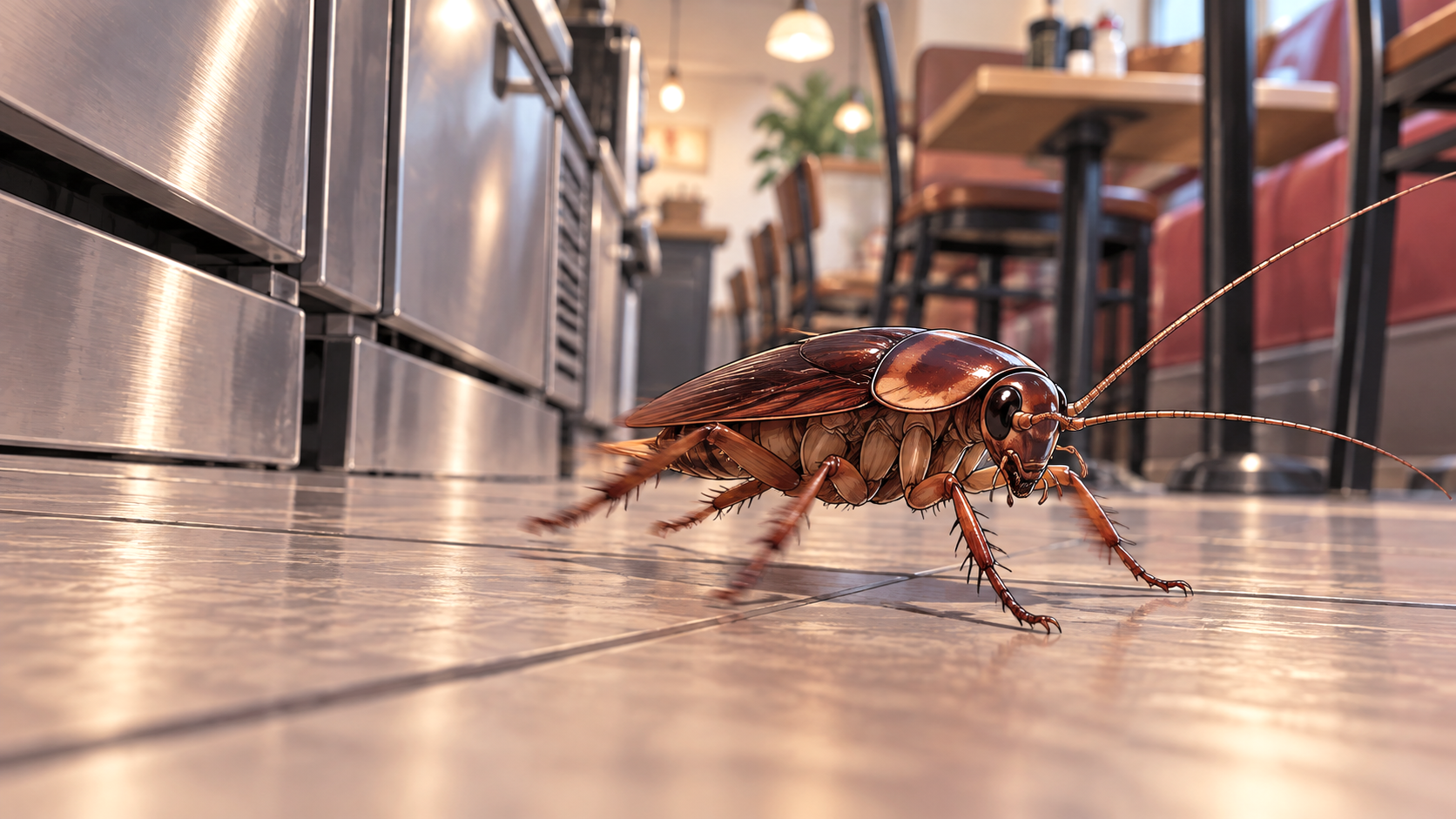
An American cockroach can run at approximately 3.4 mph (5.4 km/h), or 1.5 meters per second, making it one of the fastest-running insects studied. At that speed, it covers roughly 50 body lengths every second. However, this is a recorded high-performance speed, not the pace at which every cockroach moves across a kitchen floor.
Cockroach speed varies with species, body size, surface texture, and the circumstances that trigger movement. An insect escaping an immediate disturbance may move considerably faster than one exploring its surroundings, while a slippery surface or confined opening can change the way it runs.
How Fast Is 3.4 MPH for a Cockroach?
The American cockroach (Periplaneta americana) provides the best-known laboratory measurements of cockroach running performance.
In a landmark study published in the Journal of Experimental Biology, researchers Robert Full and Michael Tu recorded American cockroaches running at speeds up to 1.5 meters per second. Their 1991 investigation of rapid insect locomotion also documented changes in the insects’ leg movements as their speed increased.
The measurements can be expressed in several ways:
| Measurement | American cockroach |
|---|---|
| Recorded maximum running speed | Approximately 1.5 m/s |
| Miles per hour | Approximately 3.4 mph |
| Kilometers per hour | Approximately 5.4 km/h |
| Body lengths covered per second | Approximately 50 |
| Distance covered in one second at maximum speed | 1.5 meters (4.9 feet) |
The 50-body-length figure provides a different perspective from miles per hour. A cockroach several centimeters long can move through an environment filled with obstacles many times larger than its own body.
This does not mean that a cockroach can sustain its maximum speed indefinitely. The measurements describe fast experimental running, not continuous travel over an extended period.
Do All Cockroach Species Run at the Same Speed?
No. American cockroaches are among the best-studied rapid runners, but their recorded performance should not be assigned to every cockroach species.
Researchers comparing American cockroaches with members of the genus Blaberus found substantial differences in locomotor performance. The University of California’s comparative research on cockroach mechanics describes Blaberus discoidalis as capable of running at approximately half the maximum speed reported for American cockroaches.
A separate study examining the running mechanics of the lobster cockroach (Nauphoeta cinerea) found that its leg coordination changed with running speed and the slipperiness of the surface. The research published in Frontiers in Zoology demonstrates why findings from one cockroach species cannot automatically be generalized to another.
Exact, directly comparable maximum-speed measurements are not available for every common household species.
German cockroaches are relatively small but can move rapidly across short indoor surfaces. Oriental cockroaches generally appear less agile, while American cockroaches are particularly effective at rapid running. These observations should not be turned into a numerical species ranking without experiments conducted under comparable conditions.
The differences in adult cockroach sizes also complicate comparisons. A smaller species may cover more body lengths per second while traveling a shorter absolute distance than a larger insect.
Why Cockroaches Become Faster as Their Running Gait Changes
Cockroaches do not simply move their legs at the same rhythm regardless of speed.
At moderate running speeds, American cockroaches typically use an alternating tripod gait. Three legs provide support while the other three advance, and the supporting groups alternate rapidly.
The 1991 experiments recorded this pattern at approximately 0.44–1.0 meters per second. At higher speeds, the insects increasingly used running patterns involving fewer legs contacting the ground simultaneously. The researchers also observed brief aerial phases when the vertical forces exerted against the ground approached zero.
Remarkably, the fastest movements were achieved largely through longer strides rather than a continuing increase in stride frequency. At high speed, stride frequency approached 27 cycles per second.
A later study of cockroach leg forces and structural mechanics used measurements from rapid-running American cockroaches to investigate how insect legs withstand mechanical loads.
These findings explain how a cockroach can transition from ordinary movement to a powerful sprint without proportionally increasing the rate at which every leg moves.
Why a Cockroach May Run Much Slower Than Its Recorded Maximum
One experimental maximum cannot describe the full range of cockroach movement.
A study published in the Journal of Experimental Biology examined American cockroaches running along walls and navigating changes in direction. Their recorded speeds ranged from approximately 0.25 to 0.64 meters per second, considerably below the species’ highest measured speed.
The research on rapid wall-following behavior recorded these speeds while the insects negotiated angled surfaces. The researchers were investigating how cockroaches control their trajectories rather than attempting to establish a new maximum.
Other experiments examining responses to obstacles reported an average running speed of approximately 0.43 meters per second for intact American cockroaches. The study of collision avoidance also found that speed influenced whether an insect stopped, climbed, turned, or collided with an obstacle.
These results illustrate why published measurements differ. The experimental task matters: running along a wall, accelerating after a disturbance, and sprinting across an unobstructed track do not produce identical speeds.
A cockroach seen moving relatively slowly is not necessarily unhealthy or incapable of running faster. It may simply have no immediate reason to accelerate.
How Surface Texture Changes Cockroach Running Speed
The floor itself can alter locomotion.
Cockroach feet interact with surfaces through claws and specialized pads. Their performance depends partly on the friction available between these structures and the material beneath them.
Research on Nauphoeta cinerea tested running on substrates with different degrees of slipperiness. The insects adjusted their leg coordination in response to both surface properties and speed, demonstrating that their movement patterns are flexible rather than fixed.
The ability to maintain traction becomes particularly important during rapid acceleration and turning. A smooth surface may permit quick movement for one species but reduce stability for another, depending on the insect’s foot structures and the condition of the material.
There is also a difference between moving quickly across a horizontal surface and maintaining grip on a vertical one. The surface-dependent climbing ability of cockroaches involves additional demands on their attachment structures, so horizontal running measurements should not be treated as vertical climbing speeds.
An insect that crosses unfinished wood quickly but struggles on a particular polished surface may be responding to traction differences rather than showing a sudden reduction in physical capability.
Can Cockroaches Still Run Fast Through Narrow Spaces?
American cockroaches can maintain surprisingly rapid movement even when their bodies are compressed.
Researchers at the University of California, Berkeley investigated how these insects pass through openings much shorter than their normal standing height. Their 2016 study in Proceedings of the National Academy of Sciences found that American cockroaches could enter extremely confined openings by compressing their bodies and changing their leg posture.
When researchers tested movement through spaces approximately 6 millimeters high, cockroaches traveled at roughly 60 centimeters per second. Their speed decreased substantially when clearance was reduced to approximately 4 millimeters.
The experiments provide a useful example of speed being constrained by available space rather than simply by the insect’s maximum muscular performance.
The body deformation required to enter a narrow opening changes how the legs contact the ground. Yet the insects can still move rapidly under conditions that would prevent many similarly sized animals from moving at all.
The physical gaps that can accommodate cockroaches consequently do not need to provide enough space for normal upright running.
Does Temperature Affect How Fast Cockroaches Run?
Cockroaches are ectothermic insects, meaning environmental temperature influences their physiological performance.
Muscle contraction, nerve signaling, and other processes involved in movement are temperature-sensitive. Cooler conditions generally reduce insect locomotor performance, while increasing temperature within a suitable range can improve it.
However, higher temperatures do not indefinitely produce faster running. Heat stress eventually interferes with normal physiological function, and excessive temperatures can be lethal.
Controlled studies of insects demonstrate that thermal performance curves differ among species. A review published in Biological Reviews examined temperature dependence in insect locomotor performance, emphasizing that performance changes with both thermal conditions and the ecological characteristics of the insect.
A cockroach moving slowly in a cool garage should not therefore be compared directly with the highest speed measured for an American cockroach under favorable laboratory conditions.
Temperature is one contributor to performance, but its influence must be considered alongside the species, surface, developmental stage, and circumstances of movement.
Why Cockroaches Seem Faster Than Their Actual Speed
Human perception can exaggerate the apparent speed of a small insect moving unexpectedly.
A cockroach crossing a short section of kitchen floor may travel less than a meter, yet its movement can look extraordinarily fast because the insect accelerates suddenly and disappears into a narrow opening.
The insect’s small size also makes its speed impressive relative to its body length. Moving 50 body lengths every second is a remarkable performance even though 3.4 mph is not particularly fast when compared with human running.
Rapid changes in direction add to the impression. Research on American cockroach collision avoidance found that intact insects successfully avoided obstacles in approximately 90% of experimental trials. Their antennae played an important role in detecting objects during movement.
An observer may perceive this combination of acceleration, obstacle avoidance, and abrupt disappearance as greater speed than the insect’s actual measured velocity.
The distinction between running and other movements can also be difficult to observe. Some cockroaches can briefly launch themselves into the air, but ordinary high-speed running does not require a jump or flight.
Can You Measure a Cockroach’s Running Speed at Home?
A short video recorded from above can provide a rough estimate if the insect travels across a flat surface with a known measurement.
For example, if a cockroach moves 30 centimeters in half a second, its average speed over that interval is 0.6 meters per second. The calculation uses distance divided by elapsed time, without assuming that the insect maintained a constant speed throughout the recording.
Frame-by-frame examination is preferable when the animal accelerates, stops, or changes direction. Measuring only the straight-line distance between its starting and finishing positions will underestimate the actual ground covered if its route curves.
Home recordings are unlikely to establish a species’ maximum running speed. Camera frame rate, perspective, lighting, and the insect’s response to disturbance can substantially affect the result.
Nevertheless, video measurement can distinguish a rapid sprint from ordinary movement and make comparisons between separate sightings more objective. The experimental methods used to study cockroach running likewise depend on recording position changes over known intervals rather than estimating speed from appearance alone.