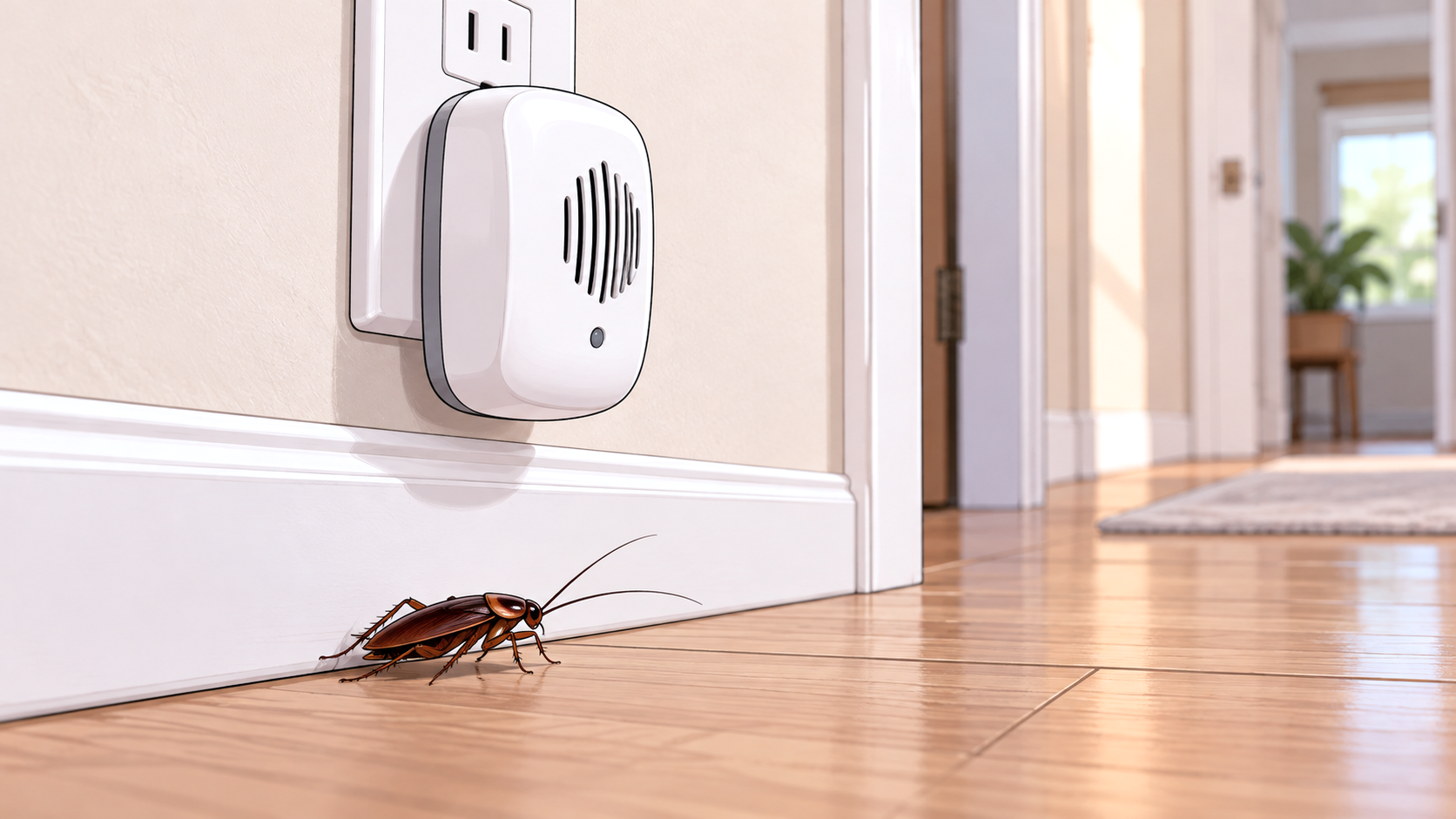
A plug-in device that promises to drive cockroaches out of an entire room without chemicals sounds convenient. Some ultrasonic repellers even advertise protection through walls, automatic frequency changes, and results within a few weeks. Unfortunately, these claims have not translated into dependable cockroach control when the devices have been tested.
Ultrasonic cockroach repellers do not reliably repel, kill, or eliminate cockroaches. Controlled experiments involving German cockroaches have repeatedly found little or no meaningful repellency, including tests of commercial devices specifically marketed for pest control.
A device may emit ultrasonic sound exactly as advertised without producing a useful response from the insects. The presence of high-frequency sound is not evidence that a cockroach infestation is being controlled.
What Controlled Experiments Found
One particularly relevant experiment examined three commercial ultrasonic devices operating at frequencies between approximately 26 and 42 kilohertz. Researchers tested whether German cockroaches avoided the sound in controlled enclosures.
The 2006 study published in Insect Science found that none of the three devices demonstrated sufficient repellency to support their use for German cockroach control. The devices were producing measurable ultrasound, but the insects did not respond in a way that established effective pest management.
Researchers subsequently tested a different approach: an ultrasonic generator capable of producing changing sound patterns across frequencies from 20 to 100 kilohertz. This addressed the argument that cockroaches might become accustomed to a constant frequency.
The 2007 experiment published in Entomologia Experimentalis et Applicata again found no repellency against German cockroaches under the tested conditions. Changing frequencies did not solve the underlying effectiveness problem.
Virginia Tech’s cockroach management guidance consequently advises against ultrasonic devices, citing the lack of demonstrated killing or repellency.
These findings concern actual insect responses rather than whether a device produces sound. A manufacturer showing that its product emits 30 or 40 kilohertz has established an electrical or acoustic specification, not that cockroaches will leave.
Why the Advertised Coverage Area Is Misleading
Ultrasonic repellers frequently claim to protect hundreds or thousands of square feet. Such figures can make a single outlet-mounted device appear capable of covering an entire apartment.
Ultrasound is not distributed through a building as a uniform protective field. Its intensity changes with distance and with the surfaces encountered. Furniture, cabinets, walls, and other obstacles can interfere with sound transmission, creating areas that receive less acoustic energy.
Cockroaches also spend substantial time in protected spaces rather than exposed rooms. An insect behind a cabinet panel or beneath a refrigerator may encounter very different sound conditions from those measured directly in front of the repeller.
An advertised coverage figure therefore needs supporting measurements and biological testing across the claimed area. Even a room with strong ultrasound throughout would not necessarily repel cockroaches, given the negative findings from controlled exposure experiments.
The U.S. Federal Trade Commission challenged precisely these kinds of advertising claims in a 2003 action involving electronic pest-control devices. The agency alleged that sellers lacked adequate evidence for claims involving cockroach control and protection over specified areas.
The settlement required appropriate scientific substantiation for pest-control representations. It did not establish that a particular coverage area was effective.
Can Cockroaches Get Used to Ultrasonic Sound?
Some advertisements claim that constantly changing frequencies prevent cockroaches from adapting to the device. Others suggest that pests initially become more active because the sound disturbs them.
Neither claim establishes that the insects are being driven out.
Habituation is a real biological phenomenon in which an animal’s response to repeated stimulation diminishes. However, the more fundamental issue for commercial ultrasonic cockroach repellers is that studies have frequently failed to demonstrate meaningful initial repellency.
The experiments using changing frequencies are especially relevant. If varying sound patterns were sufficient to overcome habituation, a measurable avoidance response should have appeared under suitable test conditions. The 2007 research did not find such an effect.
A brief change in insect movement would also be insufficient evidence of control. Cockroaches could shift position within a room without leaving the building or experiencing reduced survival.
The daytime sheltering behavior of cockroaches complicates casual observation because insects may remain out of sight regardless of whether an ultrasonic device is operating.
Claims that cockroaches will become visibly more active before disappearing need independent evidence showing that the device actually reduces the population, not merely that movement sometimes changes after installation.
Do Newer Ultrasonic Repellers Work Better?
Some manufacturers market newer devices as improvements over older models because they use stronger speakers, pulsed ultrasound, frequency sweeping, or multiple ultrasonic emitters.
A 2026 scientific review of ultrasonic pest control in domestic settings examined the available evidence and identified an important limitation: certain experimental ultrasound exposures have produced measurable effects on German cockroaches, but the equipment used much higher sound intensities than ordinary consumer repellers.
The review described laboratory exposures reaching approximately 166–173 decibels under specific experimental conditions. Such results cannot be applied to a small household plug-in producing considerably lower sound levels.
Studies of specialized, high-intensity equipment establish that sufficiently powerful acoustic exposure can affect some insects. They do not demonstrate that commercially available household devices can reproduce those effects safely or consistently throughout a home.
A newer product deserves evaluation against independent cockroach-specific testing, not assumptions about technological improvement.
Does an EPA Number Mean the Device Has Been Proven Effective?
No. An EPA establishment number on an ultrasonic repeller does not mean the Environmental Protection Agency has tested or approved its effectiveness against cockroaches.
The EPA’s consumer guidance on pesticide devices explains that pest-control devices are regulated differently from registered chemical pesticides. Manufacturers generally do not have to submit efficacy data for premarket approval.
An establishment number identifies the facility associated with producing the device. It is not an EPA registration number demonstrating that its cockroach-control claims have been evaluated.
The Federal Trade Commission has also investigated unsupported ultrasonic pest-control advertising. In 2001, the FTC warned more than 60 manufacturers and retailers that claims about repelling insects or eliminating infestations required competent scientific evidence.
Before accepting a product’s claims, look for independent tests involving the actual model, German or other relevant cockroach species, and meaningful reductions in activity under realistic conditions. Customer testimonials and demonstrations of emitted sound are not substitutes for those results.
How Can You Tell Whether a Repeller Is Doing Anything?
A household already using an ultrasonic repeller can assess whether cockroach activity has changed without relying on subjective impressions.
Place commercial sticky monitoring traps near previously active locations and record captures over comparable periods. Keep the room conditions and trap positions reasonably consistent. If insects continue appearing in traps, the device has plainly not prevented all movement through those areas.
An apparent decline in sightings is less persuasive if cleaning, pesticide treatment, repairs, or other changes occurred simultaneously. Those measures could explain the improvement independently of the repeller.
The University of California’s cockroach monitoring recommendations support comparing trap catches as an objective way to evaluate activity. The same method helps distinguish ordinary fluctuations in sightings from evidence of meaningful population reduction.
Even a substantial decline while a device is operating would not, by itself, establish that ultrasound caused the improvement. A properly controlled comparison would be needed to attribute the result to the device.
The evidence used to determine whether cockroaches are gone is more demanding than an absence of insects seen in the open.
What Should You Use Instead of an Ultrasonic Repeller?
For households with confirmed cockroach activity, monitoring and appropriately labeled bait products offer a more evidence-based approach than sound-emitting devices.
The EPA’s integrated pest management principles emphasize pest identification, monitoring, and targeted intervention. Unlike ultrasound, these methods address insects through observable capture, exposure, or removal.
The appropriate response also depends on species. German cockroaches and outdoor-associated cockroaches do not necessarily require the same intervention, and a device advertised for every crawling pest provides no meaningful guidance about that difference.
It is equally important not to confuse sound-based repellency with simply disturbing an individual cockroach. The methods that may draw a hidden cockroach into the open depend on its behavior and the placement of a lure or monitor, not on filling the room with ultrasound.
A plug-in repeller may seem attractive because it requires little effort after installation. However, the evidence does not support depending on ultrasonic devices to protect a room or eliminate a cockroach infestation, regardless of how large an area the manufacturer advertises.