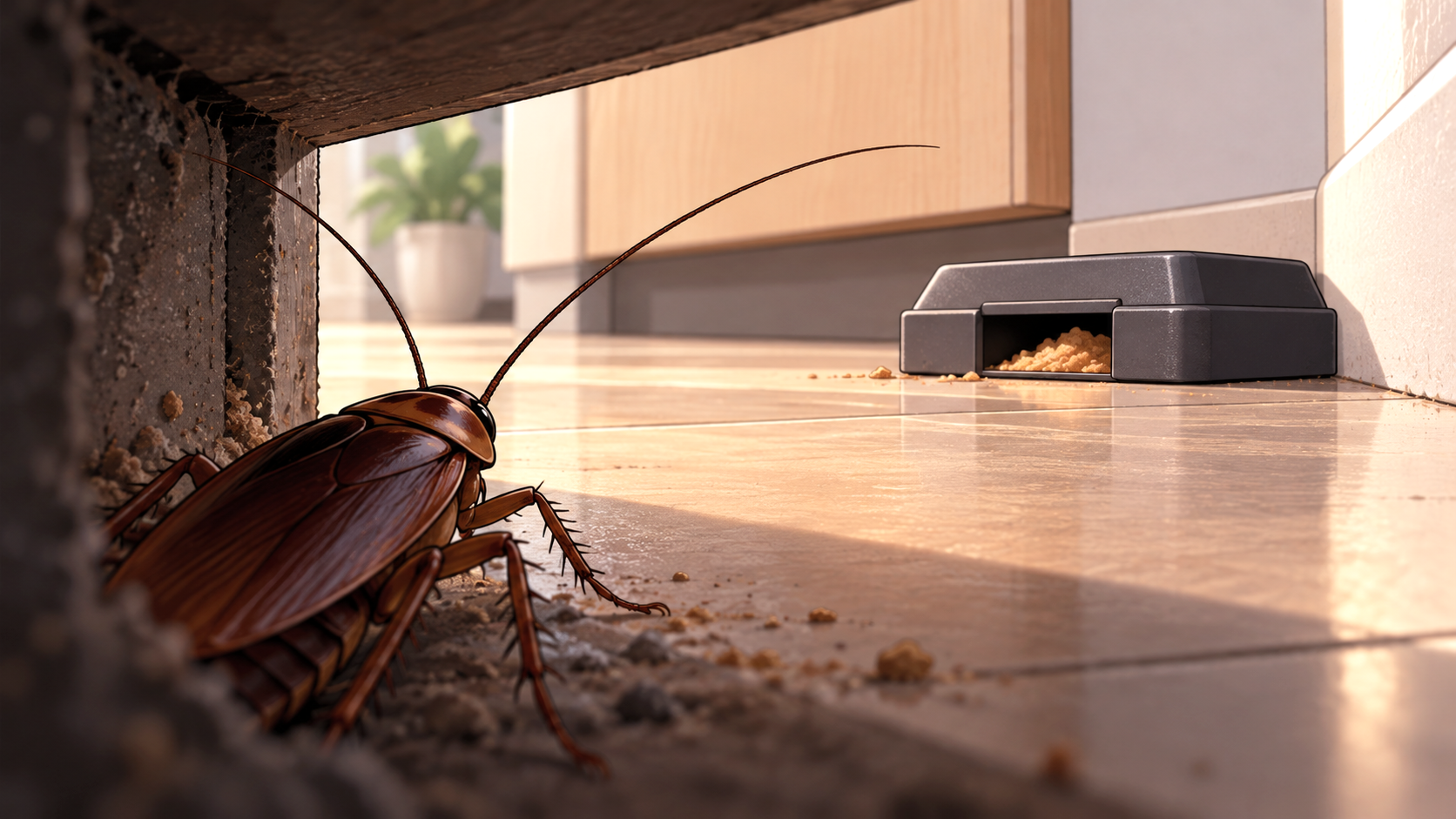
A cockroach that disappears beneath a refrigerator or into a wall gap may remain concealed long after you stop looking for it. Tapping the furniture, shining a flashlight into the opening, or spraying the area can make the insect retreat farther instead of bringing it within reach.
The most reliable way to draw a hidden cockroach into the open is to place an attractive food lure or cockroach monitoring trap close to its suspected hiding place, then leave the area quiet and undisturbed. Cockroaches generally emerge to forage when conditions feel safe, but no lure guarantees that a particular insect will appear on command.
If your goal is to capture a cockroach rather than merely see it, a commercial sticky trap positioned along its likely travel route offers a more dependable opportunity than waiting with a flashlight.
Use a Food Lure Near the Hiding Place
Cockroaches can respond to food odors, particularly when a food source is close enough for them to detect and reach without crossing an unfamiliar open area. However, the effectiveness of a lure varies with the species, nearby competing food, and whether the insect is actively foraging.
Research published in Environmental Entomology compared several attractants for German cockroaches. Bread moistened with beer substantially increased captures in experimental sticky traps compared with traps containing no attractant. Peanut butter and other food-based materials also showed attractive properties.
For a household situation, a commercial cockroach trap with an incorporated attractant is convenient. If using a food lure, place a very small amount near the suspected exit and within the effective capture area of a suitable trap. Do not scatter food across the floor or leave exposed bait where children or pets can reach it.
The Rutgers University German cockroach guidance describes using bread dampened with beer to improve sticky-trap catches. This works as a localized attraction method, not as a guaranteed way to summon every cockroach in a room.
The foods cockroaches consume are diverse, but familiarity with a particular food does not establish how strongly it will attract a concealed insect. A small lure positioned correctly may outperform a larger amount placed far from the hiding place.
Position the Trap Where the Cockroach Is Likely to Emerge
A cockroach can detect an attractive food source yet never reach it if the trap is positioned poorly. Rather than placing a trap in the middle of a room, position it against a wall or close to the opening where the insect disappeared.
The University of California’s integrated pest management guidance recommends placing sticky traps along wall-floor junctions and near suspected harborages. These positions intercept cockroaches following protected edges rather than requiring them to travel across exposed flooring.
If an insect disappears beneath a cabinet, place the trap alongside the cabinet’s lower edge, near the suspected access point. For a gap behind furniture, use the nearest accessible travel route. The entrance of a trap should face the path the insect is likely to follow.
A 2021 study of food-based cockroach attractants found that some added attractants improved German cockroach catches in laboratory and field experiments. Nevertheless, the researchers emphasized that trap performance depends heavily on placement and exposure time.
The speed at which cockroaches can run also makes hand capture difficult once an insect moves across open flooring. Intercepting its route is usually easier than reacting after it emerges.
Give the Cockroach Time to Emerge Naturally
Cockroaches commonly become more active when rooms are quiet and disturbances have decreased. An insect that retreats after someone approaches may not immediately return to the same opening.
Once the lure or trap is positioned, leave the area undisturbed. Turning off unnecessary room lighting may allow normal nighttime activity to resume, but complete darkness is not essential. A cockroach can remain hidden in darkness if it senses nearby movement or has no reason to leave its shelter.
The Rutgers cockroach species guidance describes German cockroaches as predominantly nocturnal insects that occupy protected cracks and crevices between periods of activity.
Do not expect an exact waiting time. A cockroach might emerge within minutes, several hours later, or not at all during the observation period. Its response depends on local conditions rather than a predictable countdown.
Checking a trap the following morning is often more useful than repeatedly approaching it every few minutes. The normal daytime hiding behavior of cockroaches also means that failure to observe movement during daylight does not establish that the insect has left.
Can You Use Water to Draw Out a Cockroach?
Water can attract cockroaches searching for moisture, but placing an open dish of water near a hiding place is not a particularly reliable capture method.
An insect may already have access to moisture through condensation, plumbing leaks, damp surfaces, or food. A water source also provides no mechanism for preventing the cockroach from retreating.
The EPA’s household pest-prevention recommendations advise reducing available food and water because these resources can sustain indoor cockroach populations.
If the intention is to draw an insect toward a trap, a commercial attractant or appropriately positioned food lure is usually more practical. Leaving extra moisture available indefinitely can be counterproductive, particularly when cockroaches are already active nearby.
The length of time cockroaches survive without water varies, so withholding moisture should not be expected to force a specific insect into the open immediately.
Why Flashlights, Vibrations, and Loud Noises Often Fail
A flashlight helps reveal a cockroach once it becomes visible, but light itself is not a dependable way to lure the insect out. Many household cockroaches respond to sudden illumination by moving toward shelter.
Tapping walls, shaking furniture, or directing loud noises at a gap may disturb a hidden cockroach, but disturbance is not controlled attraction. The insect might run into a deeper crevice, move toward another room, or remain motionless.
Repeated attempts can also make it harder to determine where the cockroach went. An insect forced away from its original shelter may travel through structural gaps or behind adjacent furniture.
If a cockroach is visible at the edge of an accessible opening, a container can sometimes be positioned to intercept it. Avoid inserting tools into electrical outlets, appliance motors, plumbing cavities, or other unsafe spaces.
The ability of cockroaches to climb walls and other surfaces means a fleeing insect may escape vertically rather than running across the floor toward an improvised barrier.
Do Not Use Insecticide Sprays to Force Cockroaches Out
Some professional pest-control products are designed to flush insects from concealed spaces. However, ordinary household aerosol sprays should not be used indiscriminately inside cracks simply to make cockroaches run into view.
The University of California’s cockroach control recommendations warn that aerosol products may repel and disperse cockroaches without killing them. An insect driven out of one location can disappear into another, making subsequent interception more difficult.
Spraying into inaccessible openings also creates unnecessary exposure risks. The EPA advises targeting pesticide applications rather than spraying entire rooms, and all applications must follow the product label.
Never spray insecticide into electrical equipment, air vents, or enclosed structural cavities unless the particular product is expressly approved for that application. The hazards associated with cockroach sprays make deliberate chemical flushing an unsuitable substitute for a properly positioned trap.
Professional flushing methods are distinct from household attraction techniques and may be appropriate during specialized inspections, but they are not necessary for locating a single concealed cockroach.
What if the Cockroach Never Comes Out?
An empty trap does not prove that the insect has disappeared. It may have remained inactive, found another route, or moved away from the suspected opening before the trap was positioned.
If nothing is captured after several nights, reconsider the trap’s location rather than repeatedly adding more food. A second monitor along an adjoining edge may help distinguish movement toward another area from continued activity near the original shelter.
The UC Integrated Pest Management program recommends comparing catches from several positions because monitoring reveals where cockroaches are active rather than merely whether one particular trap succeeds.
A single large cockroach that entered from outdoors may never return to the same room. Repeated captures of small cockroaches, however, indicate ongoing activity that cannot be resolved simply by drawing out one insect. The difference between solitary sightings and cockroaches occupying shared harborages becomes relevant when interpreting those results.
The useful outcome is not necessarily watching the cockroach emerge. Capturing it, establishing that it remains active, or determining that its original hiding place is no longer occupied can each provide information without chasing it through the house.