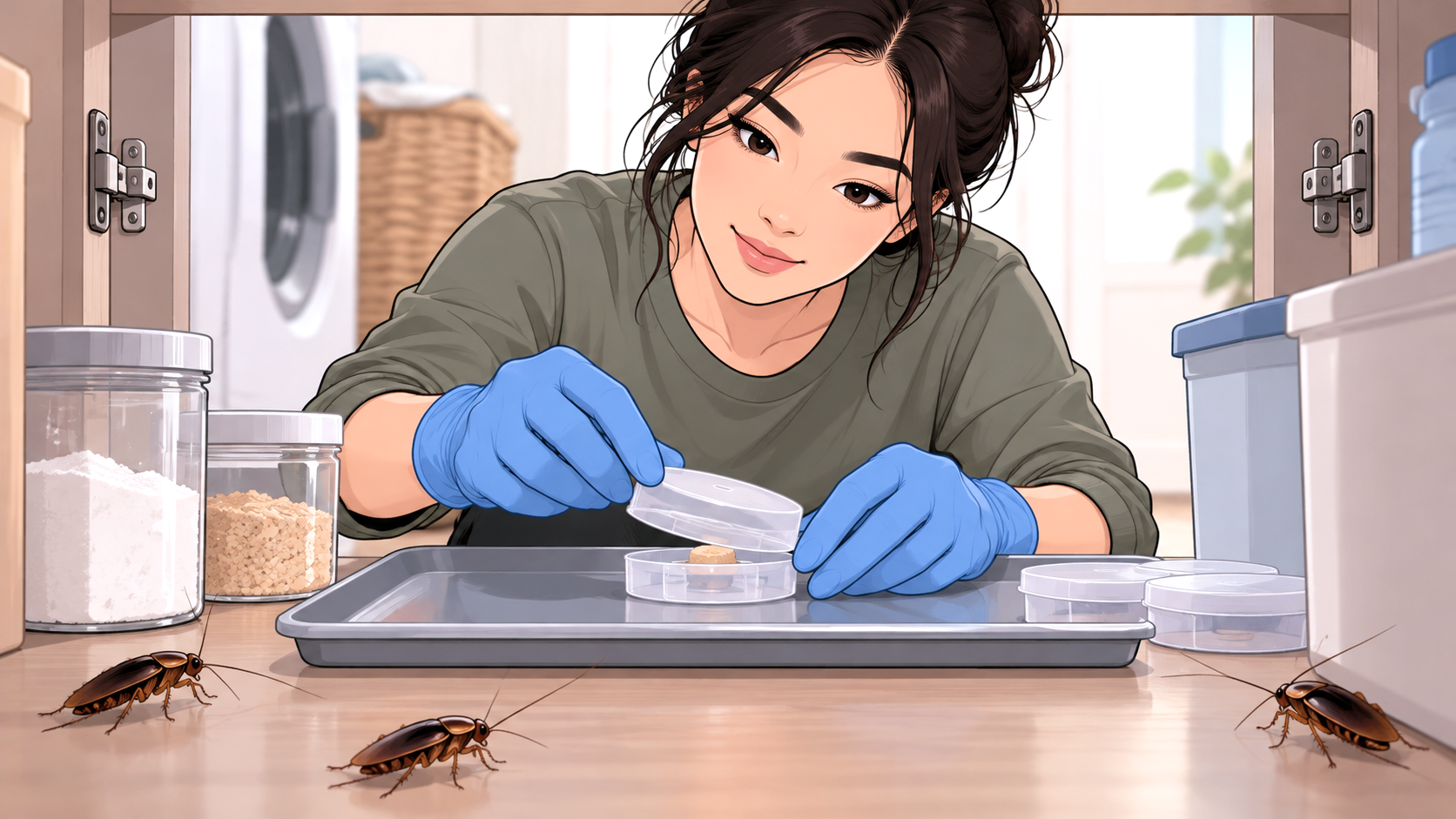
Sugar mixed with baking soda, vinegar sprays, essential oils, and borax bait balls are frequently recommended as inexpensive cockroach killers. Some homemade methods genuinely can kill cockroaches, but others have little scientific support, and several introduce unnecessary poisoning, fire, or contamination risks.
The most dependable household methods are physically killing an exposed cockroach and using soapy water when sufficient direct contact is possible. Boric acid and diatomaceous earth also have established insecticidal effects, but they should be used as properly labeled pest-control products rather than improvised mixtures. Popular recipes involving baking soda, vinegar, and essential oils have not demonstrated reliable elimination of household cockroach infestations.
The effectiveness of a method depends on whether it kills an individual insect, continues working after application, or reaches enough cockroaches to affect an established population.
Which Homemade Cockroach Killers Have Scientific Evidence?
Not all household remedies deserve the same level of confidence. Some have been tested directly against cockroaches, while others depend on assumptions about how particular ingredients might affect insects.
| Method | Evidence of killing cockroaches | Main limitation |
|---|---|---|
| Physical crushing | Reliable when sufficient force is applied | Kills only the insect reached |
| Dish soap and water | Demonstrated mortality under controlled contact conditions | Requires substantial direct exposure |
| Boric acid | Established insecticidal effectiveness | Slow-acting pesticide; homemade bait formulations are uncertain |
| Diatomaceous earth | Established desiccant insecticide | Requires contact and suitable dry conditions |
| Baking soda and sugar | No convincing evidence of reliable cockroach control | Claimed gas-producing mechanism is unsupported |
| Vinegar | No dependable evidence of effective cockroach killing | Primarily a household cleaning product |
| Essential oils | Some laboratory formulations have insecticidal effects | Household recipes lack dependable concentration and performance standards |
| Rubbing alcohol | Can kill under sufficient exposure | Serious flammability risk; unreliable household application |
| Boiling water | Lethal heat is possible with adequate contact | Scalding and property-damage risks |
The National Pesticide Information Center’s assessment of homemade pesticide remedies warns that internet recipes frequently lack evidence-based instructions, exposure precautions, and dependable effectiveness data.
A substance capable of killing an insect in a laboratory is not automatically suitable for spraying around an occupied home.
Physical Crushing Works Without a Chemical Recipe
For a single cockroach on an accessible hard surface, sufficient mechanical pressure provides immediate lethal injury without requiring an insecticide.
The result depends on making complete contact. An insect partly protected by a floor joint, carpet, or flexible surface may survive a glancing impact. A sufficiently firm crush against a rigid surface is much more dependable.
The principal disadvantage is the biological residue left behind. The contamination and disposal considerations when squishing cockroaches include collecting the remains, washing affected surfaces, and avoiding direct contact with the insect.
The EPA’s household pest-control guidance encourages nonchemical pest management where practical, reducing unnecessary pesticide exposure.
Physical removal is particularly reasonable when an isolated insect can be reached without damaging furniture or contaminating food. It offers no residual protection and cannot affect cockroaches that remain concealed elsewhere.
Soapy Water Has the Strongest Evidence Among Simple Household Sprays
Dishwashing liquid is one of the few ordinary household products tested directly for its lethal effects on cockroaches.
In a 2002 experiment published in the Journal of Economic Entomology, researchers exposed German cockroaches to different concentrations of dishwashing liquid. The study found that concentrations of 3% or greater caused all treated insects to become unresponsive within three minutes, with eventual mortality within 72 hours under the experimental conditions.
Lower concentrations were less dependable, and some insects recovered after initially becoming motionless. The findings suggested that the solution interfered with insect respiration, particularly when it reached vulnerable body surfaces.
A separate study comparing household cleaners against German and American cockroaches found that immersion in dishwashing solutions could produce substantial mortality, while contact spraying was ineffective against adult American cockroaches under the tested conditions.
These experiments do not establish a universally effective spray-bottle recipe. Household detergent formulations differ, and the amount reaching a running insect is difficult to control.
The direct-contact limitations of dish soap against cockroaches are especially important around furniture, electrical equipment, and other surfaces that cannot be thoroughly wetted. A spray should never be directed into electrical outlets or energized appliances.
Boric Acid and Sugar Can Work, but Homemade Baits Are Unpredictable
Boric acid is a genuine insecticide, not merely a household remedy. Cockroaches can receive harmful exposure through contact and ingestion, including when they groom particles from their bodies.
Mixing boric acid with sugar is a common homemade recommendation. There is legitimate research behind the concept: a laboratory study of boric acid and sugar solutions found that certain carefully formulated mixtures killed German cockroaches effectively.
However, that study does not validate arbitrary recipes involving tablespoons of boric acid, powdered sugar, flour, peanut butter, or other household ingredients. The concentration, food attractiveness, consistency, and amount consumed all influence the outcome.
The Extension Foundation’s German cockroach guidance specifically discourages homemade boric acid baits because producing a palatable, consistently effective formulation is difficult. It recommends commercially formulated boric acid bait products instead.
Boric acid also creates poisoning risks when mixed into edible-looking materials and left where children or pets can reach them. The National Pesticide Information Center’s boric acid assessment identifies accidental ingestion and inhalation as important exposure concerns.
Using a registered boric acid cockroach product according to its label is more defensible than preparing an unlabeled mixture at home.
Diatomaceous Earth Is Effective, but It Is Not a Kitchen Ingredient
Diatomaceous earth is frequently promoted as a natural cockroach killer because it consists of mineral material derived from fossilized diatoms.
Insecticidal formulations kill through desiccation. Particles damage or absorb protective surface lipids, allowing insects to lose moisture until they die.
The National Pesticide Information Center’s diatomaceous earth fact sheet confirms that registered diatomaceous earth products can control cockroaches and that their effectiveness depends on maintaining suitable contact and dry conditions.
However, sprinkling ordinary food-grade diatomaceous earth across floors does not guarantee cockroach control. Food-grade classification concerns a different use, and not every product is registered or labeled as an insecticide.
Airborne powder can irritate the respiratory tract, eyes, and skin. Excessive deposits may also discourage cockroaches from crossing treated surfaces.
The comparison between diatomaceous earth and boric acid involves meaningful differences in repellency, moisture sensitivity, and practical effectiveness. Neither product should be improvised into an unlabeled food mixture or scattered over exposed household surfaces.
Why Baking Soda and Sugar Is Not a Proven Cockroach Killer
One of the most persistent homemade recipes combines baking soda with sugar. The explanation usually claims that cockroaches eat the mixture, drink water, and die because gas accumulates inside their bodies.
There is no convincing scientific evidence that this mechanism reliably kills cockroaches under ordinary household conditions.
The Extension Foundation’s review of natural German cockroach remedies specifically identifies baking soda and sugar recipes among methods lacking evidence of effective infestation elimination.
The presence of sugar does not establish that cockroaches will consume a lethal amount of baking soda. Nor is the ability of baking soda to release carbon dioxide during certain chemical reactions evidence that it causes fatal internal pressure inside a cockroach.
Scattering sweet mixtures can also introduce an accessible food source if the supposed killing ingredient fails.
There is no established household concentration, ingestion amount, or treatment duration that makes baking soda and sugar a dependable cockroach insecticide.
Vinegar and Essential Oils Have Different Evidence Problems
Vinegar is useful for certain cleaning applications, but there is no dependable evidence that ordinary household vinegar kills cockroaches reliably or eliminates an infestation.
Its acidity does not automatically establish insecticidal effectiveness. Briefly contacting an insect with diluted vinegar is different from exposing it to a substance under controlled laboratory conditions.
Essential oils present a more complicated situation. Some plant-derived compounds have demonstrated insecticidal or repellent effects against cockroaches in laboratory studies, but their performance varies with concentration, formulation, species, and method of application.
These findings do not validate homemade combinations of peppermint oil, eucalyptus oil, citrus oil, or other fragrances sprayed throughout a house.
The EPA’s guidance on pesticide use emphasizes choosing products suitable for the intended pest and following established application instructions.
Essential oils can also irritate people and pose hazards to pets, particularly when concentrated products are applied to surfaces animals contact or groom.
Neither a strong vinegar smell nor an intense essential-oil fragrance establishes that a cockroach has received a lethal exposure. A recipe that merely changes insect movement should not be advertised as a killing method.
Avoid Alcohol, Bleach, and Improvised Heat Treatments
Some household substances can kill cockroaches under sufficient exposure while remaining poor choices for domestic use.
Rubbing alcohol is one example. It can be lethal under controlled exposure conditions, but ordinary spraying creates a substantial fire hazard and does not provide dependable residual control. The flammability and contact limitations of rubbing alcohol against cockroaches outweigh its practical usefulness.
Bleach is another inappropriate substitute for insecticide. Even if direct exposure injures an insect, spraying bleach around living spaces introduces irritation, corrosion, and potentially dangerous chemical reactions if mixed with incompatible cleaners.
Boiling water can cause lethal thermal injury, but directing it toward floors, furniture, electrical outlets, or wall openings risks scalding and property damage. Its temperature may fall before it reaches a concealed insect.
Combining household chemicals to make a supposedly stronger treatment is particularly dangerous. The National Pesticide Information Center’s DIY pest-control recommendations advise against creating homemade mixtures from pesticides and cleaning products because their combined risks and effectiveness may not have been evaluated.
A substance that can injure a cockroach is not necessarily safe or sensible to use as a household cockroach killer.
Why Successful Contact Killing Does Not Mean an Infestation Is Gone
Homemade methods are often judged by a simple observation: a cockroach stopped moving after someone applied a substance. That establishes neither confirmed death nor population control.
An established infestation may contain insects at different developmental stages, including individuals that never encounter the treatment. Some females may continue producing eggs while exposed adults are being killed.
The reproductive capacity of cockroaches helps explain why removing several visible insects may have little effect on a much larger concealed population.
Monitoring provides a more meaningful measure. The evidence used to determine whether cockroaches have disappeared includes changes in trap catches, fresh signs of activity, and continued observation rather than the immediate reaction of a single insect.
For an exposed cockroach, physical killing or a sufficiently effective soap contact treatment may be practical. For an established population, commercially formulated cockroach products with appropriate registration, instructions, and demonstrated effectiveness are more dependable than homemade poisons.
The strongest homemade methods have a narrow purpose: they can kill individual cockroaches under suitable conditions, but no popular household recipe has demonstrated that it consistently eliminates an established infestation on its own.