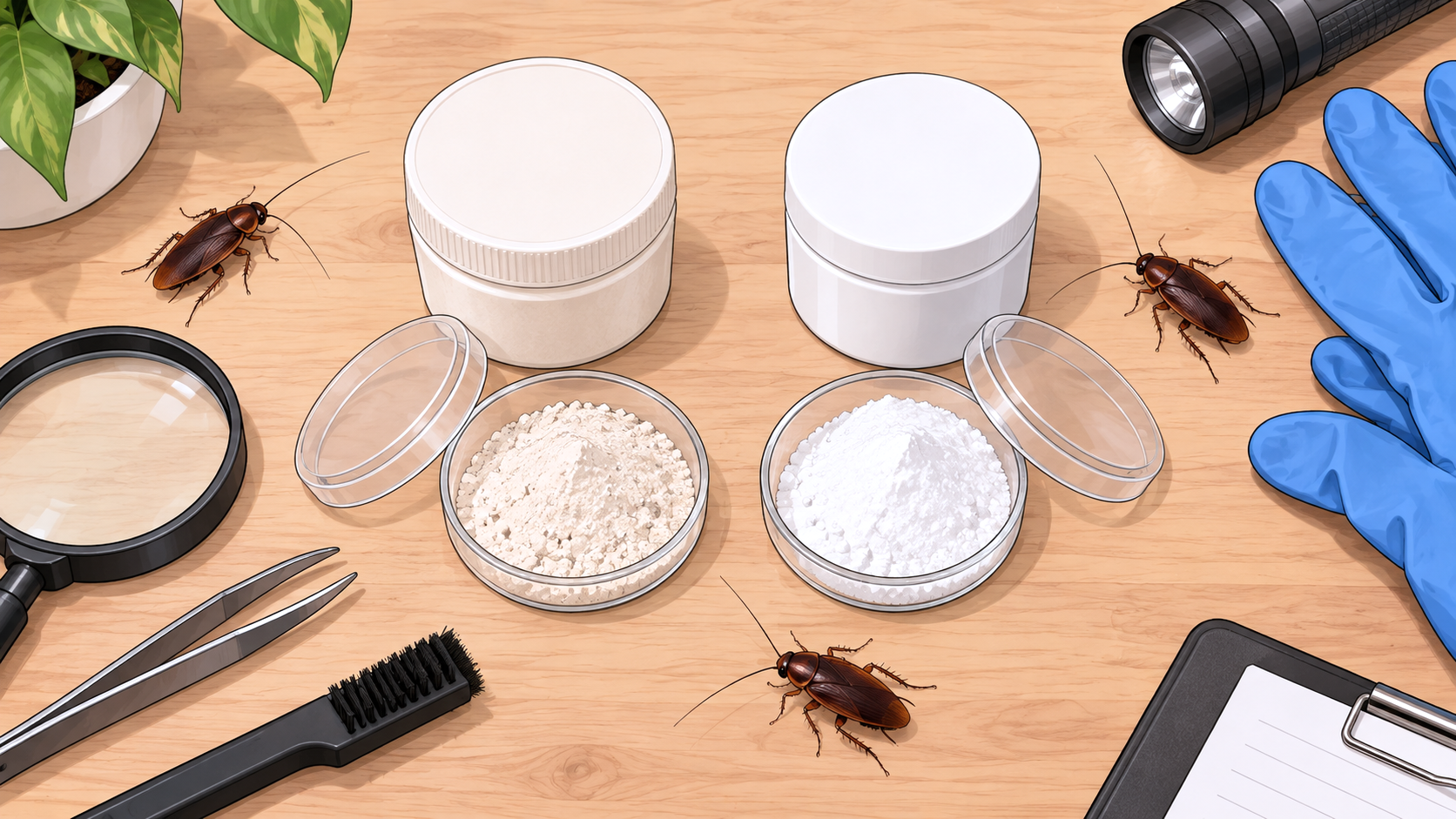
Diatomaceous earth and boric acid are both insecticidal powders used against cockroaches, but they work differently. One damages the insect’s protective outer coating, while the other acts primarily through toxicity after contact or ingestion. Both can remain effective in protected locations, although moisture, placement, and the particular formulation influence their performance.
Boric acid is generally the better choice for controlling German cockroaches indoors. It has stronger practical evidence for cockroach control, partly because cockroaches can pick up the powder without strongly avoiding treated surfaces. Diatomaceous earth can also kill cockroaches, but it depends on contact and dehydration, making environmental conditions particularly important.
Neither powder provides an instant kill, and neither should be scattered across exposed floors, countertops, or other frequently contacted surfaces.
Diatomaceous Earth vs Boric Acid: Key Differences
| Feature | Diatomaceous earth | Boric acid |
|---|---|---|
| Primary action | Damages and absorbs the insect’s protective surface lipids, causing dehydration | Contact and ingestion toxicity, including effects on internal tissues |
| Must be eaten? | No | No, although ingestion through grooming contributes to exposure |
| Speed | Generally slow; depends on contact and conditions | Generally slow; significant population reductions may take days |
| Moisture sensitivity | Strongly affected by wet conditions | Performance varies with formulation and wetting |
| Cockroach avoidance | May discourage movement through treated areas | Generally less repellent |
| Best application environment | Dry, protected spaces where insects must contact the dust | Protected indoor cracks and voids with established cockroach activity |
| Principal exposure concern | Airborne dust and respiratory irritation | Accidental ingestion, dust inhalation, and exposure of children or pets |
| Stronger practical evidence for German cockroaches | Less favorable | More favorable |
The Rutgers University German cockroach guidance identifies boric acid as more effective than diatomaceous earth for controlling this species. That comparison does not establish that every boric acid product outperforms every diatomaceous earth formulation under all conditions.
How Each Powder Kills Cockroaches
Diatomaceous earth consists primarily of silica derived from fossilized microscopic organisms called diatoms. Its insecticidal action is physical: particles absorb protective oils and waxes from the insect’s exterior, while abrasion contributes to damage. As the protective barrier deteriorates, the cockroach loses water and eventually dies from desiccation.
The National Pesticide Information Center’s diatomaceous earth assessment explains that the material does not have to be eaten to work. Effectiveness depends on sufficient contact with an active insecticidal formulation.
Boric acid acts through a different combination of mechanisms. Cockroaches may ingest particles while grooming after walking through treated areas, and direct contact can also contribute to mortality. The National Pesticide Information Center’s boric acid assessment describes its effects on insect digestive and nervous systems.
A peer-reviewed study of boric acid exposure in German cockroaches found substantial mortality even when researchers prevented the insects from ingesting the powder. Boric acid should therefore not be described as an exclusively stomach-acting poison.
Both mechanisms are distinct from the rapid paralysis produced by certain contact insecticides. The difference between immediate cockroach knockdown and actual death is particularly relevant when comparing slower dust treatments.
Which Works Better in Real Household Conditions?
Boric acid’s major practical advantage is its relatively low repellency. Cockroaches may repeatedly cross a lightly treated area and accumulate exposure before they die.
Diatomaceous earth can work effectively when insects contact enough powder, but desiccant dusts may also cause avoidance. A highly effective substance under forced laboratory exposure is not necessarily the most effective when cockroaches can choose an untreated route.
The University of California’s cockroach management recommendations describe boric acid as a long-lasting, relatively nonrepellent dust and diatomaceous earth as a desiccant suitable for protected voids.
Research published in the Journal of Economic Entomology found that boric acid’s low repellency contributed to successful German cockroach control, even when other insecticides produced stronger immediate toxic effects under direct exposure.
Neither powder compensates for poor access to the insects. Cockroaches sheltering within concealed cracks and protected spaces may never encounter dust deposited several feet away.
Which Powder Performs Better Around Moisture?
Diatomaceous earth is particularly dependent on remaining dry enough to absorb protective lipids effectively. Wetting can greatly reduce its insecticidal performance, making persistently damp locations less suitable for ordinary dry formulations.
A scientific review of diatomaceous earth insecticides describes reduced effectiveness under wet or highly humid conditions, although the degree of reduction varies among formulations.
Boric acid has a more complicated relationship with moisture. Its dust can lose practical effectiveness after wetting and drying if it cakes or becomes difficult for cockroaches to pick up. However, laboratory research has found that adding liquid water can increase the toxicity of certain boric acid formulations under controlled conditions.
A 2004 study examining moisture and insecticidal dusts found that the effects differed substantially by product composition. The results do not justify describing every boric acid formulation as completely ineffective when damp.
For routine household use, protected, undisturbed locations are preferable for either powder. The water requirements of cockroaches also mean that persistent leaks may support nearby activity independently of how well an insecticidal dust performs.
Where Does Each Powder Make Practical Sense?
Both substances are more appropriate for inaccessible areas where cockroaches travel than for exposed surfaces used by people.
Potential application areas, where expressly permitted by the specific product label, include enclosed wall voids, protected structural cracks, and spaces beneath fixed cabinets. Boric acid is often favored for persistent indoor harborages because of its proven performance against German cockroaches.
Diatomaceous earth may be reasonable in exceptionally dry, protected locations where adequate insect contact is likely. However, a sheltered void does not automatically make every formulation suitable, and pesticide labels may restrict application methods or accessible locations.
The University of California recommends light dust applications because excessive deposits can clump, become visible, or interfere with insect movement. More powder does not necessarily produce better results.
Exposed powder around sinks, children’s furniture, pet feeding areas, and food preparation surfaces creates avoidable contact. Similarly, neither product should be introduced into electrical equipment or ventilation systems unless its labeling specifically authorizes the application.
A cockroach occupying electronic devices and their internal components presents electrical and equipment-damage concerns that ordinary structural dust treatments do not resolve.
Is Diatomaceous Earth Safer Than Boric Acid?
Diatomaceous earth is sometimes marketed as harmless because it is naturally derived. That description is misleading when the material is inhaled as a fine powder.
The primary concern with diatomaceous earth is airborne dust irritating the respiratory tract and eyes. Products may also differ in their crystalline silica content. Food-grade diatomaceous earth is not automatically suitable for pest control, and material intended for swimming-pool filtration is not an appropriate substitute for a registered household insecticide.
Boric acid presents a different exposure profile. Accidental ingestion can cause gastrointestinal symptoms and potentially more serious effects, particularly in children or pets. Its dust can also irritate the eyes and respiratory tract.
The EPA’s pesticide safety instructions emphasize using registered products according to their labels, including restrictions on application sites and contact with people or animals.
Neither product should be described as universally pet-safe or child-safe. Households with vulnerable occupants may find enclosed bait stations preferable to loose insecticidal dust where accessible exposure cannot be adequately prevented.
Which Lasts Longer, and How Do You Judge Results?
Neither ingredient disappears rapidly simply because time passes. Boric acid can remain chemically stable in protected locations, while diatomaceous earth can retain its desiccant properties when suitable dry conditions are maintained.
However, a powder’s continued presence does not establish continued effectiveness. Dust accumulation, cleaning, water exposure, displacement, and changing cockroach routes can all reduce useful contact.
The EPA’s integrated pest management principles emphasize monitoring outcomes instead of assuming an application has succeeded.
Sticky-trap catches provide a more meaningful comparison than counting dead insects. Falling captures over comparable monitoring periods suggest progress, while continued activity indicates that surviving cockroaches are still present.
The evidence needed to determine whether cockroaches are gone should include sustained monitoring rather than simply finding treated surfaces covered in powder.
Which Should You Choose?
For an established indoor German cockroach problem where a labeled insecticidal dust is appropriate, boric acid generally has the stronger case. Its low repellency, contact and ingestion effects, and established performance make it the more practical choice between these two ingredients.
Diatomaceous earth remains an option for dry, protected spaces, but its effectiveness is more vulnerable to unsuitable environmental conditions and inadequate insect contact.
Neither is necessarily the best treatment for every situation. The different cockroach species found around homes occupy different environments, and some cases are better suited to labeled baits or professional treatment than to loose powders.
The decision should rest on the target species, actual application location, moisture conditions, and whether the product can be used without exposing household occupants. Choosing the stronger powder is of little value if it cannot be placed safely where cockroaches will encounter it.
One thought on “Diatomaceous Earth vs Boric Acid for Cockroaches”